Call a business after hours a couple of years ago and you learned to brace for the pause. You would finish your sentence, and then… nothing. Half a second. A full second. Long enough to wonder if the line had dropped, long enough to say “hello?” into the silence. By the time the voice came back, you had already half-decided you were talking to a machine.
That pause is quietly vanishing. And in 2026, how long it lasts has become the single number that separates an AI voice agent a caller trusts from one they hang up on. Not the voice. Not the script. The wait.
Why everyone suddenly quotes a number in milliseconds
The change has a clear marker. In late October 2026, ElevenLabs shipped a model family it calls Eleven Realtime, and the headline was not a new accent or a warmer tone — it was speed. By the company’s own figures, its larger model starts speaking about 0.57 seconds after you stop, and the lighter one about 0.62 seconds. It handles more than 90 languages, and its API was built to be a drop-in for OpenAI’s real-time endpoint, which tells you where the whole industry thinks the fight now is.
Those are vendor numbers, measured by the vendor, so treat them the way you would any spec sheet. But the direction is real, and it is not one company. The entire architecture of voice AI shifted this year, and that is what actually moved the clock.
Speech-to-speech: the plumbing change behind the speed
For years, an AI phone agent was really four programs in a trench coat. One transcribed your words to text. One decided you had stopped talking. A language model read the text and wrote a reply. A fourth turned that reply back into a voice. Each hop added delay, and stitching them together, as one vendor dryly put it, is “a project in itself.” A caller felt the sum of all four as one long, awkward gap.
The 2026 systems collapse those stages into a single model tuned end to end — “speech-to-speech,” in the jargon. Fewer hand-offs, fewer round trips, less waiting. It is the same reason a direct flight beats one with two connections even when the planes fly the same speed. ElevenLabs has written openly about the engineering of squeezing latency out of a voice pipeline, and the gist is simple: every stage you remove is time the caller does not spend in silence.
What “response time” actually means (and how the number gets fudged)
Here is where a buyer in Vancouver or Halifax needs to be a little suspicious. When a vendor says “200 milliseconds,” ask: 200 milliseconds of what?
The number that matters to a human is the round trip — the gap between the moment you stop speaking and the moment you actually hear audio come back. But that is not always the number on the slide. As the team at SignalWire argued this year in a blunt piece on how providers measure latency, it is common to quote only the fastest slice of the journey — the time for the language model to produce its first token, say — while the clock is still running on everything else: detecting that you finished, synthesizing the audio, and pushing it down the phone line to your ear. Measure one leg of a relay and you can claim an impressive split. The runner still has three legs to go.
For a real phone call, the honest figure stacks up roughly like this: a beat to detect you have stopped, a beat to understand what you said, a beat for the model to think, a beat to generate speech, plus the plain physics of moving audio across a network. Any single stage can look fast. What the caller feels is all of them, in a row.
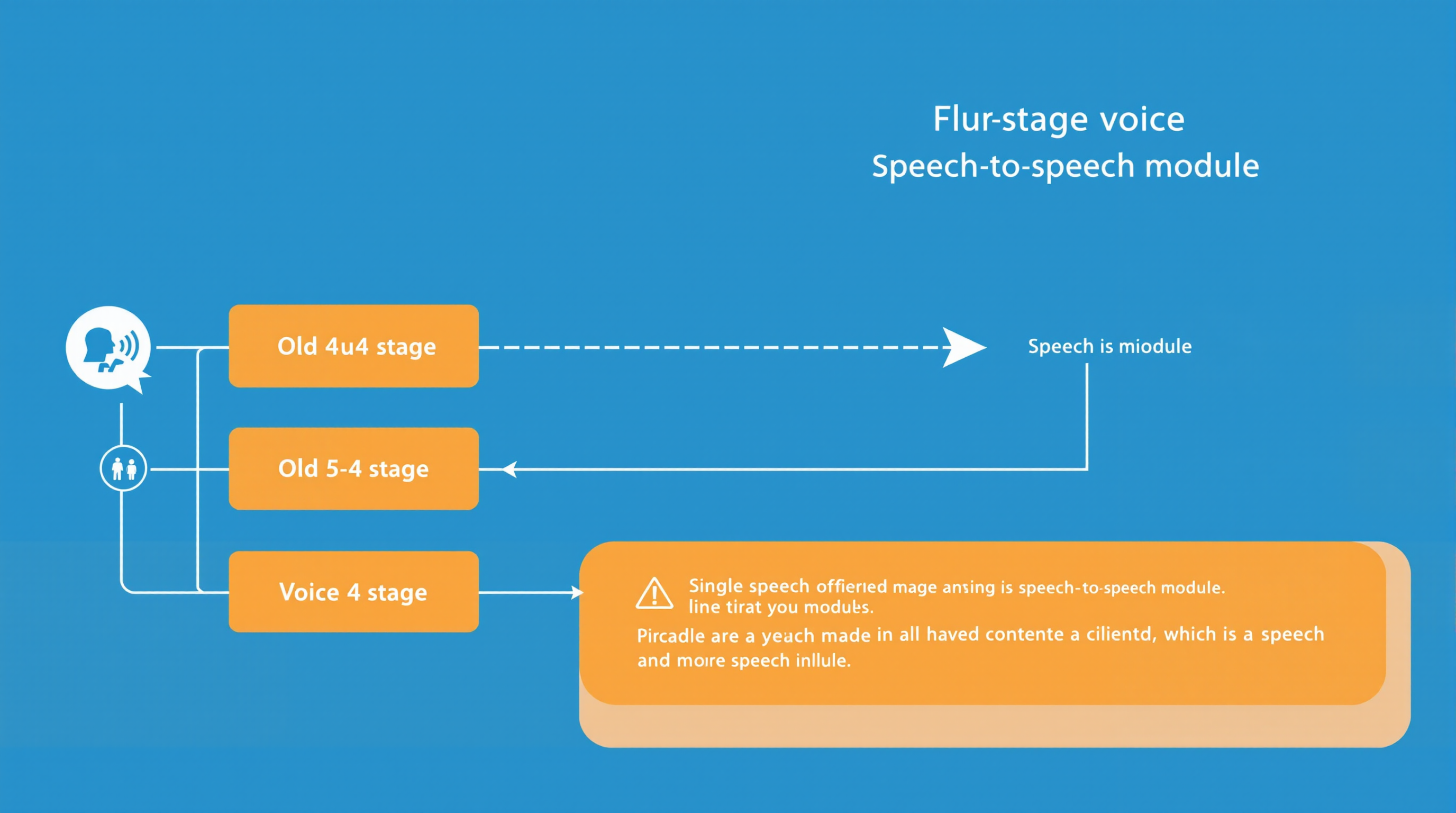
Old four-stage voice pipeline versus a single speech-to-speech model
Geography is not kind to Canadian phone calls
This is where being a Canadian business matters, and not in a flattering way. Latency is partly a distance problem, and Canada is mostly distance. A lot of voice-AI infrastructure sits in U.S. data centres. A call from a cell phone in rural Saskatchewan, or from a cottage north of Thunder Bay on a weak signal, is already fighting extra network hops before the AI does a thing. Each cross-region trip can add tens of milliseconds, and they stack.
Then there is the clock on the wall. A business in Calgary taking calls from customers in St. John’s is working across three and a half time zones; a national line spans six. “After hours” is a moving target, which is exactly why so many Canadian firms lean on an always-on agent in the first place. The slower that agent reacts at 2 a.m. in one zone while it is 8:30 a.m. in another, the more the delay compounds with a caller who is already tired or in a hurry.
None of this is a reason to avoid a voice agent. It is a reason to ask where it runs and to test it on a real call, not a demo over office Wi-Fi.
What the delay actually costs
Why fuss over fractions of a second? Because conversation is ruthlessly timed. Linguists who study how people take turns talking put the natural gap between one speaker finishing and the next starting at around 200 milliseconds — roughly the blink of an eye. We do not consciously count it, but we feel its absence instantly. A gap under about 300 milliseconds reads as a real, attentive listener. Stretch it past half a second and people start to notice. Past a second, and the behaviour changes: callers repeat themselves, talk over the agent, or mash the keypad looking for a human.
That last reaction is the expensive one. A caller who loses patience does not leave a complaint; they hang up and call your competitor, and you never learn it happened. Speed, in other words, is not a vanity metric. It is the difference between a captured lead and a silent one — which is why we treat it as a first-class number when we talk about measuring an agent’s real performance, not just whether it “works.”
A rough rule of thumb for 2026
You do not need a lab to judge this. A widely used rule of thumb, drawn from how callers actually behave, runs about like this:
- Under 300 ms: excellent — indistinguishable from an attentive person.
- 300–500 ms: good, and a sensible production target.
- 500–800 ms: noticeable. Fine for a genuinely complex question, grating on a simple one.
- 800 ms–1.2 s: poor. Callers start repeating themselves and reaching for a human.
- Over 1.5 s: broken. It will read as a bad robot no matter how good the voice is.
Notice that the best of the new models, by their makers’ own numbers, land in that first or second band on a good connection. The open question for your business is whether they hold that pace on your calls, from your customers’ phones, in your region.
How to test response time in three phone calls
Forget the spec sheet. You can judge any agent yourself, for free, before you sign anything. Call the demo line three times:
Call one, from your office, the easy case. Ask a simple question and just listen to the beat before it answers. If it lags here, on a clean line with a short question, it will be worse everywhere else.
Call two, from a cell phone, somewhere imperfect. A parking lot, a back room, a drive out of town. This is closer to how your customers actually call. A real round-trip delay that was hidden on Wi-Fi shows up here.
Call three, interrupt it. Start talking while the agent is still speaking. A 2026-grade system stops almost instantly and listens; an older pipeline keeps talking over you for a beat or two, or misses what you said entirely. How gracefully it yields the floor tells you more about the underlying tech than any number on a web page.
Do that and you will know in about five minutes what a page of benchmarks cannot tell you. And it is worth remembering that speed is only one half of “does this sound human” — the other half is the voice itself, which changed just as dramatically this year. A fast agent with a robotic voice still loses the call.
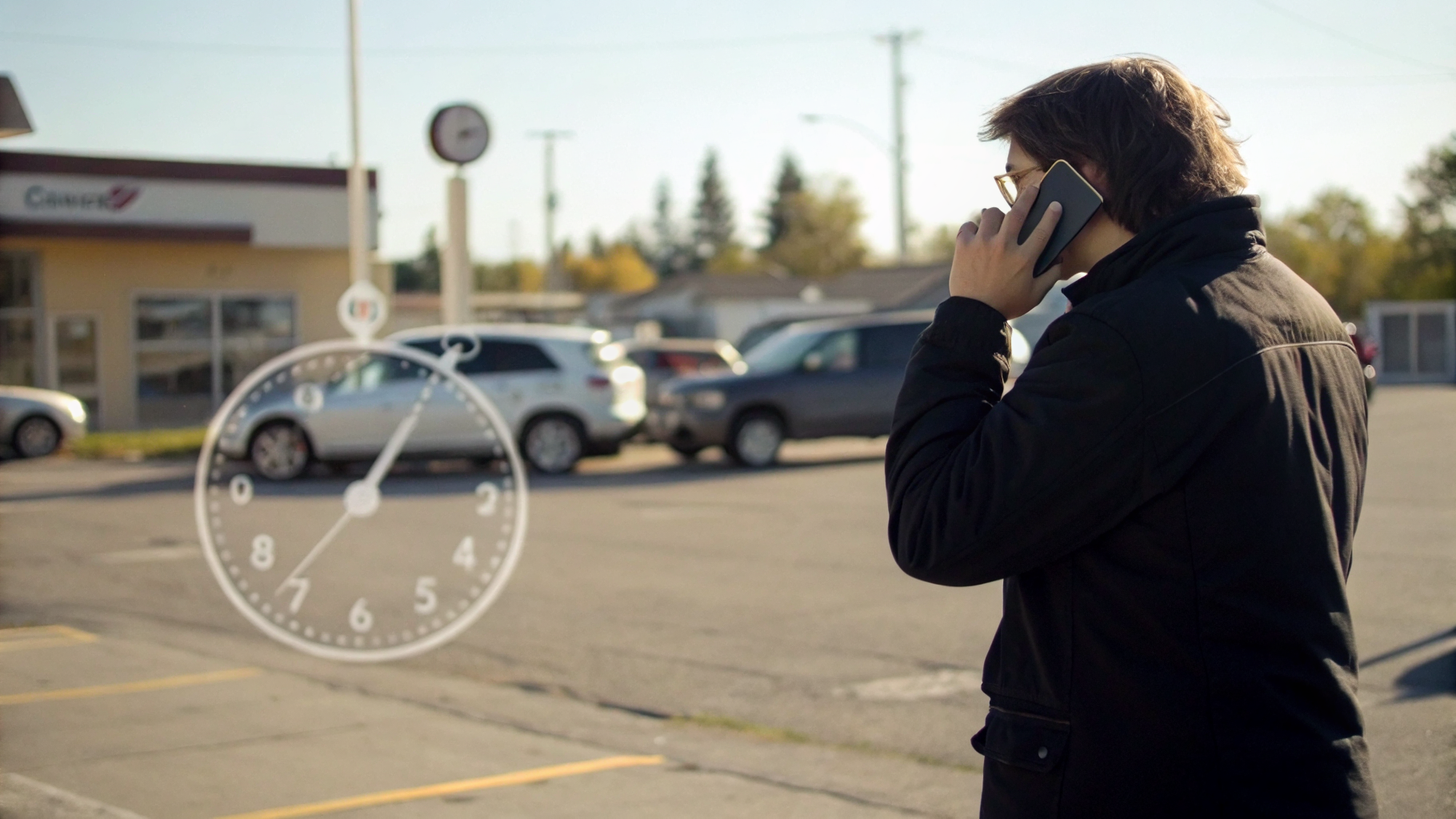
Testing an AI voice agent's response time on a real mobile call
The bottom line for Canadian businesses
The quiet pause that used to give away every phone bot is closing, and it is closing fast. For a small or mid-sized business weighing an AI voice agent in 2026, that is genuinely good news — the technology finally clears the bar where a caller forgets they are talking to software. But “sub-500ms” on a slide is a claim, not a promise. Ask what it measures, ask where the servers live, and above all, call the thing yourself from a real phone before you trust it with a real customer. Half a second is a small number. On a live call, it is the whole ball game.
Curious how a bilingual, Canada-ready voice agent would sound answering your line? See how AgentiaVocal works — and then call it and time the pause yourself.