
Ask a vendor "what does an AI voice agent cost?" and watch the sidestep. You'll get a demo, a discovery call, maybe a branded mug. What you won't get is a number. And the public pricing pages aren't much better — one says a penny a minute, the next says a dollar, a third quotes you in "tokens," whatever that's supposed to mean when the invoice lands.
So let's do the thing nobody else seems willing to: put real numbers on the table, in Canadian dollars, for a business that might be in Moncton or Mississauga or Medicine Hat — not a Bay Street call centre running ten thousand calls a day. Rates below are converted from provider pricing at roughly 1.40 CAD to 1 USD (late November 2026); currency moves, so treat the CAD figures as close, not exact.
The short answer
For most Canadian small and mid-sized businesses, a working AI voice agent lands somewhere between $200 and $850 CAD a month, all in, once you add up the software, the phone line, and a sensible amount of talk time. If you pay a professional to build it properly, a one-time setup runs from about $1,400 to $4,200 CAD for something straightforward, and comfortably into five figures once you're wiring it into a CRM, a booking system, and switching cleanly between English and French.
That's the headline. Everything below is where the money actually goes — including the parts that quietly double your bill if you're not paying attention.
Why you never get a straight number
Here's the root of it: an AI voice agent isn't one product. It's a stack of four things, each metering away in the background every second a caller is on the line.
- Speech-to-text — turning the caller's words into text. This got cheap. A service like AssemblyAI charges roughly US$0.45 per hour of audio, well under a cent a minute.
- The language model — the "brain" that decides what to say back. For a tightly built agent it's pennies: a five-minute call might burn less than a cent of model time.
- Text-to-speech — the voice itself, usually billed per character, around US$15 per million characters on the big providers.
- Telephony — the actual phone line carrying the call. This is the line item everyone forgets, and we'll come back to it.
Every provider bundles those four differently, marks them up differently, and shows you a different slice of the bill. That's the entire reason you see a "$0.01 to $1.00 per minute" spread floating around — people are comparing a raw ingredient to a finished meal and acting surprised the prices don't match.
The three ways you'll actually be billed
Strip off the branding and there are only three pricing shapes in this market. Work out which one you're looking at and half the confusion evaporates.
- Per-minute, all-in — one blended rate covers everything, roughly $0.10–$0.70 CAD per minute. Best for predictable, low-to-medium volume.
- Subscription / bundled — a monthly fee buys a block of minutes, then you pay overage. Think about $140 CAD/month for 200 minutes, or ~$490 CAD/month for 1,000. Best for steady monthly volume.
- Per-component / platform fee — you assemble the pieces and pay a platform fee plus usage, from about $0.07 CAD/min and up, sometimes with a monthly minimum around $1,400 CAD. Best for technical teams and high volume.
A fourth model is creeping in: paying per resolved call instead of per minute. It's the fairest way to buy — you pay for outcomes, not airtime — but it's still rare, and the "resolution" definition is where the fine print hides.
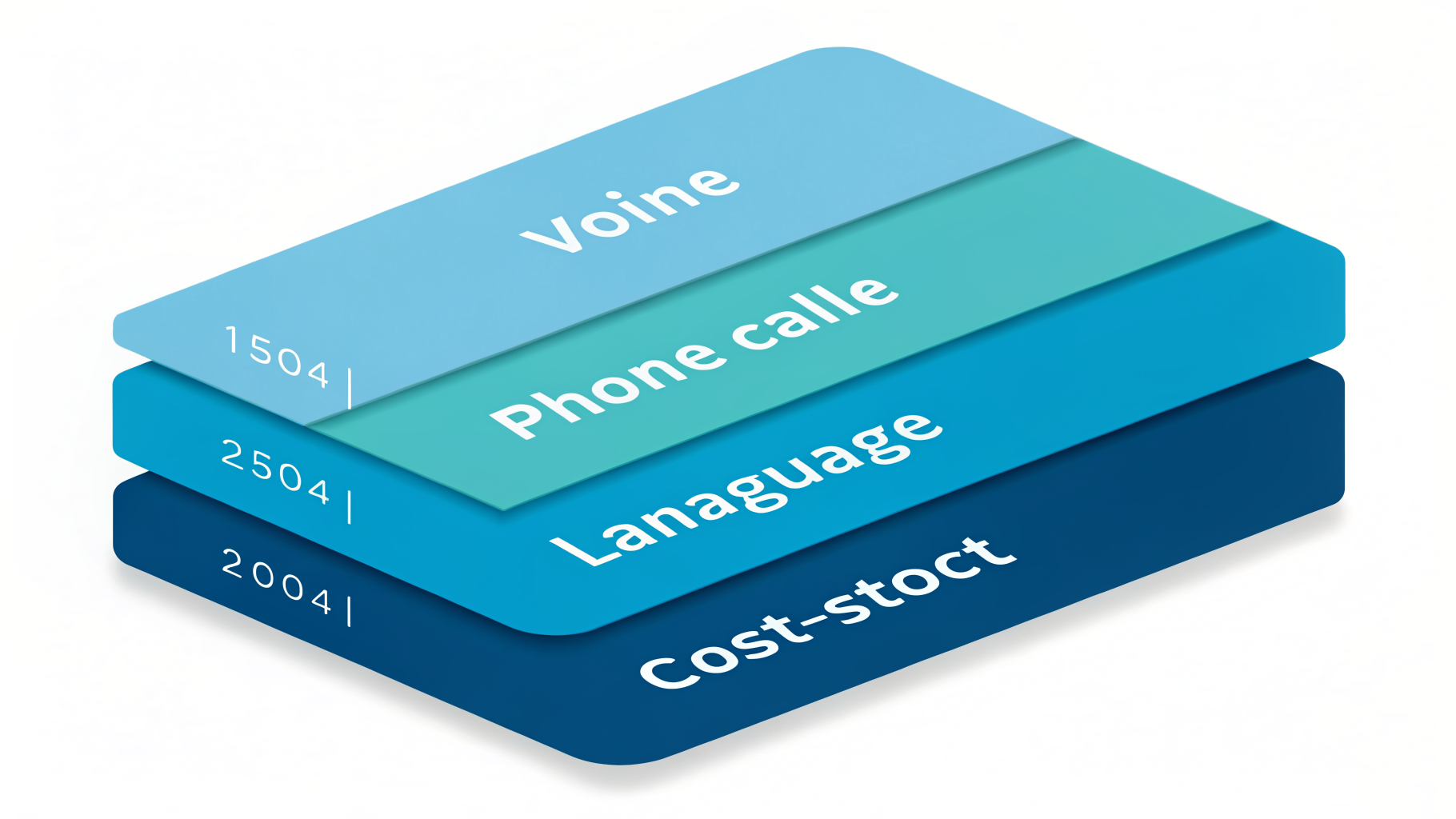
The four cost layers behind an AI voice agent
What it costs at your actual call volume
Minutes are the thing that moves your bill, so here's roughly what three common pricing approaches cost in CAD per month at 500, 1,500, and 5,000 minutes of talk time. Add telephony (below) on top.
- Mid-range all-in (~$0.28 CAD/min): about $140/month at 500 minutes, $420 at 1,500, and $1,400 at 5,000.
- Premium pay-as-you-go (~$0.70 CAD/min): about $350, $1,050, and $3,500 at those same volumes — it climbs fast.
- Bundled subscription: around $140 on an entry plan, ~$490 plus overage at 1,500 minutes, and custom pricing (~$1,500+) at 5,000.
Notice how the premium pay-as-you-go column gets painful fast. Pay-as-you-go feels safe when you're testing, but once you have real volume, a bundle or committed-use deal almost always wins. One real example worth doing the arithmetic on: a popular plan sells 1,000 minutes for about US$349 — that's US$0.35 a minute baked in, barely a discount off the US$0.50 pay-as-you-go rate. Always divide the plan price by its minutes before you believe the "savings."
The telephony line nobody mentions
Remember that fourth layer? Here are actual Canadian numbers. On Twilio's Canada pricing (current as of October 2026), a Canadian local number costs about US$1.15 a month (~$1.60 CAD), a toll-free number about US$2.15 (~$3 CAD). Receiving calls on a local line runs about US$0.0085 a minute — roughly a penny CAD. Toll-free costs more to receive, around US$0.022 a minute (~$0.03 CAD).
Small on its own. But it's real, it's usage-based, and here's the catch: some vendors pass telephony straight through to you at cost, others fold it into their blended rate, and a few quietly mark it up. When a quote looks suspiciously cheap, the phone line is often where the rest of the margin is hiding. Ask which.
The hidden costs that blow up the budget
This is the section the vendor's one-pager leaves out. None of these is a scam — they're just real costs that don't show up until the second invoice.
- Setup and onboarding: roughly $1,400–$4,200 CAD for a simple agent, and $7,000–$14,000+ once you're integrating a CRM, booking, and bilingual call flows.
- A custom voice: expect an extra US$0.02–$0.07 per minute, or a one-time US$1,000–$5,000 to clone or design one.
- Bilingual service: multilingual handling often adds from about US$0.01 a minute. In Canada this is not a luxury line item — a caller in Montreal, Ottawa, or Moncton may well start in English and finish in French, and your agent needs to keep up.
- Concurrency: handling many calls at the same time. Some platforms charge per extra simultaneous line — one well-known provider bills about US$8 for each concurrent call past 20. Fine until a Monday-morning rush.
- Data residency: keeping call data on Canadian soil can trigger a regional-endpoint surcharge, often in the ballpark of 10%.
- Overage: the per-minute rate once you blow past your bundle is usually the ugliest number in the contract. Read it before you sign.
The comparison that actually matters: AI vs. a receptionist
Most people aren't really asking "what does AI cost" — they're asking "is this cheaper than hiring someone?" So let's benchmark against a real Canadian wage. According to the Government of Canada Job Bank, a receptionist in Canada earns a median of about $22 an hour (with a low near $17 and a high near $30), for the 2024–2025 reference period.
A full-time receptionist at $22/hr is roughly $45,000 a year in base wages. Load on CPP, EI, vacation pay, and benefits and you're closer to $52,000–$55,000 — and that buys you coverage for about 40 hours a week. Nights, weekends, the lunch hour, the sick day: not covered.
Now the per-call math. A receptionist handling six calls an hour at $22/hr works out to about $3.67 a call. An AI agent at ~$0.28 CAD a minute over a four-minute call is about $1.12 — and it answers at 2 a.m. on a holiday for the same flat rate. These are rough illustrations, not a forecast for your specific business, and this isn't financial advice — but the shape is consistent across every honest comparison. The smart framing usually isn't "replace the receptionist." It's "let the AI catch the overflow, the after-hours calls, and the surges a single human can't," which is exactly the kind of thing you should measure as a cost per resolved call rather than a flat monthly fee.
So what should you actually budget?
Rough brackets, Canada-wide:
- Solo or very small (a few hundred calls a month): about $200–$350 CAD a month, plus a modest setup — or a no-frills DIY build if you're technical.
- Growing SMB (1,000–2,000 minutes, with a booking or CRM tie-in): roughly $400–$850 CAD a month once integrations are in.
- Multi-location or high volume: stop paying per minute and negotiate a committed-use or per-outcome deal.
Before you sign anything, run through the questions to ask before you buy, and if your agent will record calls, factor Canadian consent rules in from day one — the call-recording consent rules in Canada can shape which provider and which data-residency tier you choose, and that choice has a price tag.
Quick answers
Is there a free AI voice agent? Free tiers exist for testing, but the phone line always costs something. "Free" usually means a handful of trial minutes, not a free phone answered 24/7.
Is it cheaper than an answering service? For most steady volumes, yes — and it doesn't sleep, take breaks, or quit. Very low call volumes are the exception, where a shared human service can still win.
What are the sneaky fees? Telephony, overage, custom voice, concurrency, and data-residency surcharges. Ask for one all-in quote at your real monthly volume, not a per-minute teaser.
Why do quotes vary so wildly? Because each one is pricing a different slice of the same four-layer stack. Once you know the layers, you can see exactly what you're being charged for — and what you're not.
The honest bottom line: for a Canadian business, an AI voice agent is rarely the "pennies a minute" fantasy or the "enterprise-only" luxury it's sometimes painted as. Budget a few hundred dollars a month, read the overage clause, ask where the phone line is billed, and you'll know your number before the vendor finally gives you theirs.

AI voice agent versus a receptionist desk