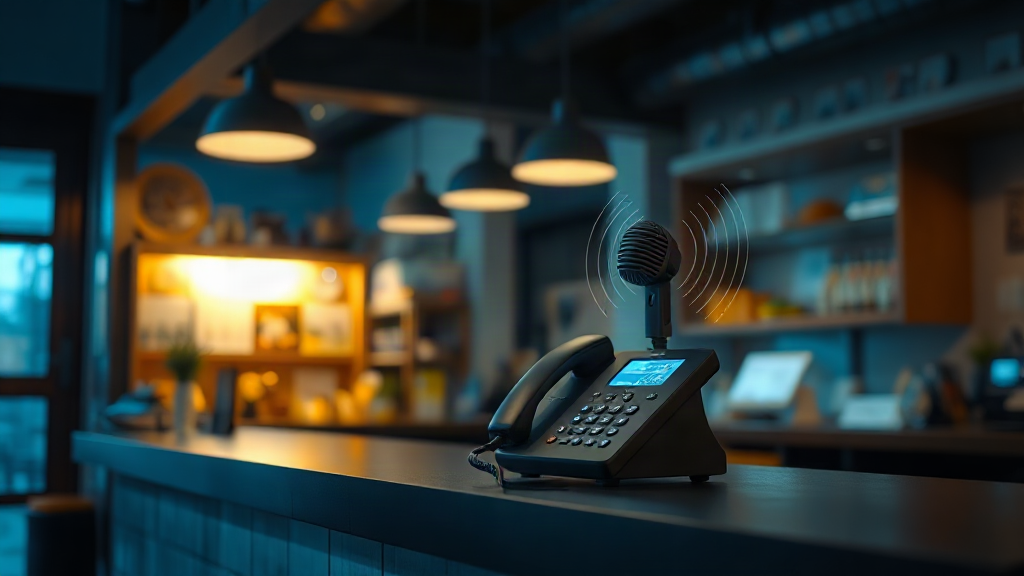
Picture a Tuesday night in Calgary. A furnace quits at 9:40 p.m., the homeowner pulls up an HVAC company on their phone, and calls. Someone answers on the second ring, asks what's happening, takes the address, checks the on-call schedule, and books a 7 a.m. visit. The caller thanks "her" and hangs up. There was no her. There was no one in the office at all.
Two years ago that call would have gone one of two ways: straight to voicemail, or to a stilted robot that mangled the street name and dumped the caller back to the main menu every time they said something off-script. In 2026, it mostly just works. So the interesting question isn't whether AI can answer a phone — it has been able to do that for years. It's why the thing on the other end finally stopped sounding like a machine.
It was never really about the voice
Here's the part most people have backwards. The synthetic voices got convincing a while ago. If you played someone a 30-second scripted recording in 2024, they usually couldn't tell it was generated. Text-to-speech crossed the uncanny valley early.
What stayed broken was the conversation. Real phone calls are messy. People trail off, say "um," change their mind halfway through a sentence, talk over the other person, pause to look something up. Older voice bots treated every silence as "your turn is over" and every interruption as an error. They would barrel ahead while you were still talking, or sit in dead air waiting for a sentence you'd already finished. The voice sounded human; the timing gave it away in about four seconds.
The fix wasn't a prettier voice. It was teaching the system when to speak and when to shut up. ElevenLabs made that explicit when it shipped its Conversational AI 2.0 platform with a dedicated turn-taking model — software that reads hesitations and filler words in real time to decide whether you've actually finished or are just thinking. As VentureBeat described it at launch, the whole point was to kill the awkward pauses and the interruptions. That single change is most of what separates a 2026 agent from a 2023 one.
Three things stacked up to get us here
The shift wasn't one product. It was three advances landing on top of each other over about eighteen months.
Turn-taking got solved. As above — this is the big one. Once a system can tell the difference between a pause and the end of a thought, conversations stop feeling like a walkie-talkie exchange.
The architecture collapsed into one step. Older setups ran a pipeline: speech-to-text, then a language model, then text-to-speech, each adding delay. The newer approach is speech-to-speech — the model hears audio and produces audio directly. OpenAI's realtime voice models work this way, and they added the ability to place and receive actual phone calls over standard telephony. Cutting out the round-trips drops the lag that used to make callers think the line had gone dead.
The quality jumped on the benchmarks, too. It's not only vibes. When OpenAI released its most recent realtime speech model, it reported double-digit gains over the prior generation on multi-turn conversation and audio reasoning tests — on the order of a 10 percent improvement on keeping track of a back-and-forth and roughly 17 percent on audio reasoning, by its own measurement. Treat vendor numbers with the usual pinch of salt; they aren't independently audited. But the direction is real, and you can hear it on a live call.
By late 2026 this stopped being a race between labs and started becoming infrastructure. At its November 2026 summit in New York, ElevenLabs pitched voice as an "interaction layer" and rolled out a wave of enterprise products, a new generation of its model, custom-model tooling, and a hardware partnership to run it all. You don't build that kind of plumbing for a toy. You build it because businesses are putting these agents on real phone lines, in volume.
What this means for a business deciding right now
For most of the last few years, the honest advice to a Canadian owner asking about an AI phone agent was "wait." The tech was close but embarrassing often enough that putting it in front of customers was a gamble. That calculus flipped in 2026. The question stopped being "will this humiliate me on the phone" and became "where do I point it, and where do I keep people."
That matters more in Canada than almost anywhere, for a boring geographic reason: this is a country spread across six time zones. A Halifax law office and a Vancouver clinic can't staff the same reception desk, and plenty of customers call outside anyone's business hours. An agent that sounds natural at 11 p.m. in Winnipeg or 6 a.m. in St. John's is covering the exact gaps a human front desk was never going to cover cheaply. It also handles the thing every small business dreads — the Monday-morning flood, the storm-day surge — without putting ten callers on hold.
There's a language dimension that's easy to underrate. Canadian businesses field calls in English, French, and a long list of other languages depending on the city — Toronto, Montreal, and Vancouver callers don't all phone in the same tongue. Modern agents can detect the caller's language and switch without a menu, though the quality still varies by language and accent. We dug into that specific problem in our look at how AI voice agents handle Canada's many languages and accents, and it's worth reading before you assume "multilingual" means "flawless in every language."

Two sound waveforms taking turns, representing natural conversational timing
Where it still sounds like a machine
Being straight about the limits is the fastest way to set expectations that won't blow up on you. A 2026 agent is good. It is not a person, and a few situations still expose it.
- Heavy accents and bad lines. A thick regional accent over a crackly cell connection in a noisy shop still trips recognition more often than anyone would like.
- Cross-talk. Turn-taking is dramatically better, but if the caller and a toddler and a TV are all going at once, the agent can still mistime its reply.
- Emotion and complexity. A furious customer, a grieving family member, a genuinely novel problem with ten moving parts — these are where you want a human, and a well-designed agent should recognize that and hand off rather than fake its way through.
That last point is the design question that actually matters now. Sounding human isn't the goal; being useful is. The best deployments decide in advance which calls the agent owns end-to-end and which ones it routes to a person, fast and gracefully. We walked through how to draw that line in our guide on when an AI voice agent should transfer a call to a human. Get the handoff right and the occasional limit becomes a non-event instead of a bad review.
Should your customers be told it's AI?
This comes up the moment an agent sounds convincing: if people can't tell, do you have to say so? Our own view is yes, and not only because disclosure is good manners. A quick, natural "you've reached our automated assistant, I can book you in or get a person on the line" costs you nothing, heads off the awkward moment when someone figures it out mid-call, and tends to make callers more patient, not less. It also keeps you on the right side of a regulatory mood that is clearly tightening. If you want the longer argument, we covered the trust question in detail in can you trust an AI voice agent in 2026.
The bottom line
The machine stopped sounding like a machine because it finally learned the rhythm of a conversation — when to jump in, when to wait, when to let you finish a messy sentence. For a Canadian business, that moves AI voice from a gimmick you'd be nervous to show a customer to a tool that can reasonably own your after-hours line, your overflow, and your second language. It won't replace your best person on your hardest calls. But for the ringing phone nobody's there to answer — in Toronto at midnight or Moncton at dawn — it's no longer a question of whether it can. It's a question of whether you're losing business by leaving that phone to ring.

An empty after-hours reception desk with a ringing phone
Quick questions
Can callers really not tell it's AI? On a routine call, often not — until the agent hits something unusual. That's exactly why a short upfront disclosure is the smart play rather than hoping no one notices.
Is this good enough for a serious business line yet? For booking, intake, FAQs, after-hours and overflow across Canada, yes, in 2026 it generally is. For emotionally charged or highly complex calls, design it to hand off to a human quickly.
Will it work in French and other languages? It can detect and switch languages automatically, but quality varies by language and accent, so test it on the languages your customers actually use before you rely on it.