
Introduction
It is 9:03 a.m. in Toronto, 8:03 in Winnipeg, 7:03 in Calgary, and 6:03 in Vancouver. A dental clinic in Ottawa has just opened. A plumbing company in Edmonton already has crews on the road. A real estate team in Halifax is fielding listing inquiries before coffee is finished. The phone rings, then rolls to voicemail. That small missed moment can mean a lost booking, a colder lead, or a customer who simply tries the next business.
That is why the numbers matter this year. According to Gartner, by 2026 about 80% of customer service and support organizations will be applying generative AI in some form. For Canadian SMEs, that shifts AI voice agents from a nice-to-have experiment into a practical operating decision. If your business depends on calls, response speed and call coverage are now revenue issues.
This roundup organizes 40 data points into one question: what should a Canadian business owner actually do with them? We will look at market growth, missed-call behaviour, efficiency and ROI, customer expectations, and the Canadian context, including six time zones, an officially bilingual market, and privacy obligations.
The market in numbers
Start with the scale of the category. According to Grand View Research and Juniper Research, the global conversational AI market was roughly USD 13 billion to 17 billion in 2024 and is projected to pass USD 45 billion to 50 billion by 2030. Estimated CAGR sits around 24% to 30%. Markets do not grow at that pace because companies are buying novelty. They grow because enough businesses see real operational value.
For Canadian businesses, that growth has a second meaning. It signals normalization. As conversational AI becomes more common, customers become less patient with missed calls, long hold times, and dead-end voicemail boxes. What felt like acceptable friction a few years ago now feels outdated, especially in service-heavy sectors.
Gartner's 2026 estimate matters even more at the ground level: about 80% of customer service and support organizations will be using generative AI in some form. Not all of those deployments will be voice-first, of course, but the direction is clear. AI is moving into front-line communication, where speed, consistency, and availability matter most.
Then there is Gartner's longer-range forecast: by 2029, agentic AI will autonomously resolve about 80% of common customer service issues. That does not mean every interaction should be automated. It means common, repeatable requests are increasingly a poor use of scarce human time. Hours, booking changes, lead qualification, FAQs, routing, confirmations. The basics. The calls that pile up every single day.
The missed-call math
One of the most quoted response-time findings still hits hard because it is so practical. Research from Lead Response Management, cited by Harvard Business Review, found that contacting a web lead within 5 minutes makes a business about 21 times more likely to qualify that lead than waiting 30 minutes. The odds of reaching that lead also fall by roughly 10 times in the first hour. For any SME running ads, forms, or inbound inquiries, that is not a minor lift. It is a different outcome entirely.
While the original statistic focuses on web leads, the behavioural lesson applies to phone calls too. People reach out when intent is highest. They are ready to book, ask, compare, or buy. Delay the response and intent cools fast. In local service categories, it cools even faster because the next option is one quick search away.
Missed-call research points the same way. A large majority of callers who reach voicemail hang up without leaving a message, and most people who cannot reach a business on the first try never call back. They call a competitor instead. Industry compilations drawing on Forrester report that more than 60% of callers abandon after a busy signal or voicemail. That is the hidden math behind "we'll call them back later." Often, there is nobody left to call back.
This is where an AI voice agent earns attention. Its first job is not replacing staff. It is preventing demand from leaking out of the top of the funnel. If the phone is answered immediately, basic details are captured, and the caller gets a clear next step, the business keeps the conversation alive.
The efficiency and ROI numbers
Once the missed-call problem is clear, the next question is economics. According to McKinsey, AI handling of routine calls can cut average handle time by about 30% to 40%. For a Canadian clinic, contractor, brokerage, or restaurant group, that usually means less staff time spent repeating the same information and more time available for cases that actually need judgment.
ROI is the other number owners care about, and fairly so. IDC reports that many organizations see positive ROI within 12 months of deploying conversational AI, with typical payback in a few months. That timeline matters because small and midsize businesses do not have room for endless pilot projects. A tool has to either recover missed revenue, reduce labour drag, or both.
Cost per interaction also shifts the equation. According to Deloitte's CX benchmark, an AI-handled call costs a fraction of a live agent's per-minute cost. That does not mean human staff are less valuable. It means their time is too valuable to spend on every repetitive request. The smart operating model is division of labour: AI handles the routine layer, while people focus on nuance, escalation, sales, and care.
If you want to break down the economics further, start with what an AI voice agent really costs a Canadian business. The real comparison is never just subscription price versus payroll. It is subscription price versus missed calls, slower response, admin burden, and uneven after-hours coverage.
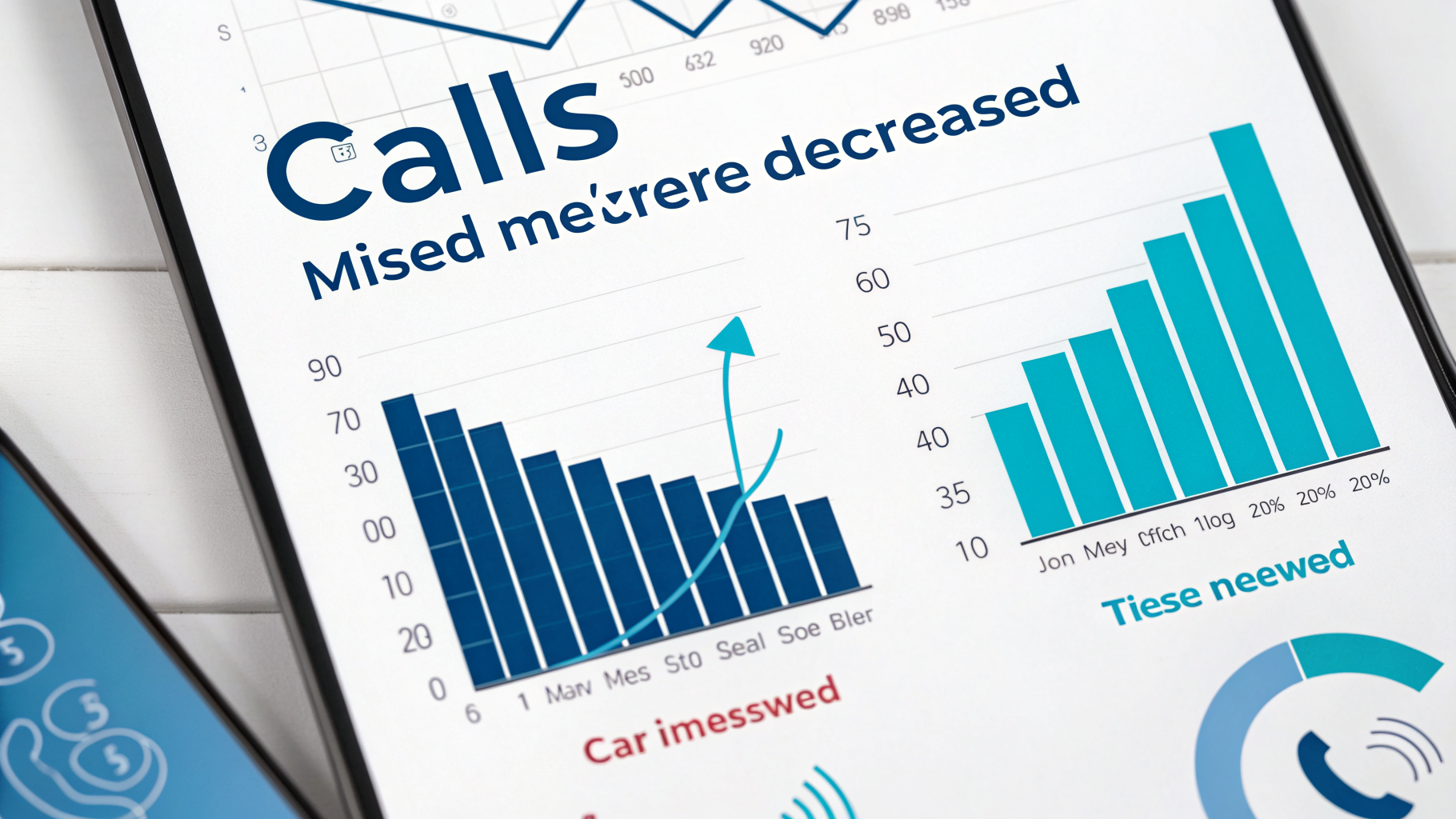
Chart concept showing missed calls falling and answered calls rising for Canadian businesses
What customers now expect
Availability is no longer interpreted generously. According to HubSpot, more than 70% of consumers expect businesses to be available 24/7. That does not mean a live receptionist has to sit by the phone at 2 a.m. in every city from Halifax to Vancouver. It does mean callers expect some useful path forward at any hour: an answer, a booking option, a captured message with structure, or the right routing.
Customers also increasingly want speed without hand-holding. Salesforce's State of Service reports that a majority of customers prefer self-service for simple issues. For phone channels, that is a big shift. A caller asking for hours, availability, appointment confirmation, or basic service information often does not want a long conversation. They want completion. Fast.
Poor service compounds quickly. PwC reports that more than half of consumers abandon a brand after repeated bad service. Not one imperfect interaction, but repeated friction. Long rings, voicemail loops, inconsistent answers, no callback, after-hours dead ends. Bit by bit, trust drops. Then the customer leaves.
For another industry overview, see CloudTalk's 2026 statistics roundup. The exact framing differs by source, but the directional pattern is consistent: customers reward immediacy, consistency, and low-effort service.
The Canadian dimension
Canada adds a few realities that make these statistics more operational, not less. The first is geography. Canada spans six time zones. When it is 9 a.m. in Toronto, it is 6 a.m. in Vancouver. A business with customers, referrals, or campaigns across provinces can miss calls simply because the workday does not start and end at the same moment nationwide. After-hours coverage is not a luxury in that environment. It is basic reach.
The second is language. Canada is officially bilingual, and in many sectors the ability to answer in English and French is more than a courtesy. It is part of delivering a smoother customer experience in a bilingual market. An AI voice agent can route and respond in both languages automatically, which is especially useful for businesses serving multiple provinces, federal clients, or mixed-language urban markets like Ottawa and Montreal.
The third is compliance. Under PIPEDA federally, and with Quebec's Loi 25 in that province, businesses need to handle call recordings and customer data responsibly. The practical questions are straightforward: what is being collected, why, where is it stored, how long is it retained, and who can access it? If that is on your checklist, review how AI voice agents handle PIPEDA data privacy.
This is also why vendor selection matters. The right system has to fit your call flow, language needs, and privacy requirements, not just sound impressive in a demo. Before choosing one, work through 7 questions to ask before choosing an AI voice agent. A little due diligence up front saves a lot of cleanup later.

AI voice agent answering calls 24/7 across Canada's six time zones
Where the numbers bite hardest
Trades are one of the clearest use cases. Electricians, HVAC companies, plumbers, roofers, locksmiths, landscapers. The owner or dispatcher is often on-site, driving, or juggling urgent work. That makes missed-call and speed-to-lead numbers especially punishing. If a homeowner cannot get through, they usually do not wait politely for a callback. They try the next listing.
Clinics and professional practices feel the pressure differently. They may have front-desk staff, but call volume tends to cluster around routine tasks: confirmations, cancellations, directions, insurance questions, intake basics, office hours. If routine interactions can reduce average handle time by 30% to 40% according to McKinsey, staff can spend more attention on patient care, compliance, and cases that genuinely need human judgment.
Restaurants and hospitality businesses get hit by timing. The phone rings during service, and no one has a free hand. Yet more than 60% of callers abandon after busy signal or voicemail according to Forrester-based industry compilations. That can mean lost reservations, catering inquiries, event bookings, or simple customer questions that never turn into orders.
Real estate is where the response-time statistic becomes almost painfully literal. The Harvard Business Review finding on the 5-minute window should shape every inbound process. Agents are in showings, on calls, or negotiating. An AI voice agent can answer immediately, capture buying or selling intent, qualify the lead, and hold the opportunity until a human takes over.
What these numbers mean for your business in 2026
Taken together, the statistics point to a pretty direct conclusion. Conversational AI is growing fast. Generative AI adoption in service functions is becoming standard. Routine calls can be handled faster and at lower cost. Customers expect 24/7 availability for at least basic requests. And missed calls are not harmless overflow. They are often lost revenue.
For Canadian SMEs, the practical question is not whether AI belongs somewhere in the customer journey. It is where the friction is costing you the most right now. Is it after-hours coverage across time zones? Is it bilingual call handling? Is it delayed lead response? Is it staff time consumed by repetitive phone traffic? Different businesses will land in different places, but the diagnostic is usually simple once you look at your call patterns honestly.
A smart next step is to audit your own phone flow: peak hours, voicemail volume, unanswered-call patterns, common questions, callback delays, and language needs. Then compare that against deployment cost, privacy requirements, and expected payback. If you are at that stage, review what an AI voice agent really costs a Canadian business, 7 questions to ask before choosing an AI voice agent, and how AI voice agents handle PIPEDA data privacy.
By 2026, the better question is no longer whether AI can answer the phone. It can. The better question is how much every unanswered call is still costing your business.