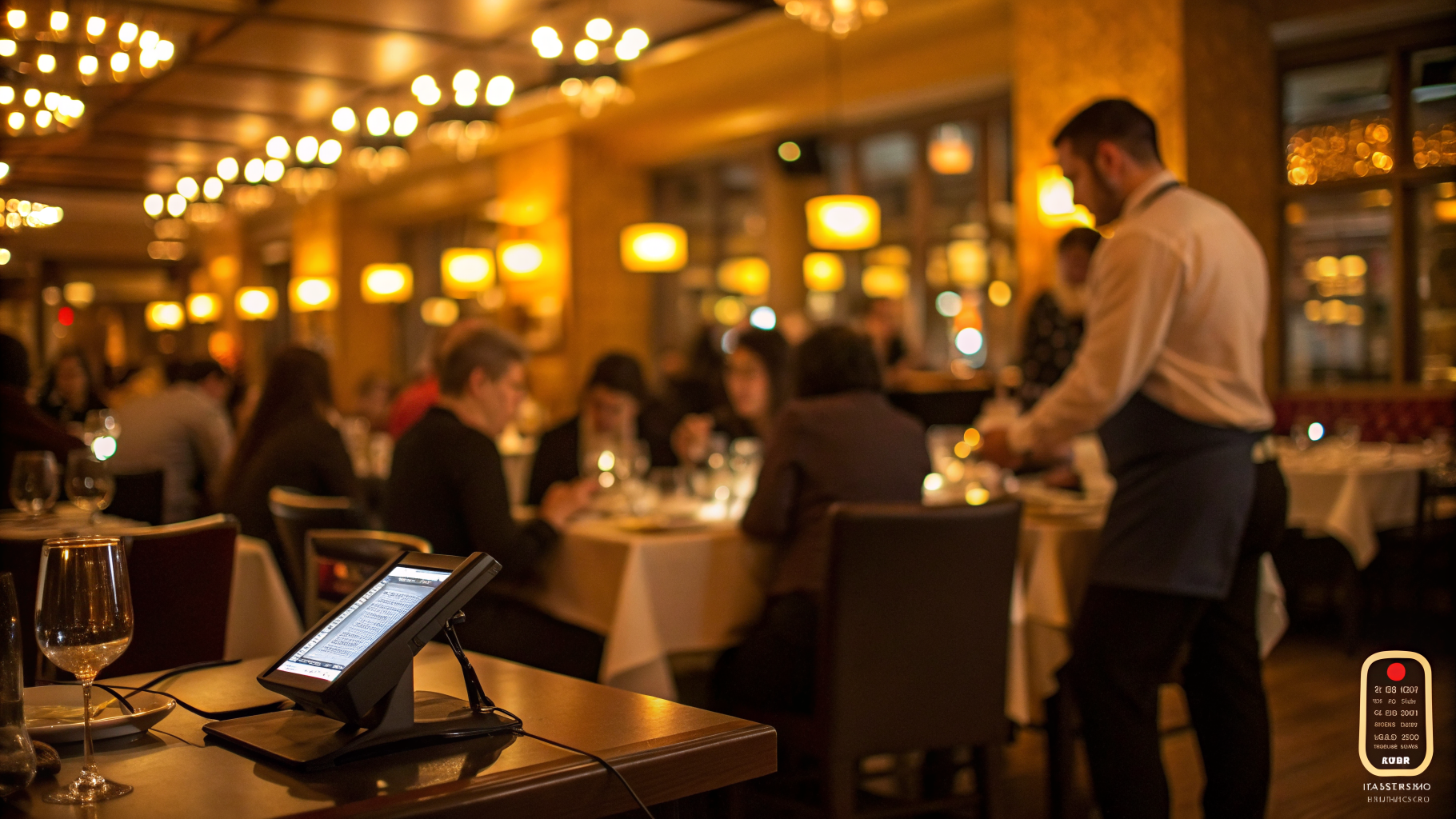
Friday, 7:40 p.m.: the phone rings and nobody can answer
Picture the scene. It's Friday night, the dinner rush is in full swing, the room is packed and your two servers are running from table to table. The phone rings. Nobody can pick it up, not because your team doesn't care, but because a real, live customer is already waiting at the counter. On the other end of the line, someone wanted to book a table for six, tonight. They hang up after four rings and call the restaurant next door.
This small drama plays out dozens of times a week in restaurants across Canada, and almost nobody measures it. A missed call makes no noise. It leaves no trace in the till. But added up over a month, those calls add up to empty tables, lost takeout orders and customers who, once they've gone elsewhere, don't come back. That's exactly the gap an AI voice agent fills.
Here is how an AI voice agent for restaurants actually works in 2026: what it takes on, what's better left to a human, and above all how to tell whether it's genuinely paying for itself.
The problem isn't the phone. It's the timing.
In a restaurant, the phone competes directly with in-person service. During the rush, every ring forces an impossible choice: the guest in front of you or the one on the line. Nine times out of ten, the one who's already there wins, and rightly so.
The trouble is, the caller doesn't try again. Across small service businesses, a large share of incoming calls goes unanswered, and most of those people never call back. They simply move to the next result on Google. A missed call isn't a postponed opportunity. It's an erased one, whether your restaurant is in Toronto, Vancouver, Calgary, Halifax or Winnipeg.
There are really two windows of loss in a restaurant. The first is the rush, when everyone is slammed. The second is after closing, when there's simply nobody there. An AI voice agent covers both of those windows without blinking, seven days a week, across all six of Canada's time zones.
Do the math: what an empty table is worth
Foodservice runs on thin margins. According to Restaurants Canada, it's a $124 billion industry employing nearly 1.2 million Canadians, but per-location profitability stays fragile, squeezed between rising food costs and rising wages. In that environment, every lost cover matters more than it used to.
Take a concrete example. Say a bistro misses ten reservation calls a week, a conservative figure in peak season. If half would have turned into bookings, and an average table brings in $90, that's $450 a week evaporating. Over a year, that's more than $23,000 in sales that never show up anywhere, because you can't ring up what you never took.
Compare that to the cost of an AI voice agent, usually a few hundred dollars a month. The math adds up fast. And to understand what really sits behind the advertised price, we broke down the true cost of an AI voice agent in Canada in a separate article.
And the real cost goes beyond the table you lose tonight. A caller who hits voicemail, or worse a busy signal, forms an impression: this is a restaurant that's hard to reach. They mention it, they sometimes leave a review, and next time they choose somewhere else. Recovering the call protects both today's booking and tomorrow's relationship.
What an AI voice agent handles in a restaurant
A good voice agent starts with the repetitive, low-ambiguity tasks. It captures the name, number, date, time, party size and occasion, then writes the request into your reservation tool. If the requested slot is full, it offers another or moves the guest to the waitlist, without ever inventing an answer it doesn't have.
It also handles the standard questions that tie up your staff without earning a cent: opening hours, address, parking, kids policy, validated gluten-free options. And if you offer takeout, it triages rather than dictates: it points guests to your online ordering link, far more reliable than reading a menu aloud over a noisy line.
The key is that it never sleeps and never panics. Twenty calls at once on a Saturday night? It takes them all, simultaneously, without putting anyone on hold. We've pulled all these use cases together on our restaurant industry page.
One detail that changes everything: the agent sends an SMS confirmation the moment the call ends, with the time, party size and a one-tap cancellation link. On the management side, every call is logged: who called, when, and why. You finally see your true peak hours, the dishes most requested by phone, and the nights you were bleeding the most calls, data nobody was recording by hand before.
Smartphone showing an incoming restaurant reservation confirmation at night
The real jackpot: after-hours calls
Here's the use case most restaurant owners underestimate. The restaurant is closed, it's 11 p.m., nobody's there, but someone has just finished their evening and wants to book for tomorrow, right now, while it's on their mind. Without an agent, that call vanishes. With one, it becomes a confirmed reservation while you sleep.
These calls are often the most profitable, because buying intent is at its peak: the person wants to book now. Booking habits are shifting fast, too. Per OpenTable data cited by Restaurants Canada, solo-diner reservations jumped 28% in a year, and a growing share of requests arrives outside business hours.
Add Canada's linguistic reality to the mix: an agent that greets callers just as smoothly in English as in French wins customers a one-language voicemail would scare off, which matters everywhere from Montreal to Ottawa to New Brunswick. We explain how to set up a bilingual AI voice agent so switching between languages feels natural and instant.
What has to stay human
An AI voice agent isn't there to do everything, and pretending otherwise is the surest way to botch the rollout. It should never settle a complaint, promise a goodwill gesture, comment on an incident or improvise an exception to your reservation policy. Handling an unhappy guest takes judgment, sometimes compensation, and that stays a manager's job.
Same goes for VIPs, regulars and big events: birthdays, corporate functions, groups of twenty. The agent can pre-qualify the request and gather the details, but the final allocation of space, menus and deposits belongs to your team.
The most sensitive case is a severe allergy. The agent can capture the information and add it to the reservation, but a serious allergy should always be re-verified by a human, ideally the manager or the kitchen. Food Allergy Canada recommends speaking directly to the person in charge for exactly these situations.
Integrations, no-shows and what to measure
The right architecture isn't an AI answering the phone off in its own corner. It's an AI wired to your source of truth for availability. In Canada, systems like OpenTable, Resy, TouchBistro and Lightspeed manage reservations, waitlists and confirmations. The critical piece is syncing: an agent that books without regard for the floor plan creates more problems than it solves.
No-shows deserve special mention. The automatic reminders and confirmations the agent sends aren't a luxury: they measurably cut no-shows and keep guests engaged. If you operate in Quebec, note that a no-show fee is tightly regulated, so build cancellation ease into the flow from day one, and treat any deposit or fee policy as something to confirm with a manager rather than the agent.
As for measurement, four numbers are enough: covers saved (calls that would have been lost, then converted), the no-show rate, the share of after-hours calls handled, and the escalation rate to a human. If you're still losing calls when all your lines are busy, we wrote a full guide on how to stop losing those overflow calls.
A quick word on rollout risk: because the agent hands off cleanly to a human whenever it isn't sure, the downside of a cautious setup is small. The worst case is an escalation that didn't strictly need one, which costs far less than a booking lost to a ringing phone.
Elegant reserved restaurant table representing an after-hours booking captured by an AI voice agent
How to start without upending everything
An effective rollout comes down to four steps, and it starts from the reality of your calls, not from picking a voice. First, map the calls you actually get: reservation, change, group, allergy, hours, takeout, complaint. Then connect the source of truth for your availability.
Next, set the operating rules: table durations, cancellation policy, after-hours handling, and above all the keywords that trigger an escalation to a human. Finally, measure before and after. A thirty-to-sixty-day pilot is more than enough to see whether the agent removes real friction or just shifts the work around.
Don't forget compliance: the moment a technology collects personal information, a name, a number, a preference, Canadian privacy law applies, and the restaurant stays responsible for that data even when a vendor is involved. We laid out what PIPEDA and data privacy mean for your customer calls.
The bottom line
An AI voice agent doesn't replace the soul of your restaurant. It replaces neither the host who greets with a smile nor the manager who defuses a complaint. What it does is plug the most expensive and most silent hole in your operation: the calls nobody can take during the rush and after closing.
In a business where every cover counts, recovering even half of those calls changes the picture over a year. Start small, with a pilot, measure the covers you save, and let the numbers decide. Your restaurant phone will still ring, but this time, someone will always be there to answer.