
It is 4:47 p.m. in Ottawa. A 72-year-old man has finally decided to call a hearing clinic after his daughter told him, again, that the TV is too loud. He has a paper with the clinic number beside the phone. He calls between errands because that is when he remembers. The front desk is helping with a hearing-aid fitting. The line rings out. He does not leave a voicemail. He does not fill out a web form. Ten minutes later, he calls the next clinic on Google.
That lost call feels small in the moment. It is not.
For Canadian audiology clinics, the phone is still the front door. Patients skew older, many want a real conversation before booking, and many are comparing options across Toronto, Vancouver, Calgary, Winnipeg, Halifax, Edmonton, Ottawa, and smaller communities where trust matters even more. When a clinic misses the call, it often misses the patient. That is exactly where an AI voice agent for audiology clinics can make a real difference, not by replacing clinical care, but by making sure every caller gets answered, guided, and booked.
The scale of the opportunity, and why hearing care is still phone-first
The size of the hearing-care market in Canada is easy to underestimate if you only look at booked appointments. The bigger picture is much larger.
According to Canadian Health Measures Survey data reported by CARP, an estimated 54% of Canadians aged 40 to 79, about 8.2 million people, have at least mild high-frequency hearing loss, and most do not realize it. The same survey shows measured hearing loss rises sharply with age, roughly 77% of Canadians aged 60 to 69 and 94% of those 70 to 79 have hearing loss.
Statistics Canada hearing data adds another important angle. In the 2022 Canadian Survey on Disability, 5.6% of Canadians aged 15 and over, more than 1.6 million people, reported a hearing disability. Among those aged 65 and over, that rises to 13.6%.
For hearing clinics across Canada, that matters because this patient base is older than average, and older patients are far more likely to book by phone than by web form. They want to ask if they need a referral. They want to know what is covered. They want to hear a calm human-like voice explain what happens at a first assessment. In audiology, the phone is not just one channel. It is often the booking channel.
That also means a missed call in hearing care is more dangerous than in many other sectors. CallRail's 2025 consumer survey of 1,000 respondents found that 82% of consumers will call a competitor if a business does not answer, and 21% say they would do so immediately. For audiology clinic missed calls, that is the key risk. The caller does not wait. They move on.
And because hearing care patients often begin with a simple question, the clinic may never even know how many potential new patients it lost. The call never becomes a lead in the CRM. It just disappears.
This is also why many clinics are rethinking an AI voice agent vs voicemail. Voicemail records a loss after it happened. A voice agent tries to prevent the loss in the first place.
What a missed call really costs
One unanswered call does not equal one lost hearing-aid sale, of course. We should be honest about that. Some callers are existing patients rescheduling. Some are asking for hours. Some will call back. But the economics still add up fast because hearing care is high-value and recurring.
In Canada, hearing aids commonly cost about $1,000 to $4,000 per ear. Patients also return for hearing tests, fittings, adjustments, cleanings, reprogramming, repairs, domes, wax guards, accessories, and eventual replacement, often around every five years. A new patient relationship can be worth thousands in the first fitting and much more over time.
There is also a Canadian funding nuance that matters in these conversations. In Ontario, the Assistive Devices Program can cover up to 75% of the cost, capped at $500 per aid, for eligible residents. On top of that, some patients may ask about WSIB, Veterans Affairs coverage, or private insurance. Those are exactly the questions that often come in by phone before someone is willing to book.
Here is a conservative, illustrative way to think about the math.
- A clinic receives about 600 calls per month.
- It misses about 25%, or roughly 150 calls.
- If only 2 to 3 of those unanswered calls were lost new hearing-aid patients, at a cautious $3,000 in first-fitting value each, that is about $6,000 to $9,000 per month.
- Annualized, that is roughly $72,000 to $108,000, before recall visits, repairs, second-ear purchases, and future replacements.
That is not an aggressive model. It is deliberately restrained. It does not assume every missed call was a buyer. It only assumes that a small number were high-intent new patients, which is realistic for a hearing clinic.
This is why the revenue leak is underestimated. Owners often compare the cost of answering calls to the salary line for reception. But the better comparison is lost patient lifetime value. A fully loaded front-desk or receptionist role can cost well over $60,000 per year and still only cover business hours. The phone, meanwhile, keeps ringing at lunch, after 5 p.m., and across six Canadian time zones.
Why hearing-clinic phones get missed in the real world
Most clinics are not ignoring the phone. They are busy doing clinic work.
In a hearing practice, the front desk is often juggling check-ins, walk-ins, cleaning appointments, hearing-aid pickups, manufacturer calls, funding paperwork, and patients who need help right now because a device stopped working. During a fitting or troubleshooting moment, the phone slips.
That is especially true in smaller clinics with one receptionist, or in multi-provider clinics where call spikes come all at once.
The common failure points are predictable:
- Front desk staff are tied up with fittings or in-person patients.
- Calls arrive at lunch.
- After-hours calls go to voicemail.
- Monday morning and post-holiday overflow overwhelms the team.
- Multi-location clinics miss calls when one site is short-staffed.
Across Canada, from downtown Toronto to suburban Calgary to smaller Atlantic markets, the pattern is the same. The clinic may provide excellent care once the patient is inside. The weak point is often the few minutes before the first booking happens.
And because hearing care callers often skew older, they are less likely to tolerate friction. They may not text. They may not complete an online intake. They called because calling is what they prefer.
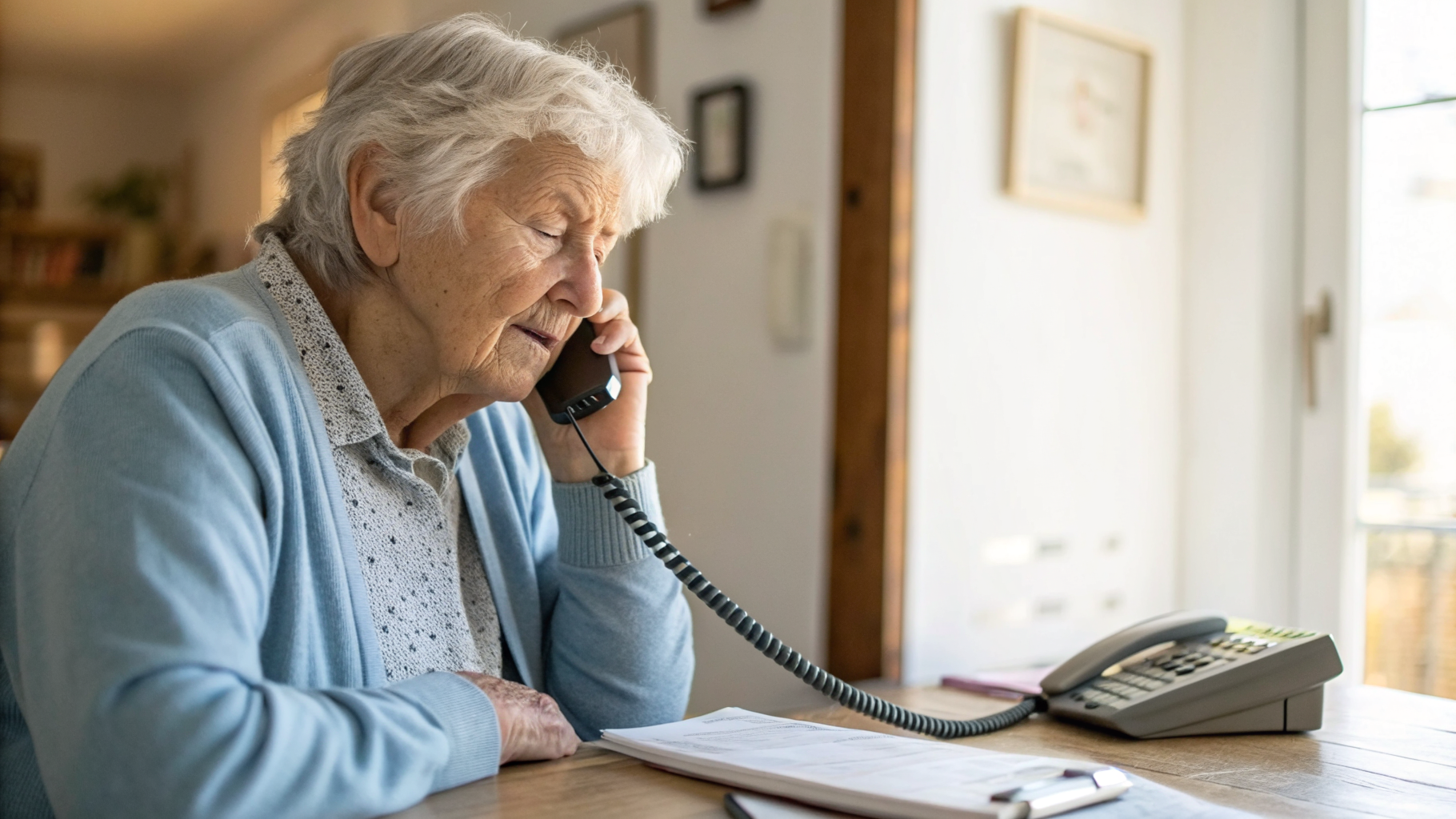
An older patient calls a hearing clinic while the reception phone rings unanswered, illustrating the cost of a missed call
AI voice agent for audiology clinics: what it actually does
An AI voice agent is not a vague automation layer. In a hearing clinic, it has a practical job: answer every call, handle the common paths well, and bring staff in when a human is truly needed.
At a minimum, a good system can answer 24/7, greet callers clearly, explain that it is a virtual assistant, and help with hearing clinic appointment booking. That includes new consultations, hearing tests, hearing-aid checks, cleanings, follow-ups, and rescheduling.
It can also handle the repetitive questions that consume staff time all day:
- Do I need a referral?
- Do you direct bill insurance?
- What does Ontario ADP cover?
- Do you work with veterans or WSIB cases?
- What are your hours and locations?
- Do you offer services in French and English?
For clinics serving mixed markets, bilingual support matters. In many Canadian regions, not only in Ottawa and Montreal-adjacent corridors but also in parts of New Brunswick, Eastern Ontario, Manitoba, and major urban centres elsewhere, callers may expect service in French or English. A strong AI receptionist for hearing clinics Canada should switch languages naturally and keep the terminology clear and respectful.
It can also triage. Not diagnose, triage.
If a patient says, "My hearing aid stopped working," the agent can route to support or book a service slot. If someone asks a clinical question such as sudden hearing loss, dizziness, tinnitus with new symptoms, or concerns after a fitting, the agent should escalate to staff or instruct the caller appropriately based on the clinic's protocol. That boundary matters.
Done well, the system also helps reduce no-shows with reminders and confirmation calls, and captures every caller's details so the clinic can follow up if a booking was not completed.
There is a wider pattern here too. Hearing clinics are not unique in facing this problem. Many other appointment-based clinics losing patients to missed calls see the same revenue drain, though in audiology the impact is often larger because the patient value is so high and the phone remains so central.
For owners comparing options, the right question is not only whether it can answer calls, but what an AI voice agent actually costs relative to the revenue currently leaking out after-hours and during busy periods.
Canadian specifics: funding, privacy, language, disclosure, and clinical boundaries
Canadian audiology clinics operate in a specific regulatory and patient-service context. Any voice system has to fit that reality.
First, funding. Callers often ask about public or quasi-public support before they book. In Ontario that may mean ADP, which covers up to 75% of the cost to a maximum of $500 per aid for eligible residents. In other cases it may involve veterans benefits, WSIB, provincial programs, or private insurance. The agent should be able to explain basic eligibility pathways in plain language, while making it clear that final coverage depends on the program and the clinic's staff can confirm details.
Second, privacy. Patient data is not ordinary customer data. Clinics need workflows that respect federal and provincial rules, including PIPEDA where applicable and provincial health privacy laws such as Ontario's PHIPA. The Office of the Privacy Commissioner of Canada is a useful reference point, but clinics should also confirm requirements with their own advisors and vendors. Calls may be recorded or transcribed for quality and booking purposes, yet that has to be disclosed appropriately and handled with care.
Third, language. Canada spans six time zones and serves patients with different expectations around English and French service. A clinic in Ottawa may need bilingual handling every day. A clinic in Vancouver or Halifax may need it less often, but still enough that missing a French-speaking caller is a lost opportunity. The French must sound natural and appropriate for Canadian usage, especially in patient-facing healthcare contexts.
Fourth, disclosure. The caller should know they are speaking with an assistant. That is good practice and builds trust. The goal is not to trick anyone. It is to answer quickly, help with routine needs, and move the person to the right next step.
Fifth, scope. Organizations such as Speech-Language & Audiology Canada help define the professional context in which audiologists work, and that context matters here. An AI agent should never present itself as giving clinical advice or replacing an audiologist or hearing-instrument practitioner. It should collect information, answer operational questions, and escalate clinical matters to licensed staff.

A bilingual AI voice agent answers calls for a Canadian audiology clinic 24/7
What it should not do, and how to pilot and measure it
This part is important because not every task belongs with AI.
A hearing-clinic voice agent should not diagnose hearing loss. It should not interpret audiograms. It should not recommend a specific device based on symptoms alone. It should not handle urgent medical concerns beyond routing and escalation. And it should not improvise coverage answers when the clinic has not approved the script.
The best rollout is a pilot, not a big-bang replacement.
Start with the highest-friction use cases: after-hours answering, lunch coverage, overflow during peak periods, basic FAQs, and appointment requests. Keep the script narrow at first. Review call recordings and transcripts. Fix weak spots. Then expand.
Measure the pilot with plain metrics:
- answer rate before and after
- booking rate from inbound calls
- after-hours appointments captured
- voicemail volume
- front-desk time recovered
- no-show and reminder performance
- number of escalations to staff
If a clinic wants one north-star metric, it is simple: how many more qualified appointments were booked from calls that previously would have gone unanswered?
That is the practical test. Not whether the technology sounds clever, but whether fewer callers vanish.
FAQ
Will older patients actually speak with an AI assistant?
Many will, if the greeting is clear, the pace is natural, and the task is simple. Older callers do not need novelty. They need an answer. If the system clearly says it is an assistant, offers help in English or French, and can book or transfer quickly, acceptance is often better than clinics expect.
Can an AI receptionist book hearing tests and hearing-aid follow-ups into our calendar?
Yes, if it is connected properly to the clinic's scheduling workflow and rules. That includes appointment types, provider availability, location logic, and buffers. The key is to start with approved booking paths, not every edge case on day one.
What about clinical questions or urgent concerns?
Those should be escalated. The agent can gather the reason for the call, identify keywords that require staff review, and transfer or flag the call based on the clinic's protocol. It should not give clinical advice beyond approved guidance such as directing the caller to immediate human support when needed.
Is this only useful for big multi-location clinics?
No. Smaller independent clinics may benefit the most because they have less staffing cushion. If one person is at lunch or helping a patient with a device issue, the phone gap is immediate. A 24/7 answering layer can protect revenue without requiring another full-time hire.
For Canadian audiology clinics, missed calls are not just a front-desk nuisance. They are often the first break in the patient journey, and a quiet source of lost revenue. If you want to see how a bilingual voice system could fit your clinic's workflow, book a demo or try Agent IA Vocal.