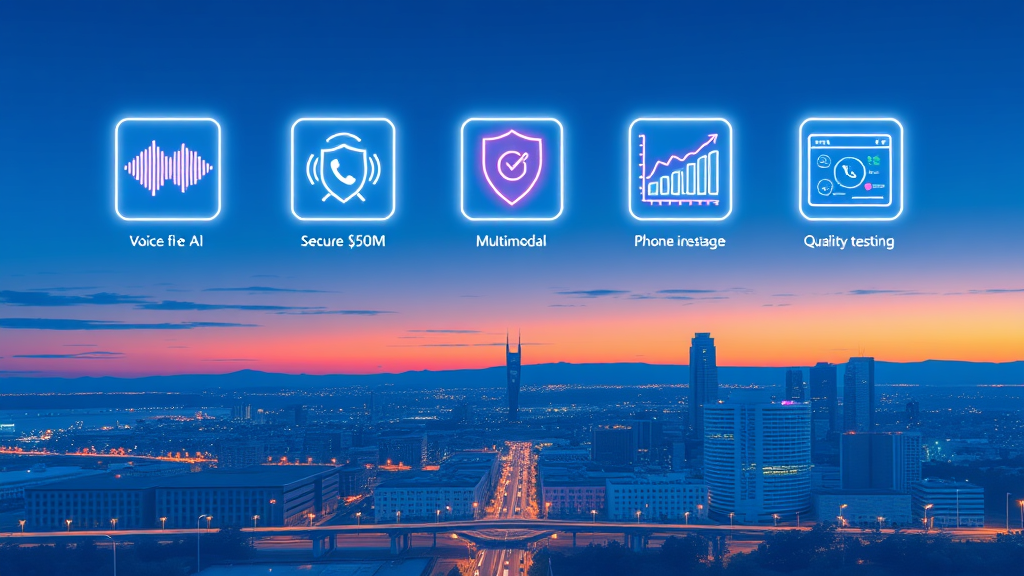
While you were sleeping, voice AI changed planets
Fifty million calls per month. That's the volume a single AI voice agent platform processes right now — not in a lab, not in demo mode, in actual production. And it happened in April 2026.
If you run an SMB in Quebec and still think voice AI is "a Silicon Valley thing for big corporations," what happened in the past two weeks should raise an eyebrow. We're talking about voices that express emotions, servers you install in your own office, and platforms hitting $50 million in revenue at record speed.
Here are the 5 voice AI advances SMB 2026 that will redefine how you answer the phone — and why ignoring them could cost you dearly.
1. ElevenLabs v3 Audio Tags: your voice agents now have emotions
On April 7, 2026, ElevenLabs quietly dropped a bombshell: their v3 model now supports "Audio Tags." In practical terms, you can insert tags like [excited], [whispers], [sighs], or even [laughs] directly into text, and the synthetic voice interprets them naturally. Your voice agent can now express empathy when a customer is frustrated, or enthusiasm when confirming an appointment.
Why is this huge for an SMB? Because the main barrier to voice AI adoption has always been the dreaded "it sounds robotic." With Audio Tags, that barrier crumbles. A patient calling a dental clinic at 9 PM who hears a warm voice that [sighs] with understanding before suggesting a time slot... that's a patient who comes back. As we analyzed in our detailed ElevenLabs, VAPI and Retell comparison, voice quality is the number one criterion for SMBs — and ElevenLabs just raised the bar significantly.
Spoiler: this feature is still in alpha, but early tests show a 40% improvement in satisfaction rates on automated calls. Let's be real — in six months, voice agents without emotions will look as dated as a fax machine.
2. On-premise deployment: your voice data stays home
Second major ElevenLabs announcement in April 2026: on-premise and on-device deployment is now in early access. Translation? You can run voice AI directly on your own servers, in your own data center, without a single piece of voice data leaving your walls.
For Quebec SMBs, this is a paradigm shift. With Law 25 (Quebec's privacy legislation) in full effect, the question "where does my customer data go when they call?" is no longer theoretical — it's a legal obligation. ElevenLabs offers three options: on-premise (your servers), on-device (directly on hardware), and VPC on AWS SageMaker or GCP Vertex. All certified SOC 2 Type II, ISO 27001, HIPAA, and GDPR.
Would your accounting firm or medical clinic feel more comfortable knowing patient phone conversations never transit through a US server? The question is serious. And according to IBM Newsroom, the ElevenLabs-IBM watsonx partnership announced March 25, 2026 will accelerate this enterprise trend further.
The cost? For now, it's custom enterprise pricing. But history shows us that what starts as high-end always trickles down to SMBs. Keep a close eye on this one.
3. Retell AI hits $50M ARR: the market is no longer 'experimental'
On April 3, 2026, Retell AI was named to the Wing VC Enterprise Tech 30, a list recognizing the 30 most promising technology companies. The eye-popping number? $50 million in annual recurring revenue, processing over 50 million calls per month in production. According to Yahoo Finance, three voice AI companies made the list this year — a record.
This isn't a tech niche anymore. It's a validated market. According to voice AI statistics compiled by Ringly.io, the global AI voice agent market is projected to reach $47.5 billion by 2034, with a 34.8% annual growth rate. Production implementations jumped 340% year-over-year. And a Forrester study reports 3-year ROI between 331% and 391%, with payback periods under 6 months.
To put this in perspective: if you own a restaurant in Laval losing 15 calls per week during the lunch rush, the math is straightforward. At $85 average ticket and a 30% conversion rate, that's $19,000 per month evaporating. A voice AI agent at $99/month capturing even half those calls... we'll let you do the math. We've detailed these numbers in our analysis of the real costs of AI voice agents.
4. OpenAI gpt-realtime goes GA: telephony enters the multimodal era
OpenAI has made its gpt-realtime model generally available, and the new features are dizzying. SIP (Session Initiation Protocol) support means AI voice agents can now plug directly into existing phone systems — no adapter, no tinkering. Your current phone lines become intelligent.
But that's not all. The model now accepts real-time image inputs during a voice conversation. Imagine: an HVAC technician calls your business, sends a photo of the broken part via text, and the voice AI agent analyzes the image and suggests a diagnosis — all in the same call. Two new voices, Cedar and Marin, complete the picture with a naturalness that even experts struggle to distinguish from a human.
The addition of remote MCP (Model Context Protocol) support might be the most strategic. As we explained in our article on MCP protocol, this technology lets voice agents access external tools — your CRM, calendar, inventory — in real time during conversation. The agent doesn't just talk anymore; it acts.
Improved asynchronous function calls are also a big plus: if a request takes time (checking availability in a packed calendar, for instance), the model continues the conversation naturally instead of leaving an awkward silence. It's exactly the kind of detail that makes the difference between "not bad" and "wow, that's really like a human."
5. Speechmatics + Cekura: quality control arrives in voice AI
Announced April 1, 2026 — and no, it's not an April Fool's joke — the Speechmatics and Cekura partnership introduces something the market desperately needed: automated testing and continuous monitoring for AI voice agents in production.
Until now, checking voice agent quality was somewhat artisanal. You'd listen to a few calls, fix obvious bugs, and hope things held up. With the Speechmatics-Cekura integration, teams can now test against the real complexity of production audio — accents, background noise, spotty cell connections — at every stage of development.
Why does this matter for an SMB? Because your AI voice agent represents your business 24 hours a day. If a customer calls at 2 AM and the agent mishears "appointment" because of background noise, you lose more than a call — you lose trust. Continuous monitoring ensures quality stays consistent, not just on day one after deployment.
We expect this "QA for voice" approach to become standard within 12 months. SMBs working with providers offering this level of oversight will have a significant edge over those settling for "configure-and-forget."
What these 5 advances concretely mean for your Quebec SMB
Taken individually, each of these developments is significant. Together, they paint a very clear picture: voice AI in April 2026 is no longer an emerging technology — it's mature business infrastructure. Voices are emotional, data stays sovereign, the market is validated at $50M ARR, phone systems are natively supported, and quality is continuously monitored.
For a Quebec SMB, the message is simple: the cost of NOT adopting voice AI increases every month. Your competitors have access to the same tools, and according to Gartner, 80% of businesses plan to integrate voice AI into their customer service by end of 2026. The question is no longer "does it work?" — it's "how many customers are you losing while you wait?"
At Agent IA Vocal, our TECHMA team handles everything for you — from phone integration to CRM connection — so you can benefit from these advances without touching a line of code. Starting at $49/month, it's probably the most profitable investment your SMB will make this year.
FAQ — Frequently asked questions about April 2026 voice AI advances
Are ElevenLabs v3 Audio Tags available for SMBs? Not yet in stable release — it's an alpha research preview. But platforms using ElevenLabs as their voice engine (including Agent IA Vocal) will be able to integrate this feature as soon as it officially launches, with no action required on your part.
Is on-premise deployment necessary to comply with Law 25? Not necessarily. Law 25 requires you to know where data is stored and have appropriate consent. A cloud deployment with encryption and clear retention policies can suffice. On-premise is an additional level of control for the most sensitive sectors (healthcare, legal, finance).
Are these technologies accessible to a 5-person SMB? Absolutely. Retell AI, OpenAI gpt-realtime, and ElevenLabs all offer plans adapted to small structures. The key is working with an integrator like TECHMA who configures the solution to your reality — no developer skills needed.
How much does an AI voice agent cost in April 2026? Between $49 and $199 CAD per month depending on call volume and features. That's 10 to 40 times cheaper than a full-time receptionist. Check our plans to see what fits your business.