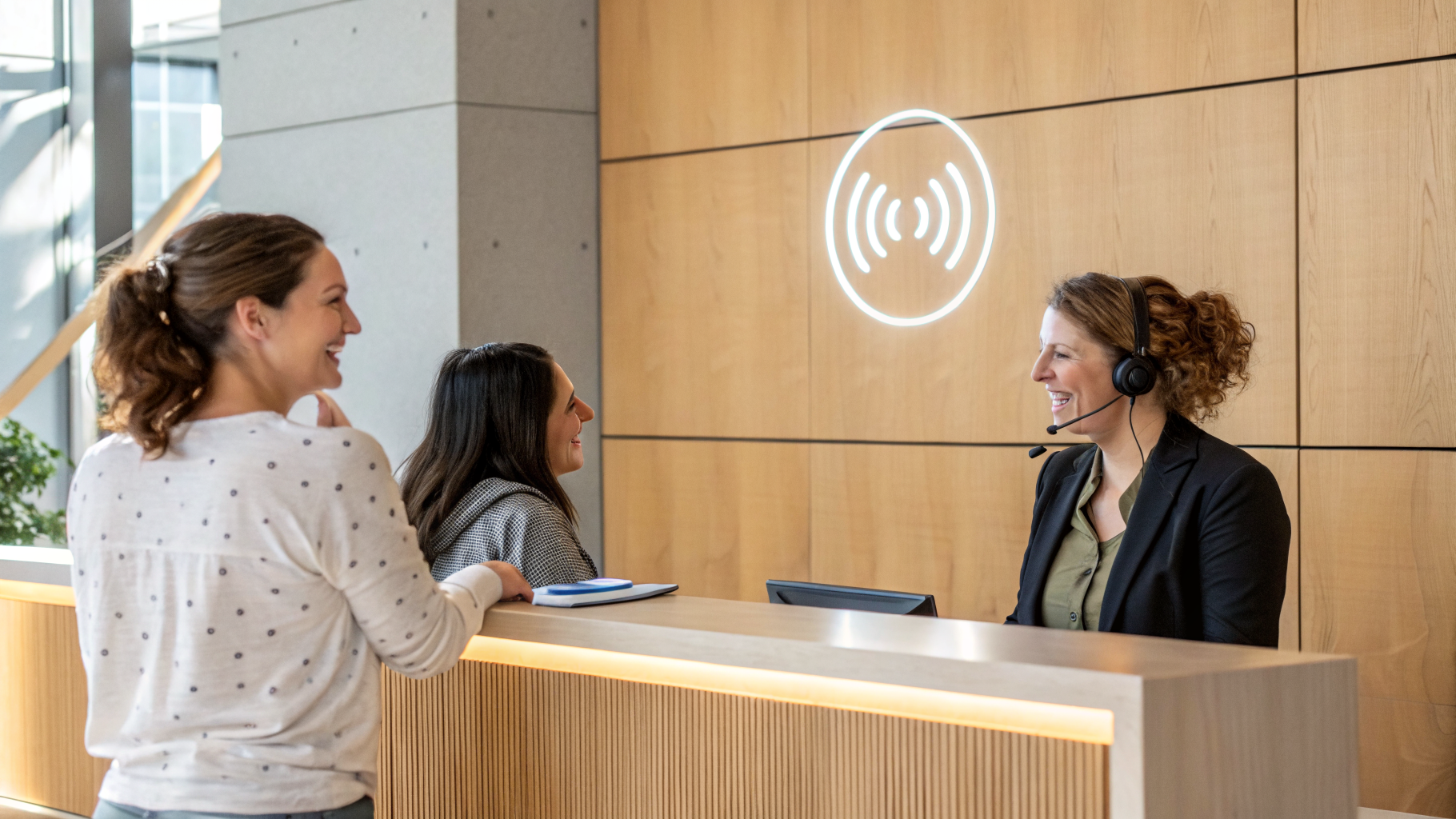
Here's a scene I see every week. A Quebec small business owner — say, an optometry clinic in Laval or a garage in Saint-Hyacinthe — pulls up an Excel sheet: "OK, we're losing calls. We need to fix this. What's the right move?"
Three options on the table: hire a bilingual receptionist, sign with an outsourced answering service, or plug in an AI Voice Agent. Three prices. Three philosophies. Three very different conversations with their accountant come January.
The market has completely reshuffled in May 2026. IBM signed with ElevenLabs in March to bring premium AI voice into watsonx Orchestrate with PCI and HIPAA. Vapi just raised $50M after crossing 1 billion calls. What was an experiment in 2024 is now an enterprise standard. But for the 8-employee Quebec shop, the math stays local: how much does it really cost, and what do we give up in return?
Let's pull out the calculator. No jargon, no inflated promises. Just the numbers you'd see on a December 31 invoice.
Why this matchup matters right now
Quebec's minimum wage moved to $16.10/h, bilingual labor is harder to find than ever, and voice agents can now handle a full call without going off the rails. The comparison isn't "does this work" anymore. It's "what works for you."
And let's be honest: 85% of people who hit voicemail never call back. So doing nothing is also a budget decision — just an invisible one, like a slow leak inside the wall.
Option 1 — The salaried receptionist: $58,000 per year (and that's almost generous)
The classic option. A human at the front desk, phone to the right of the computer, answering calls, booking appointments, smiling at walk-ins. In Quebec, May 2026, here's what the real number looks like:
- Base salary, bilingual: $42,000 to $48,000/yr (Greater Montreal, 2-5 years experience)
- Payroll taxes (QPP, EI, QPIP, HSF, CNESST): about 13-14% of salary → ~$6,000
- Benefits (group insurance, RRSP match): $3,000 to $5,000
- Paid vacation + statutory holidays: roughly 4 weeks off the desk
- Equipment, training, software: ~$1,500/yr
Honest landing zone: $56,000 to $60,000 per year for a full-time role, 40 hours/week. What does that buy you in coverage? Monday to Friday, 8am-5pm. That's about 2,080 hours covered out of the 8,760 hours in a year. Roughly 24% of the time.
The remaining 76% — evenings, nights, weekends, lunch, vacations, snow days — where do your calls go? Voicemail. And we're back to that 85% who never call back.
A practical note: hiring one receptionist also means hiring her risk. Illness, resignation, parental leave — your phone line vanishes for 3 days or 12 months depending on the case. A second hire to provide backup roughly doubles the line item to $110,000+.
Option 2 — The answering service: $18,000 per year (and quality varies wildly)
Hybrid model: an external call center (sometimes in Quebec, often elsewhere) handles your overflow or 24/7 calls. Humans on the other end follow a script and email or text you the summary.
Pricing observed in Quebec, May 2026:
- Basic plan (300 calls/month, business hours): $600 to $900/month
- 24/7 bilingual, ~500 calls/month: $1,200 to $1,800/month
- Premium with booking and CRM integration: $2,000 to $2,800/month
Annualized, that's $14,000 to $24,000. Call it $18,000 as a fair mid-range for standard SMB volume.
The upside: broad coverage, and a bilingual human talking to your customers. The downside: an agent who doesn't know your business, who follows a generic script, and who bills per minute (so a 4-minute call instead of 2 is double the cost). North American benchmarks show these services typically cost 50 to 75% more than an AI solution for equivalent service.
The other blind spot: quality drops between 10pm and 6am. Not out of bad faith — it's just harder to retain a qualified francophone agent on overnight shift. Your customers feel it, even if they can't put words on it.
Option 3 — The AI Voice Agent: $4,800 per year (the realistic scenario)
Here we're talking about an AI voice agent, configured and hosted for your business, that answers 24/7 in your brand voice, with your script and your rules. It books appointments straight into your calendar, routes emergencies to the right person, and pushes call summaries into your CRM.
Actual costs in May 2026 for a typical Quebec SMB:
- Initial configuration (done by our team): $1,500 to $3,500 one-time
- Per-minute usage cost: $0.18 to $0.32/min depending on the platform
- Telephony plan (local number, SMS): $20 to $60/month
- Typical SMB volume (400 calls × 2.5 min): 1,000 minutes/month
Math: 1,000 min × $0.25 = $250 + telephony + amortized setup = around $400 per month, or $4,800 per year. The full per-platform breakdown is here.
Important — and this isn't a marketing line, it's just how we operate: at Agent IA Vocal, our TECHMA team handles the full configuration, the calendar and CRM integrations, and ongoing maintenance. You don't touch JSON or prompts. You give us your greeting script; we handle the rest.
The head-to-head table
Which option fits which SMB — the decision grid
No single answer. Here's how I slice it when talking to an owner:
You receive walk-ins (clinic, salon, workshop)
A receptionist still matters for physical presence. Not for phones. The winning combo in 2026: a versatile on-site employee (without phone duty), plus an AI Voice Agent handling all inbound calls. Net savings: $40,000 to $50,000/yr.
You're a service business with no storefront (consultant, broker, independent plumber)
Answering service or AI Voice Agent — a salaried receptionist makes no sense. Between the two, the AI wins on cost (4x cheaper) and on booking quality (direct calendar integration).
Call volume above 800/month
Answering service becomes prohibitive (>$3,000/month). The AI scales fine. A single receptionist saturates around 60-80 calls per day depending on call length.
Need to handle emotionally heavy cases (mental health, conflicts, claims)
Human. Always. The AI routes to the right person but doesn't process these calls solo.
The Law 25 and Law 96 angle people forget
In Quebec, two constraints that American comparisons never mention:
Law 25 (privacy): every call recording, every transcription, every piece of client data must be handled with clear consent and compliant hosting. An outsourced answering service hosted in the United States puts you in a grey zone. An AI Voice Agent properly configured (Zero Retention mode, Canadian or European hosting, encrypted transcription) solves this cleanly.
Law 96 (French language): your phone line must greet callers in French by default. For a bilingual receptionist, fine. For an outsourced answering service, you pay the bilingual premium (often +20%). For a modern AI Voice Agent, it's native — same French quality as the English side.
Common questions owners ask before committing
What if the AI gets confused on a complex call?
It transfers. Every good deployment includes escalation rules: keywords like "lawyer," "complaint," "emergency," or a request for a manager trigger a live transfer to your team's mobile during business hours, or to a designated on-call number off-hours. The AI knows what it doesn't know.
Can we test before signing a year-long contract?
Yes — and you should. The honest vendors offer a 14 to 30-day pilot on a parallel number with your real script. You measure call quality, booking conversion, and customer feedback against your current setup. If the numbers don't beat your existing process, you walk away.
What happens if our call volume spikes (promotion, holiday rush)?
The AI absorbs it without renegotiating. A receptionist saturates and starts sending calls to voicemail. An answering service tells you next month with a surprise overage line on the invoice. The AI scales horizontally — that's the structural advantage.
The honest verdict
If you're reading this trying to save money without sacrificing quality, the answer in May 2026 leans heavily toward the AI Voice Agent for most Quebec SMBs. The cost-to-coverage ratio is unbeatable, Law 25 compliance is easier to achieve, and French quality has caught up with a human agent for 92% of standard use cases (booking, qualification, routing, FAQ).
But — and this matters — the AI Voice Agent is not a replacement for high-value roles. If your receptionist sells, advises, closes deals, manages VIP relationships: keep her. Plug the AI behind her to absorb routine volume and free her time for the 20% of calls that actually move the needle.
That hybrid model is what most Quebec SMBs are adopting in 2026. And it's not a compromise — it's just good management.
If you want to see what this would look like concretely for your business, reach out. Our team runs the math (free) on your actual call volumes and shows you where the break-even sits in your context — not in some generic American case study.