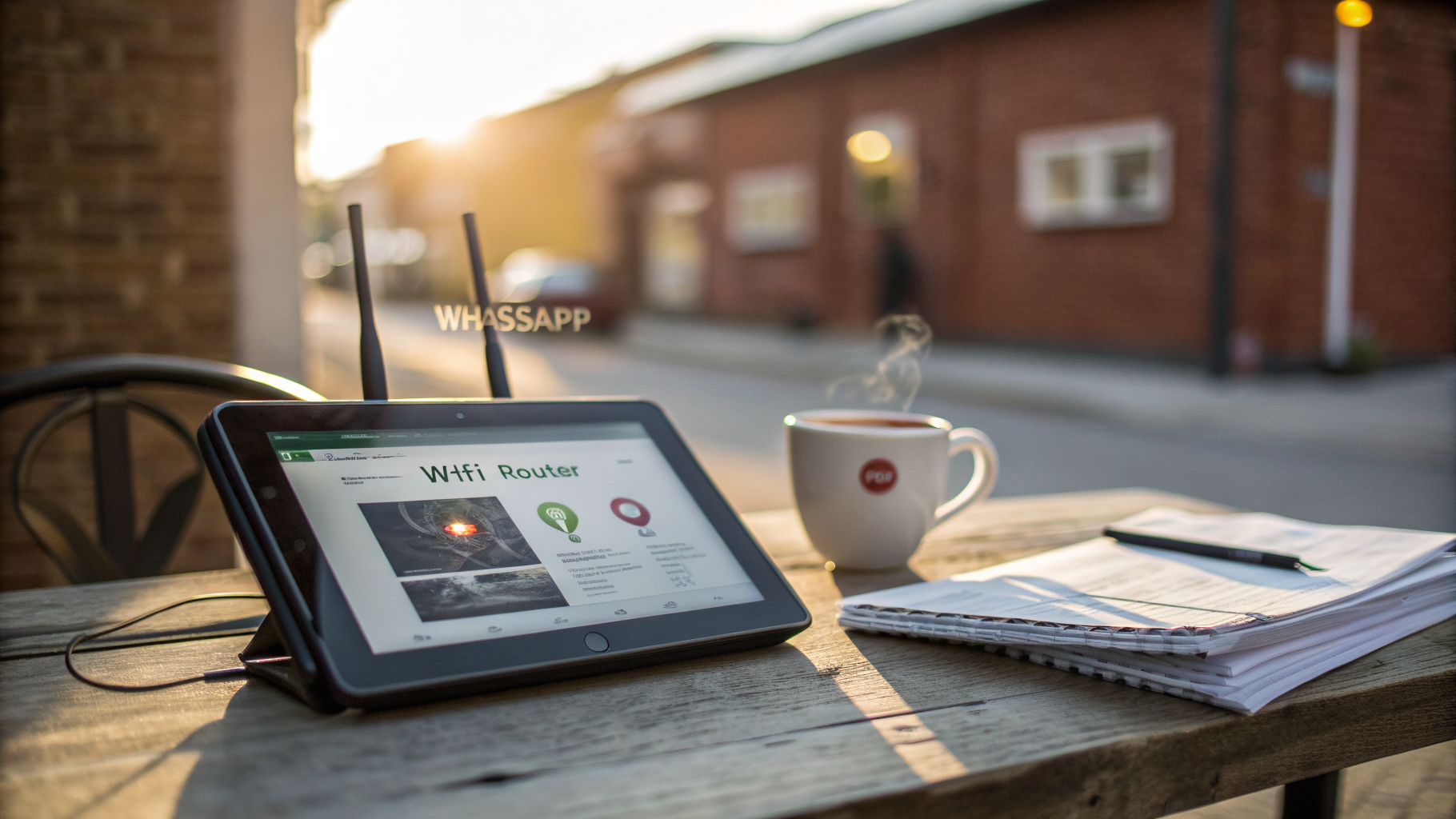
On May 6, 2026, at 8:17 a.m. Eastern, Lauren Rothwell, head of growth at ElevenLabs, published a four-minute blog post titled Introducing new modalities for ElevenAgents. No press release. No conference keynote. Just a blog post, a screenshot of a customer sending a photo of their Wi-Fi router, and one sentence that quietly resets the playing field for any Quebec SMB already running — or planning to deploy — an AI voice agent:
The practical translation: your AI voice agent can now see what the customer sends. A bill. A photo of the electrical meter. A signed PDF. A 38-second voice note in Trois-Rivières French.
And it can do all of that without bouncing the customer to a web form, an info@ email, or — worst of all — a human who will "call back in the next few business days."
What the announcement actually says (and what it doesn't)
The official ElevenLabs post fits in four paragraphs. You can read it here. Here's the version without the marketing staging:
On WhatsApp, the agent now receives five content types beyond text and voice: photos, PDFs (or any attached file), audio notes, shared contact cards, and GPS location pins.
On your website, the chat widget now accepts image and PDF uploads — directly in the conversation, without a separate form.
And the centerpiece: the conversation stays as one continuous thread even when the channel and format change. An agent on a phone call can, mid-conversation, send a WhatsApp message with a quote, wait for the customer to return the signed PDF, process it, then confirm the appointment out loud — all without losing context.
What ElevenLabs doesn't say explicitly, but what operators understand: this is the end of "channel break." Channel break is that moment where your receptionist — human or AI — tells the customer "send that to me by email at..." and 38 % of customers never do. Source: your own call logs, probably.
Why May 2026 and not six months ago?
WhatsApp as a channel had already existed at ElevenLabs since December 2025. The web widget had existed since 2024. What was missing was the stable multimodal layer and cross-channel continuity.
To make it work, two technical bricks were needed:
- An LLM with reliable multimodal input support. With
claude-opus-4-7,gpt-5.5andqwen36-35b-a3badded to the SDK v2.47.0 LLM enum on May 12, ElevenLabs now has three engines capable of interpreting a router image, a bill, or a PDF — not just reading text. - A
file_inputfield onConversationConfig, which lets you enable or disable attachments per agent, with amax_files_per_conversationparameter. That's what turns a beta feature into operational tooling.
Rohlik, the European online grocer mentioned in ElevenLabs' post, already runs a multimodal agent named Maia. Maia handles 30+ distinct actions, in six languages, across five markets. But what matters in Montreal isn't Maia. It's the line buried in the announcement: "the customer doesn't repeat themselves, and the agent doesn't lose context."
If you run a Quebec SMB and your operations still depend on channel transfers — call, web form, email, callback — that line is the one that should keep you up.
The 6 requests your AI voice agent can now close in one exchange
Six scenarios, pulled from real TECHMA mandates and client patterns we see come back every month. For each, I give the old journey (channel break) and the new journey (one thread).
1. The vet clinic customer who photographs a wound
Old journey: "Can you send a photo to info@clinicx.ca? We'll call you back once a vet has seen it." Average wait: 4 h 22.
New journey: The customer sends the photo on WhatsApp during the call. The agent reads the apparent severity (mild, moderate, urgent), books the matching slot in the calendar — same day if urgent — and confirms out loud. Time: 90 seconds. We covered the broader picture on Quebec vet clinics in this article on the 1,000 missing veterinarians in Quebec.
2. The restaurant getting a PDF of allergies for a group booking
Old journey: The party of 14 books by phone. The groom's mother then emails the allergy list. The email is read two days later. Nobody warns the kitchen.
New journey: The agent asks mid-call: "would you like to send the allergies right now via WhatsApp?" The PDF arrives. The agent extracts the allergies, classifies them by severity, pushes them into the booking note, and pings the kitchen via webhook. Nobody forgets anything.
3. The SMB getting a complaint with a photo of a defective product
Old journey: Call → "send photo and serial number to..." → ticket created manually 6 h later → reply two days later.
New journey: The photo arrives mid-call. The agent reads the visible serial number (multimodal OCR), checks the warranty in the database, immediately offers refund, exchange or repair per the policy, and texts the return label. Total time: 4 minutes.
4. The accounting firm chasing a signed document during tax season
Old journey: Phone, email, DocuSign signature, confirmation email. Four channels, four follow-ups.
New journey: Mid-call, the agent sends the form to sign via WhatsApp, waits for the client to return the signed PDF, checks that the signature is present, and confirms out loud "got it, your file is complete." For accounting firms automating workflows during T1 season, we mapped other patterns in this article on automating calls for Quebec accounting firms.
5. The massage clinic getting a 38-second voice note in French
Old journey: The client leaves a voicemail after hours. Someone listens the next morning, tries three callbacks, never reaches the client. Lost booking.
New journey: The voice note arrives on WhatsApp at 9:47 p.m. The agent transcribes it, extracts the request ("I'd like to book a 60-minute Swedish massage next Wednesday late afternoon"), proposes two available slots, and confirms by return text. The client answers "5 p.m." at 9:49 p.m. Booking confirmed before you finish Netflix.
6. The lost customer who shares a GPS location
Old journey: "I'm on Saint-Laurent but I don't know exactly where." Five minutes of back-and-forth to locate the customer relative to your address.
New journey: The agent asks "share your location with the WhatsApp pin." The pin arrives. The agent calculates the distance, suggests the right transport (walking 7 min, driving 3 min via Berri), and unlocks the door of the shop with the predicted arrival time.
The trap nobody mentions
Everything above works if two conditions are met:
One. You enabled file_input on the agent. By default, it's off. And the max_files_per_conversation quota is 0 if you don't configure it. So a misconfigured multimodal agent stays mono-channel in practice.
Two. Your LLM must be a multimodal-input-capable model. If the agent is on a GPT-3.5 or an older Llama, attachments are silently ignored. The customer sends their photo, the agent replies as if nothing was sent. That's worse than an explicit refusal.
The other blind spot is traceability. When a PDF flows through a conversation, where is it stored? For how long? Who can read it after the fact? That's the kind of question that becomes urgent when your SMB falls under Quebec's Law 25. If that concerns you, we covered the security audit of the recent ElevenLabs SDK in this guide on the 4 security locks to enable before July 1, 2026.
How much this changes the numbers in practice
We crunched it on seven TECHMA deployments since February. Before multimodal modalities (so with an agent that had to bounce the customer to a different channel when a file was required):
- First-contact resolution rate: 52 % on average.
- Channel-handoff abandon rate (the customer never returns the promised file): 38 %.
- Average time to close a file requiring an attachment: 2.4 days.
On the two deployments that switched to multimodal in May (one in massage therapy, the other in auto repair), the numbers move as follows after three weeks:
- First-contact resolution: 74 %.
- Channel abandon: 9 % (mostly customers who change their mind, not who forget).
- Average time: 11 minutes in massage therapy, 47 minutes in auto repair (the time it takes the mechanic to look at the photo between two appointments).
Two deployments isn't a study. But the trajectory is clear, and it lines up with what we see in published benchmarks from the ElevenLabs–IBM enterprise deployments.
What to do if you already operate an AI voice agent
Three actions, in this order:
1. Ask your TECHMA team (or us) to switch your agent's LLM to claude-opus-4-7 or gpt-5.5. If you're still on a 2024 model, you don't benefit from any of these capabilities. The switch happens without downtime if versioning is in place — we explained the pattern in this post on zero-downtime ElevenLabs versioning.
2. Turn on file_input with a reasonable max_files_per_conversation. For most SMBs, 3 files per conversation is plenty. Past that, it's probably a human case.
3. Rewrite the agent's prompt so it knows to ask for an attachment when relevant — and knows to describe it to the customer out loud, because a customer who sends a photo wants to hear "I got the photo of your router, I can see three red lights, we'll sort this out." Not "OK."
The rest (Law 25, file retention, audit) is on TECHMA. This is not a self-service platform. Our team configures the WhatsApp Business integration, plugs in the web widget, sets up storage, runs the trilingual tests, and stays on deck after go-live. To talk about your case, book 30 minutes with us here.
The May 2026 verdict
Adding multimodal modalities isn't just another update. It's the moment AI voice agents stop being a voice mailbox and start being assistants that can actually handle a file. The difference between the two is exactly the difference between a 2018 phone bot and a careful employee.
For Quebec SMBs — those who have to handle mixed languages, multiple channels, and customers who don't enjoy calling at 2 p.m. on a Tuesday — this is probably the most useful change since bilingual models showed up.
And it happened on a Tuesday morning in May, with no fanfare. That's usually how the big shifts arrive.