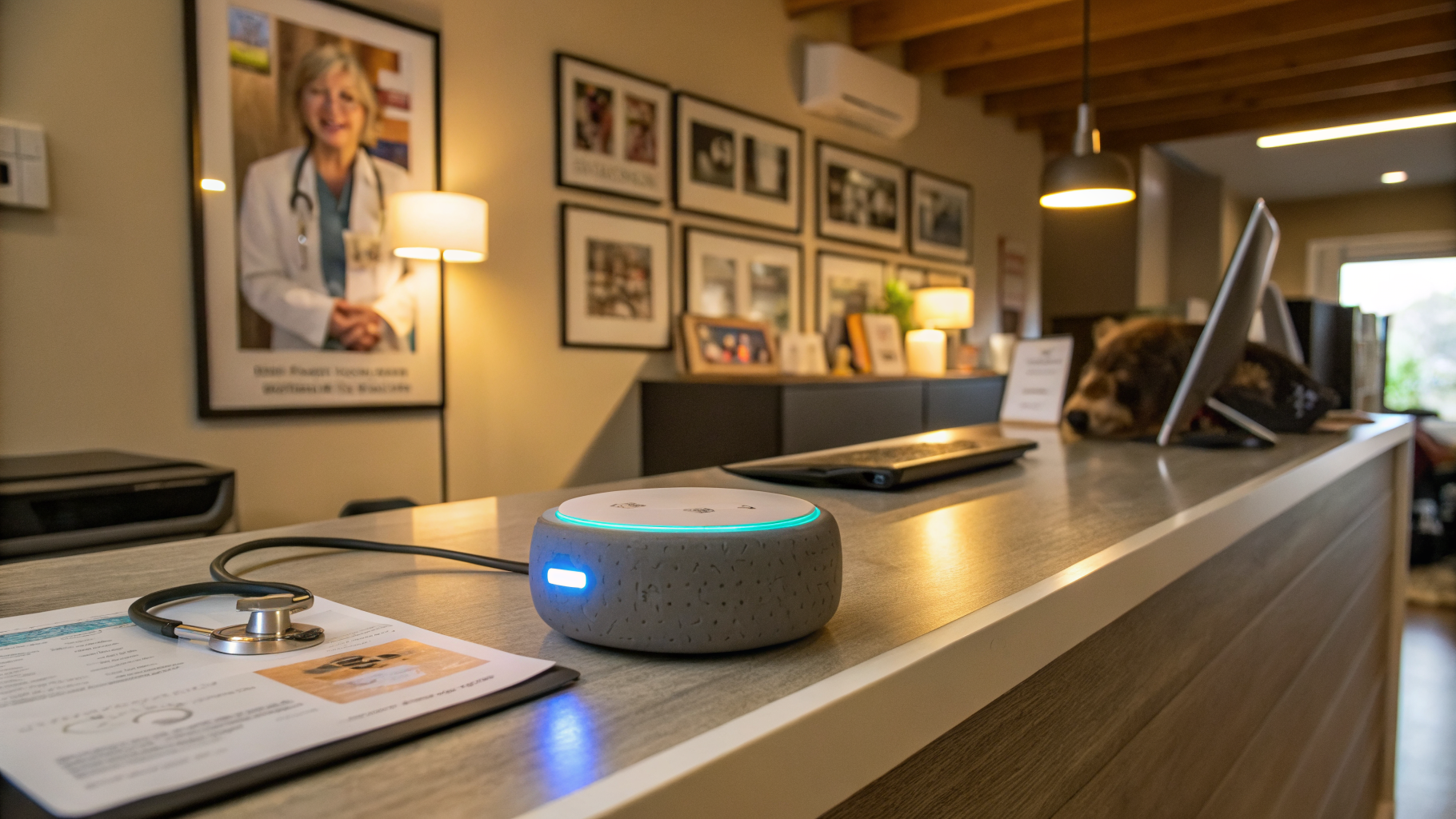
It's 6:15 PM on a Friday evening. Your clinic receptionist just shut down her computer. The phone rings. Nobody answers. A dog owner — calling because his golden retriever has been limping since this morning — hears voicemail and hangs up. Same thing every time. He'll call the clinic down the street tomorrow morning instead.
You just lost a potentially loyal client. And this isn't an edge case.
Industry data shows the average veterinary clinic misses between 20% and 28% of incoming calls during business hours. After closing time, that figure climbs above 70%. And 72% of callers won't leave a voicemail message.
This isn't a motivation problem. It's a structural one. Your front-desk team is managing patients in the waiting room, answering the vet's questions, updating medical files, preparing vaccination reminders — all simultaneously. The phone becomes the last priority.
AI voice agents change this equation. And since May 2026, with ElevenLabs' new Guardrails 2.0, they can do it with precise safety boundaries for medically sensitive conversations. That matters in a veterinary clinic, where owners sometimes call in a panic with an animal in distress.
The reality of Quebec veterinary clinics in 2026
Quebec has over 1,500 veterinary clinics, according to the Ordre des médecins vétérinaires du Québec (OMVQ). Demand has never been higher: the post-pandemic wave of pet adoptions hasn't subsided, and pet owner expectations have shifted. They expect to reach you easily, get quick confirmations, and not wait two weeks for an appointment.
The problem? Labor shortages are hitting front-desk positions hard. Finding and keeping a qualified receptionist costs between $40,000 and $55,000 per year in Quebec — plus benefits. And even with a great receptionist, overflow periods exist: lunch hours, end-of-day rushes, Saturday afternoons.
That's when appointments slip through the cracks. Not because you don't want them. Because nobody was available at that exact moment.
Three types of calls an AI voice agent handles perfectly
One thing to clarify upfront: the AI voice agent is not there to replace your veterinarian. It handles the repetitive telephony layer. Here are the three call categories it manages without complaint.
1. Standard appointment booking
"Hi, I'd like to book an appointment for my cat's annual vaccines." Your agent handles this in 90 seconds: checks availability in your system, confirms the time slot, sends an SMS reminder. No human intervention required.
For clinics using software like Provet Cloud, eVetPractice, or AVImark, the agent integrates directly via API. Appointment confirmations land in the system with nobody lifting a finger.
2. Frequently asked questions
"What are your hours?" "Are you accepting new clients?" "How much does spaying cost?" "My dog ate chocolate last night — is that dangerous?" That last category deserves special attention.
The AI voice agent doesn't play doctor. It's configured to provide the clinic's general information. For medical questions, it redirects to official resources or recommends an emergency consultation based on the severity described. This is exactly where ElevenLabs' Guardrails 2.0 become essential.
3. Emergency triage
When an owner calls at midnight because their cat hasn't eaten in three days, the agent doesn't disconnect. It asks the right questions — how long the symptoms have been present, other signs, age of the animal — and based on the answers, either directs to the nearest emergency clinic, books a priority appointment for the next morning, or sends a confirmation SMS with basic overnight care instructions.
ElevenLabs Guardrails 2.0: why they matter for vet clinics
In May 2026, ElevenLabs completely redesigned its safety layer for voice agents. Guardrails 2.0 now let you define with precision what the agent can and cannot say in sensitive contexts.
For a veterinary clinic, what does that mean in practice?
- No phone diagnoses: the agent is configured to never assert that an animal is healthy or sick. It gathers information and redirects.
- No unrealistic cost estimates: prices vary depending on the animal, procedure, and potential complications. The agent gives ranges or invites the caller to ask for a specific quote.
- Protected language handling: for Quebec's bilingual clinics, guardrails apply identically in French and English. No policy drift between languages.
- Automatic escalation: if a conversation goes off the configured rails — an emotionally distressed owner, a critical emergency — the agent triggers a transfer to a human line or leaves a priority message for the morning team.
The new onGuardrailTriggered callback lets your team see exactly when and why a guardrail activated in the conversation logs. You keep full control.
What it actually costs — in Canadian dollars
Let's talk money. The first question clinic owners always ask: "How much does it cost compared to a receptionist?"
Here's the reality for an average Quebec clinic:
The AI agent doesn't necessarily replace your receptionist — but it eliminates the need for a second receptionist to cover overflow, weekends, and evenings. And it answers 100% of calls, 24/7, no vacations and no sick days.
For a clinic missing an average of 10 appointments per week at $85 each, that's $850 lost weekly — $44,200 per year. Even if the agent recovers just 30% of those calls, the ROI is clear within the first month.
To see how this calculation compares with other Quebec service sectors, read our analysis on Quebec gyms and their missed-call recovery strategy.
Implementation: what happens in the first 30 days
The reality is simpler than most people imagine. Deploying an AI voice agent in a Quebec veterinary clinic typically takes 2 to 4 weeks. The TECHMA team handles everything — you don't need to touch a single line of code.
Week 1 — Basic configuration: define the most frequent call scenarios. For a vet clinic, the list is fairly predictable: appointment booking, price questions, prescription renewal requests, emergencies. Set the tone (professional but warm), primary language (Quebec French), and Guardrails rules.
Week 2 — System integration: connect the agent to the clinic management software, configure the availability calendar, test call transfers. This is the most technical step, done once.
Weeks 3-4 — Testing and adjustment: real calls start coming in. Review the logs, adjust responses that don't sound natural, fine-tune the guardrail thresholds. After two weeks in production, the vast majority of clinics report an autonomous resolution rate above 75%.
The question everyone asks: what if the agent makes a mistake?
That's legitimate. In a medical context, incorrect information can have real consequences.
The short answer: the agent is configured to defer, not improvise. The moment a question falls outside its defined scope, it doesn't guess — it transfers, notes, or escalates. Guardrails 2.0 are precisely there to close every door that shouldn't be open.
Additionally, TECHMA configures your agent with a clear escalation policy: if an owner mentions serious symptoms (breathing difficulties, bleeding, seizures), the agent doesn't try to manage the situation. It switches immediately to a human line or emergency veterinary services.
For more on voice agent security and compliance in Quebec, see our article on the 4 ElevenLabs security locks Quebec SMBs should enable. And if you're still comparing options, our receptionist vs. AI voice agent comparison guide puts all the numbers side by side.
Conclusion: the 6:15 PM Friday call
Back to that golden retriever owner calling at end of day. With a properly configured AI voice agent, here's what would have happened: the agent answers in two rings, evaluates the symptoms (how long the limp has been present, fever, refusing to eat), concludes it's probably not a life-threatening emergency but warrants a priority appointment, offers the first available slot for the next morning at 8:30 AM, and sends an SMS confirmation with overnight care instructions.
Happy client. Appointment booked. Vet informed before even arriving the next morning.
That happens 24/7, 365 days a year — no coffee breaks, no sick days, no summer vacations.
If you own a veterinary clinic in Quebec and want to see how an AI voice agent would work for your specific situation, contact the TECHMA team.