
It's 11 p.m. and the Basement Is Filling With Water
A homeowner in Scarborough hears water running where water shouldn't be. She goes downstairs, finds an inch of it spreading across the floor, and does what anyone does: she grabs her phone and starts calling plumbers. Not one plumber — four, five, whoever comes up first. The first shop that answers with a real, calm voice gets the job. The rest get a callback the next morning, long after the work is booked and the truck is already in the driveway.
This is the part of running a trades business that nobody puts on the website. The marketing is about craftsmanship and fair pricing and showing up on time. But the job is often won or lost in the three seconds before anyone says a word — in whether the phone gets answered at all. For HVAC, plumbing, and electrical shops across Canada, a missed call isn't a minor annoyance. It's the single leakiest spot in the whole operation.
An AI voice agent is one way to plug that leak. Not a robotic phone tree, not voicemail with nicer hold music — a system that picks up on the first ring, talks like a person, figures out whether it's an emergency or a Tuesday tune-up, and books the job while your crew is elbow-deep in someone else's furnace. This is a close look at how that actually works for the trades: what it does, what it costs, where the Canadian rules come in, and where it still needs a human.
Why the Trades Have a Phone Problem Nobody Else Quite Has
Plenty of businesses miss calls. A dental office that misses one loses a cleaning that reschedules anyway. A trades business is different, and it's worth being precise about why.
First, the calls come when nobody's at the desk. Furnaces die on the coldest night, not during office hours. Pipes burst on long weekends. The storm that peels shingles off a roof in Halifax doesn't check whether it's 2 p.m. or 2 a.m. A huge share of trades calls — especially the valuable emergency ones — land after hours, exactly when the phone is least likely to be answered.
Second, the caller is in a hurry and has no loyalty yet. Someone with a flooding basement is not going to leave a voicemail and wait. Surveys of caller behaviour keep finding the same thing: most people who reach a business voicemail hang up without leaving a message, and a large share simply dial the next company on the list. For a brand-new customer with an urgent problem, a missed call usually means a lost customer, for good.
Third, demand is high and crews are stretched thin. Jobber's Home Service Economic Report has tracked rising revenue and new-work volume for the contracting trades through 2026, with homeowners finally moving ahead on repairs they'd deferred. More demand is good news — but it also means your techs are busier, your office manager is juggling more, and the phone rings while everyone's already occupied. The work is there. The question is whether you can catch it.
What One Missed Call Is Actually Worth
It helps to do the arithmetic for your own shop, because the number is usually bigger than people expect. Take a plumbing business with an average job around $450 and an emergency ticket closer to $1,200. Say the phone rings 15 times a day, and five of those calls come in after hours or while the line is busy. If even three of the five are real jobs, and you catch one more per day that you'd otherwise have lost, that's one extra job a day — call it $450 — five or six days a week.
Run that out over a month and you're looking at ten to fifteen thousand dollars of work that was quietly walking out the door, not because your service is bad, but because nobody picked up. These are illustrative numbers, not a promise — plug in your own average ticket and your own missed-call count and the logic still holds. The point is that a missed call in the trades isn't a $0 event. It's an average-job-value event, and sometimes a full emergency-ticket event.
The comparison that matters is cost versus capture. We walked through the real monthly math of the answering options — AI agent, live answering service, and hiring another person — in our cost breakdown for Canadian businesses, and the short version is that the cheapest option is almost never the one that leaves the phone ringing.
What an AI Voice Agent Actually Does on a Trades Call
Strip away the buzzwords and here's the job. The agent answers immediately, every time, including at 3 a.m. and including the fourth simultaneous call during a cold snap, when your one receptionist can only hold one line. It greets the caller in a natural voice, in English or French, and starts working the call the way a sharp dispatcher would.
It triages. "Is anyone in danger? Do you smell gas? Is there active flooding?" A good agent is built to tell the difference between a true emergency and a routine request, and to treat them completely differently. The no-heat call in February gets fast-tracked; the "I'd like a quote on a new water heater sometime" call gets booked into a normal slot.
It collects what your crew needs before they roll: name, service address and city, the nature of the problem, whether they're an existing customer, and how urgent it really is. It books the appointment straight into the calendar or field-service software you already use, texts the caller a confirmation, and drops a clean summary into your system so the tech isn't starting from a sticky note.
And it knows its limits. For anything that smells like a real emergency, or any call that needs human judgment it shouldn't make, it hands off — to your on-call tech, to a live line, to whoever you've told it to reach. Getting that handoff right is its own subject, and we go deep on it in when an AI voice agent should transfer a call to a human.

A ringing phone on a busy trades-business desk with no one free to answer
Three Calls, Start to Finish
Descriptions only get you so far. Here's what the agent actually sounds like on three calls a trades shop gets all the time.
The after-hours emergency. It's 1 a.m. in Winnipeg, –28 outside, and a furnace has quit. Caller: "My furnace just died and the house is already cold." Agent: "Okay, let's get someone to you — are there any children, elderly folks, or pets in the home right now?" It confirms the address, flags the call as a no-heat emergency, connects straight through to the on-call technician's cell, and texts the homeowner that help is on the way. No voicemail. No morning callback to someone who already found another company.
The routine booking. A homeowner in Calgary calls on a Wednesday afternoon wanting their AC looked at before summer. The agent offers the next two open maintenance slots, books the one that works, confirms by text, and notes that the unit is "about 12 years old, making a rattling noise" so the tech brings the right parts. Total time: under two minutes, and your office manager never touched it.
The storm surge. A wind storm hits the south shore and forty people call in two hours. Your receptionist can answer one at a time; the agent answers all of them at once, books the straightforward jobs, and queues the rest with a callback promise instead of a busy signal. That ability to swallow a sudden spike is exactly why we wrote a whole guide on handling seasonal call surges — for the trades, the surge is the business.
The Canadian Rules You Can't Wave Away
Automating phone calls in Canada comes with real obligations, and a vendor who shrugs them off is a vendor to avoid. Two things matter most for the trades.
Outbound calls and texts. The moment your agent starts making calls out — appointment reminders, callback promises, "your part is in" notifications — you're in territory the CRTC governs. The Unsolicited Telecommunications Rules set out what's allowed, including identification requirements and limits on automated dialing. A reminder to an existing customer about their own booked job is a different animal from a cold marketing call, but you still need to know where the lines are.
Consent, recording, and privacy. If the agent records or transcribes calls — most do, and it's genuinely useful — you're handling personal information under PIPEDA, and in Quebec under Law 25. That means telling callers they're being recorded, having a lawful reason to keep what you keep, and storing it responsibly. None of this is a dealbreaker; it's table stakes. Ask any vendor exactly where call data lives, who can see it, and how long it's held.
And one more, quietly important across much of the country: language. In Quebec, serving a customer in French is a legal and cultural expectation, and in bilingual markets from Ottawa to Moncton it's simply good business. An agent that switches cleanly between English and French isn't a luxury feature here — it's the baseline.
AI Agent, Answering Service, or Another Hire?
Shops usually weigh three ways to stop missing calls, and they're not equivalent.
A live answering service puts a human on the line, which sounds ideal, but those humans are usually generalists reading a script for dozens of businesses. They can take a message and maybe book a slot, but they don't know a heat pump from a hot-water tank, they bill by the minute, and they still queue during a surge. Hiring another in-house CSR gives you someone who learns your business — and costs you a full salary, benefits, training, vacation coverage, and turnover, for a desk that's still empty at 2 a.m.
An AI voice agent sits somewhere else: it answers every call at once, never sleeps, costs a fraction of a salary, and — once it's set up with your pricing, your service area, and your rules — speaks to your business specifically. It is not better than a great human on a complicated, emotional, judgment-heavy call. It is far better than voicemail, and far better than a busy signal, which is what it's actually replacing most of the time. For a lot of shops the answer isn't "AI or people." It's the agent catching everything first, and your people handling the calls that genuinely need them.
How Fast Can You Be Live?
Faster than most owners expect, because the hard parts aren't yours to do. You don't configure anything technical. The setup — wiring the agent into your phone line, your calendar or field-service software, and your service rules — is handled for you. At Agent IA Vocal, that integration work is done on our side.
Your job is the part only you can do: telling us how the business actually runs. When is it an emergency versus a next-day job? What's your service area, and what's out of bounds? What are the ten questions customers ask most, and the honest answers? Who should a true emergency reach, and how? Hand over that, plus your current phone setup, and most trades businesses are answering live — on every ring — in well under a day of real work.
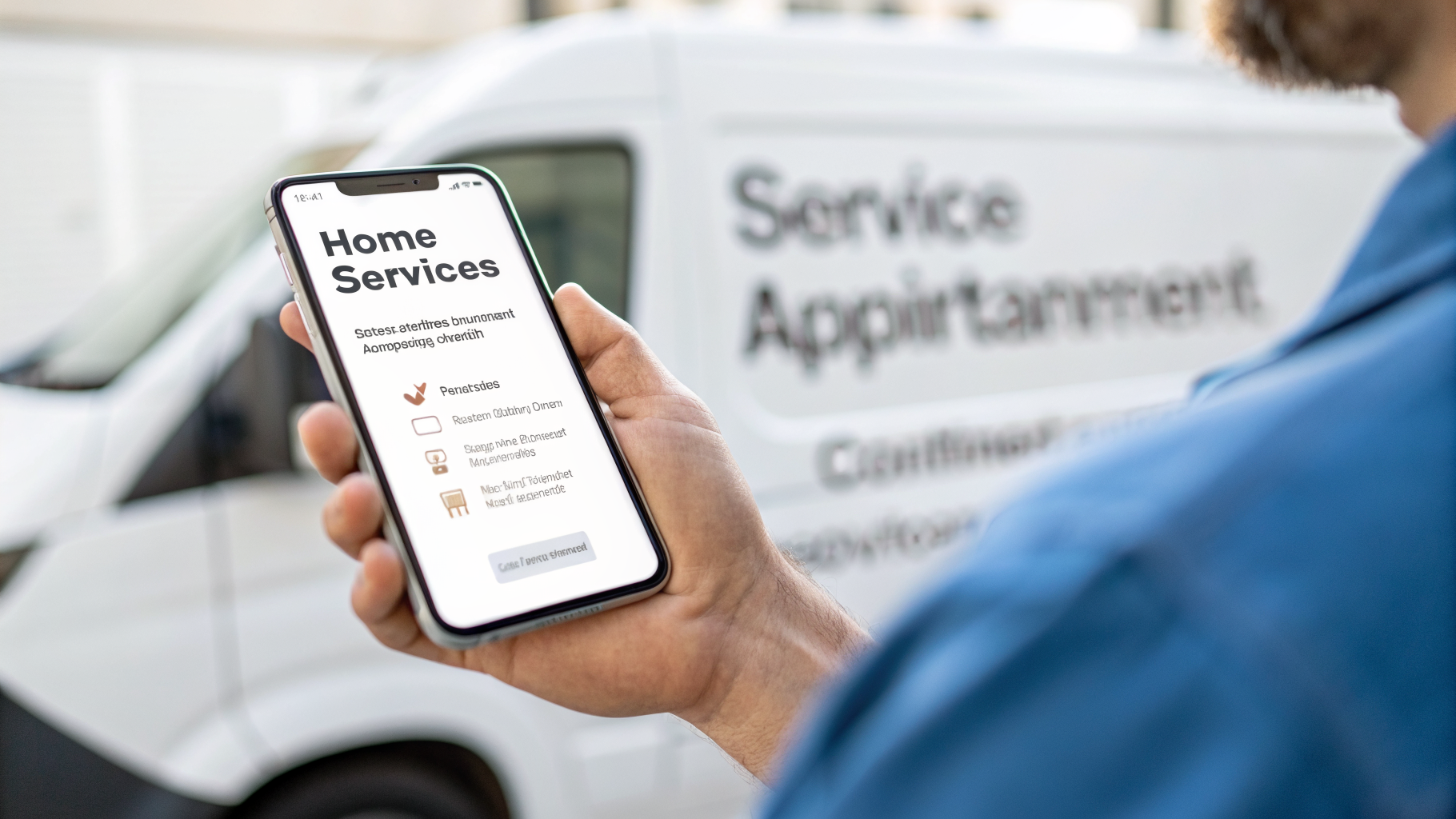
A technician phone showing a service appointment booked automatically
Straight Answers to the Questions Owners Actually Ask
Will it replace my dispatcher or office manager? No, and you wouldn't want it to. It replaces the voicemail and the busy signal — the calls that currently go unanswered. Your people stop chasing missed calls and spend their time on the ones that need a human. Most shops keep their staff and simply stop leaking jobs after hours.
What happens on a real emergency? It's built to catch emergencies first and escalate them immediately — connecting to your on-call tech or a live line rather than booking a "next available" slot for a flooding basement. You decide what counts as an emergency and who it reaches.
Does it work with ServiceTitan, Jobber, or Housecall Pro? The whole point is that it books into the system you already run on. During setup, the integration with your calendar or field-service software is handled for you, so bookings land where your crew already looks — not in a separate inbox nobody checks.
What if it quotes the wrong price? It only says what you tell it to say. For firm pricing it quotes your set rates; for anything variable it does what a good dispatcher does — gathers the details and books a quote rather than guessing. You're never handing a stranger the keys to your pricing.
What does it cost? Pricing usually runs as a monthly plan, often in the low hundreds of dollars a month for a typical trades shop — well below a salary and competitive with a live answering service, while actually catching more. The honest comparison isn't against zero; it's against the jobs you're already losing. One captured emergency ticket a month tends to cover it.
The Bottom Line for Canadian Trades
The trades don't have a marketing problem or a craftsmanship problem. They have a "the phone rang while we were under a sink" problem, and it quietly costs real money every week. The first shop to answer — calmly and competently — tends to win the job, and increasingly that first answer doesn't have to come from a person who's already busy or asleep.
An AI voice agent won't fix a bad business. But for a good one that's simply losing calls, it closes the leakiest gap in the operation: it answers, it triages, it books, and it hands the hard calls to your people. Whether your shop is in Toronto, Calgary, Vancouver, Winnipeg, or Halifax, anywhere the phone rings after hours, that's worth a serious look. The jobs are already calling. The only question is whether anyone picks up.
If you'd like to hear what it sounds like for your specific trade, Agent IA Vocal can set it up with your pricing, your service area, and your rules — in English, in French, or seamlessly in both.