
Miss 40 calls in a month and the math gets ugly fast. If even a handful were new jobs, booked appointments, or urgent after-hours calls, the cheapest-looking phone option can become the most expensive one.
That is why Canadian businesses keep comparing three choices: an AI voice agent, a live answering service, or a full-time receptionist. The sticker price is only part of it. You also have to look at after-hours coverage, bilingual service, missed-call recovery, payroll burden, GST/HST, and whether the vendor bills in CAD or sneaks the invoice through in USD.
Quick answer
As of November 2026, typical market pricing in Canada looks like this: an AI voice agent usually lands around CAD $200-$600/month for managed SMB plans, with extra usage, phone, tax, and setup costs on top; a live/human answering service is often CAD $300-$1,500/month at normal small-business volumes, with premium 24/7 coverage costing more; and a full-time in-house receptionist usually costs about CAD $4,100-$4,350/month all-in, not just wages. All figures here are market ranges in CAD unless noted otherwise. Prices change often, and many AI vendors still bill in USD, so your real Canadian cost may be higher after FX and card fees.
The three options in plain terms
1) AI voice agent
An AI voice agent answers calls automatically, 24/7, using a conversational voice. It can pick up every call, answer common questions, qualify leads, book appointments, route urgent issues, and escalate to a human when needed. For many Canadian SMEs, the appeal is simple: no voicemail pileup, no lunch-break gaps, no missed weekend calls from Toronto, Calgary, Vancouver, Halifax, or anywhere else across time zones.
Some systems are DIY platforms billed by usage. Others are managed services where the vendor builds the call flows, scripts, routing rules, and reporting for you.
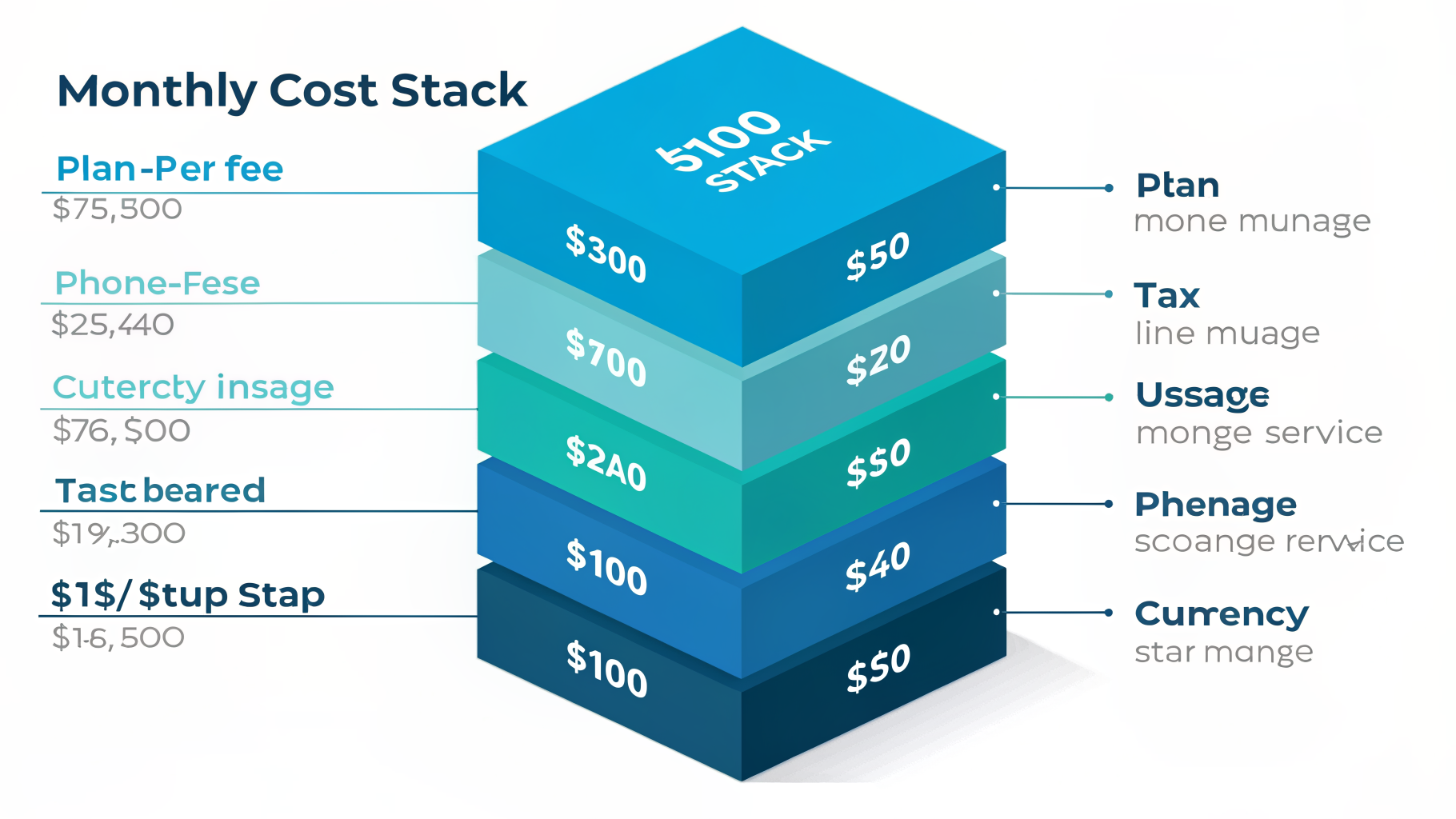
The real monthly cost stack of an AI voice agent, shown as stacked cost blocks
2) Live/human answering service
This is a team of human agents answering on your behalf, usually using a script and basic intake process. They are often better than AI for highly emotional, unusual, or sensitive calls. Think bereavement, legal emergencies, or complicated healthcare situations. The tradeoff is cost. Human time is billed by the minute, and 24/7 coverage gets expensive fast.
3) In-house receptionist
This is the classic front desk or office administrator model: one employee on payroll, working your business hours. A good receptionist can handle calls, visitors, paperwork, scheduling, and all the messy exceptions that make a real office run. But payroll is only the start. Once you add employer CPP, EI, vacation pay, and workers' compensation premiums, the real monthly number is much higher than the hourly wage suggests.
The real monthly cost stack
When business owners compare an AI voice agent vs answering service, they often compare the wrong numbers. They look at the headline plan and stop there.
Bad idea.
Here is the real monthly stack for an AI voice agent in Canada.
Plan fee
Managed or done-for-you SMB plans commonly sit around CAD $200-$600/month as a market range in 2026. That usually covers the base software, a monthly minute allowance, and some level of support. DIY usage-based platforms can be cheaper at low volume, but they require more setup and ongoing tuning.
Per-minute overage
Many plans include a minute bundle. Go over it, and you pay extra per handled minute. DIY platforms often price usage around USD $0.05-$0.15 per minute as a market range. If the vendor bills in USD, your Canadian cost is not just the posted number. You need to factor in exchange rate and card FX charges, which often push the real amount to roughly 1.35x-1.40x the USD figure.
Example: a USD $300 invoice may feel like a CAD $300 plan when you first see the ad. It is not. By the time it lands on your card statement, it can be materially higher in CAD.

Weighing an AI voice agent against a human receptionist
Phone number or telephony line
Some vendors include a phone number or call forwarding setup. Others charge separately for the line, number, or telephony usage. If you are forwarding an existing business line, confirm whether your carrier charges for forwarding minutes too.
GST/HST
Canadian businesses need to look at tax properly. A price quote that says CAD $400/month is not your final invoice if GST/HST applies. The good news: if your business is registered and eligible, you can usually claim the tax back as an input tax credit. Cash flow still matters, though, especially for smaller firms.
USD-to-CAD foreign exchange
This one gets missed all the time. Plenty of AI vendors market to Canada but bill in USD. For a business in Ottawa, Winnipeg, or Victoria, that means your monthly cost moves with FX. If the Canadian dollar weakens, your phone bill rises without the vendor changing a thing.
Setup and configuration time
Even a good managed service needs setup work: greeting, call routing, booking rules, escalation logic, FAQ answers, bilingual prompts, and testing. Sometimes that is a one-time vendor fee. Sometimes it is your own staff time. Either way, it is a real cost.
If you want the agent to do more than answer FAQs, setup matters even more. For example, some businesses want the system to take deposits or collect balances over the phone. That is possible, but it needs the right payment flow and compliance guardrails. This guide on what an AI voice agent can safely collect over the phone is worth reviewing before you assume every vendor handles payments the same way.
The three billing traps to watch for
- Silent auto-upgrade to a higher tier: You cross a usage threshold and get bumped into a more expensive plan.
- Per-minute rounding: Some vendors round each call up. Ten short calls can bill like ten full minutes even if talk time was far lower.
- “Unlimited” plans with fair-use caps: Unlimited often is not truly unlimited. Read the cap, the throttling language, and the overage rules.
Ask to see the exact billing policy in writing. Not a sales summary. The real billing terms.
What a receptionist really costs in Canada
This is where the numbers get more grounded.
According to the Government of Canada Job Bank, receptionist wages for the 2023-2024 reference period show a national hourly low of CAD $16.25, median of CAD $21.00, and high of CAD $29.00, with provincial medians including Ontario at CAD $20.50, Quebec at CAD $20.00, British Columbia at CAD $24.00, and Alberta at CAD $21.00 according to the Government of Canada Job Bank wage data.
Use the national median to build the base case.
Step 1: Base wage
Full-time baseline: about 2,080 hours/year (40 hours x 52 weeks).
CAD $21.00/hour x 2,080 = CAD $43,680/year
That is about CAD $3,640/month before employer costs.
Step 2: Employer CPP
For 2026, the employer CPP rate is 5.95% on pensionable earnings between the CAD $3,500 basic exemption and the Year's Maximum Pensionable Earnings of CAD $74,600, with a maximum employer contribution of CAD $4,230.45/year. On a receptionist earning CAD $43,680, the pensionable amount is roughly:
CAD $43,680 - CAD $3,500 = CAD $40,180
CPP employer cost ≈ 5.95% x CAD $40,180 = CAD $2,390.71/year
That is about CAD $199/month.
Step 3: Employer EI
EI is paid by the employer at 1.4x the employee premium. The exact annual amount depends on the current EI premium formula and insurable earnings cap, but the key point is simple: it is an employer cost on top of wages, not part of the posted salary.
Step 4: Vacation pay
Minimum vacation pay is 4% in most provinces.
4% x CAD $43,680 = CAD $1,747.20/year
That is about CAD $146/month.
Step 5: Provincial workers' compensation
Then add provincial workers' compensation premiums, such as WSIB in Ontario or CNESST in Quebec. The exact rate depends on province and industry classification, but it is still a real payroll burden.
What the all-in number looks like
Taken together, the net effect for a Canadian employer is typically about 12-18% above base wage. That puts a full-time receptionist at roughly CAD $49,000-$52,000/year all-in, or about CAD $4,100-$4,350/month.
And that only covers business hours.
No nights. No weekends. No statutory holiday coverage. No second line answered while your receptionist is already on another call. If your business needs calls covered across multiple time zones or after-hours emergencies, one receptionist does not solve that on their own.
Side-by-side comparison
Break-even by trade
Here is the simplest way to think about phone coverage economics:
Break-even months = monthly cost / (missed-call share x conversion rate x average ticket in CAD)
Or, if you want it in plain English: how much missed business does the phone solution recover, and how quickly does that pay for itself?
A hypothetical example: if a business misses 40 calls/month, converts 1 in 5, and the average job is CAD $250, that is CAD $2,000/month in lost work. Plug in your own call log and average ticket. Do not use someone else's numbers if your business is different.
HVAC or plumbing
Hypothetical: after-hours emergency calls matter, average ticket is meaningful, and speed to answer matters. If you miss even a modest number of calls on evenings and weekends, an AI voice agent can break even quickly because one booked emergency call may cover a large share of the monthly cost.
A live answering service may still win if your calls are messy, urgent, and callers expect a human to triage unusual situations.
Dental clinic
Hypothetical: lots of routine calls about booking, rescheduling, hours, insurance basics, and directions. AI often fits well here because the call patterns are repetitive and bilingual service can matter in cities like Ottawa, Montreal, or parts of New Brunswick. A full-time receptionist still makes sense if you need heavy front-desk coordination and in-person patient flow management.
Law firm
Hypothetical: new-client intake can be valuable, but some calls are sensitive or emotionally charged. AI can capture every call, gather basic intake, and route urgent matters, but a live answering service or trained in-house staff may be the safer choice for criminal, family, or estate matters where empathy and nuance matter more than raw coverage.
Auto repair shop
Hypothetical: callers often ask the same things: hours, availability, towing, inspection timing, basic quotes, and appointment booking. If the shop regularly misses calls while staff are on the floor, AI can be a practical middle ground. One receptionist may be overkill if the front desk workload is mostly phone-heavy rather than in-person admin-heavy.
The Canadian costs the comparison sites forget
Bilingual and French-language obligations
Canada-wide does not mean English-only. Businesses serving customers in Montreal, Ottawa, parts of New Brunswick, and many national markets need French capability. Sometimes it is a legal or contractual expectation. Sometimes it is just good business. Either way, bilingual coverage is not automatic.
Ask whether the system truly supports French and English, not just translated scripts. Accent handling, transfer logic, booking prompts, and voicemail summaries all matter. This overview of bilingual AI voice agents and French-language requirements covers the practical questions to ask.
Privacy, consent, and data residency
If calls are recorded or transcribed, privacy is not a side issue. Canadian businesses need to think about consent language, storage, access controls, and where data is processed. Federal private-sector privacy rules under PIPEDA, as outlined by the Office of the Privacy Commissioner of Canada, are part of that picture.
And yes, callers may need to be told when recording is happening, depending on how your workflow is set up. If you need the practical version rather than the legalese, here is a useful explainer on recording calls legally and handling consent in Canada.
Anti-spam and telemarketing rules
If your phone workflow includes outbound follow-up, reminders, reactivation campaigns, or sales calls, Canadian telecom rules apply. That matters whether a human makes the call or software does. The CRTC's telemarketing and unsolicited telecommunications rules are the baseline reference here.
Why mention this in a cost article? Because compliance mistakes cost time, policy work, and sometimes outside advice. A cheap system that creates regulatory headaches is not cheap.
When each option still wins
There is no universal winner. Here is the blunt decision rule.
Choose an AI voice agent if...
- You miss calls during the day, after hours, or across time zones.
- Most calls are repetitive: booking, FAQs, lead capture, routing, status checks.
- You want 24/7 coverage without paying human-per-minute rates.
- You need predictable coverage for one location or multiple sites across Canada.
This is often the sweet spot for trades, clinics, home services, auto services, and many multi-location SMEs.
Choose a live answering service if...
- Your calls are sensitive, emotional, or highly variable.
- Callers expect empathy and judgment more than speed.
- You need humans to de-escalate, comfort, or interpret unusual situations.
Think funeral services, some legal practices, some healthcare contexts, or complex emergency intake. In these cases, a live service can absolutely be the better option, even if it costs more.
Choose an in-house receptionist if...
- You need a person physically present.
- The role includes visitors, paperwork, scheduling, office coordination, and ad hoc admin.
- Your phone work is only one part of a broader front-desk job.
If someone is greeting clients in person, handling mail, coordinating technicians, scanning forms, and managing the office rhythm, software is not a replacement for that role.
Also, if your call volume is low and mostly during business hours, a receptionist or office admin you already employ may be all you need.
FAQ
Will callers know it is AI?
Usually, many will. And that is fine if the system is honest, clear, and useful. The goal is not to trick callers. The goal is to answer quickly, solve common requests, and hand off cleanly when a human is needed.
Can I cancel without penalty?
Depends on the vendor. Ask about term length, setup fees, minimum commitments, and whether numbers, call flows, and transcripts can be exported. Month-to-month pricing often costs more but lowers risk.
What about unused minutes?
It varies. Some plans include use-it-or-lose-it minutes. Others pool usage or bill strictly by consumption. Ask whether unused minutes roll over and whether overages are billed by the second or rounded up.
Is it worth it under 100 calls per month?
Sometimes no. If your business gets under 100 calls a month, mostly during staffed hours, and you rarely miss them, an AI system may not be the best spend. A simple voicemail-plus-callback workflow, or a part-time admin, may be enough. But if even a small number of missed calls are high-value, the answer can flip quickly.
Is AI always cheaper than a live answering service?
Not always at very low volume. But as call volume, after-hours coverage, and concurrency needs rise, AI often becomes the cheaper option. The key is to compare total monthly cost, not just the entry plan.
Bottom line
For most Canadian SMEs comparing an AI voice agent vs answering service, the real question is not “Which one is cheapest on paper?” It is “Which one answers the calls we actually miss, at a cost that makes sense in CAD?”
The rough 2026 ranges are straightforward: AI voice agent around CAD $200-$600/month plus usage, tax, FX, and setup; live answering service around CAD $300-$1,500/month for typical SMB volumes; and full-time receptionist around CAD $4,100-$4,350/month all-in.
If your calls are repetitive, after-hours matters, and you want every lead answered, AI is often the practical middle ground. If empathy and nuance are central, a live service may be worth the premium. If you need a real front desk, hire the human.
That is the honest version. No hype required.