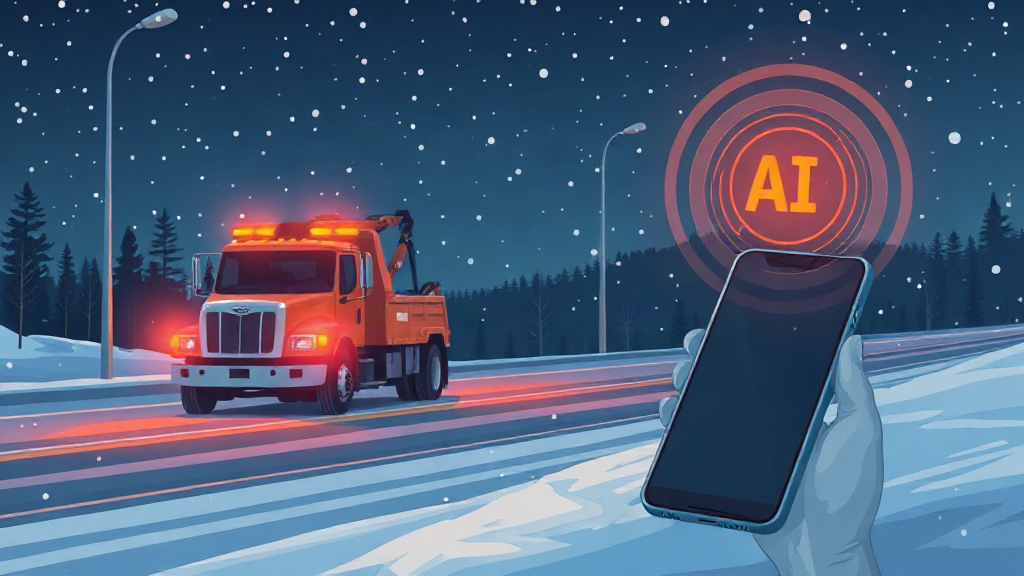
Picture a driver stranded on the shoulder of Highway 401 at 11 p.m. in January. It is minus twenty-two, the battery is dead, the hazard lights are fading, and they want exactly one thing: a tow truck, now. They pull up the first towing company Google hands them and call. It rings. And rings. Nobody picks up, because your one night driver is already forty minutes away, under a car with a winch cable in his hands. So the stranded driver does the obvious thing. They hang up and call the next number on the list.
That is the whole business, right there. In towing, the phone is not a marketing channel. It is the job. And of every trade in Canada, towing might be the hardest one to actually answer, because the calls land at the worst hours, in sudden bursts, while the only person who could pick up is busy doing the very thing the caller is paying for.
This is exactly the gap an AI voice agent for towing companies is built to close. Let us walk through why towing is such a brutal phone business, and what changes when software answers every single ring.
Why towing is the hardest phone in the trades
Most businesses have a rush and a lull. Towing has neither and both. A call can come at 3 a.m. on a Sunday, or in a wall of fifteen at once when a squall hits the Trans-Canada. There is no "business hours" to hide behind, because breakdowns do not keep office hours.
Then there is the cruel math of a small towing operation: the person best equipped to answer the phone is the driver, and the driver cannot take a call while backing a flatbed up to a wrecked sedan on an icy ramp. Every minute he spends fumbling for the phone is a minute he is not hooking the car, and every call he lets ring is a customer gone. A plumber can call you back in an hour. A stranded, freezing driver will not wait ninety seconds.
Voicemail does not save you either. A person shivering on the shoulder is not leaving a message and hoping for a callback. They are already dialing the next tow company while your greeting plays.
The cold-snap problem no dispatcher can out-staff
Canadian winters turn this from a steady trickle into a flood. When a deep freeze settles in, dead batteries and no-starts spike across the country at the same hour, and roadside demand goes vertical. CAA clubs regularly flag their busiest days of the year during cold snaps, with call volumes jumping well past normal as the temperature drops. CAA-Québec has reported full-throttle stretches through frigid holiday periods where the phones simply do not stop.
Here is the problem with staffing for that: you cannot. Hiring enough humans to answer a once-a-month surge means paying them to sit idle the other twenty-nine days. So most towing shops understaff the phones, eat the missed calls on the busiest nights of the year, and watch the jobs they most needed go to whoever answered. The surge is precisely when every call is worth the most and precisely when you are least able to catch them.
What an AI voice agent actually does on a tow call
This is where it stops being abstract. A well-built AI voice agent answers on the first ring, every time, no matter how many calls hit at once, and it does not panic at fifty simultaneous callers because it simply handles all fifty. On a towing call, in under a minute, it can:
- Pin down the location — highway and direction, nearest exit or landmark, parking lot, or a full address. For a rattled caller, it can ask the specific questions a dispatcher would.
- Get the vehicle and the situation — make, model, colour, and whether this is a flat, a lockout, a dead battery, a winch-out of a ditch, or an accident recovery.
- Capture a callback number and the destination the vehicle needs to go.
- Dispatch it — text or push the job straight to the on-call driver with all the details, and give the caller a realistic ETA instead of dead air.
The caller gets answered and reassured in the moment that matters, and your driver gets a clean job ticket on his phone instead of a half-heard address yelled over a running engine. That alone is the difference between catching the job and losing it. If round-the-clock coverage is the piece you are missing, we go deeper on it in our guide to 24/7 phone support with an AI voice agent.
The bilingual reality, and a panicked caller's first language
Here is something that matters more in roadside than almost anywhere else: when people are stressed, scared, and cold, they revert to their first language. A driver who gets by in English on a good day will switch to French the second adrenaline kicks in — and a tourist stuck outside Mont-Tremblant may have no second language to fall back on at all.
For a towing company serving Quebec, this is not just good service, it is the law. Businesses operating in Quebec must be able to serve and inform customers in French under the Charter of the French Language. But even for a company in Ontario, Alberta, or the Maritimes, the practical point stands: a lot of your winter callers are not locals. They are travellers, truckers, and visitors, and the one who can be understood is the one who gets helped. A good AI voice agent handles the call in French or English from the first word and switches mid-call the instant the caller does, with no transfer and no hold — something no single bilingual dispatcher can guarantee at 2 a.m.
The money: what one missed tow is actually worth
Run the numbers and the case gets uncomfortable. A basic hook-and-tow typically bills somewhere between $100 and $300 depending on distance, and an accident recovery or a winch-out climbs well beyond that. Miss the call, and you do not lose a message — you lose the entire job, plus the repeat business if that driver liked how it went, plus the five-star review they would have left.
Now weigh the fix. A full-time overnight dispatcher is a real salary for coverage you only fully use a few nights a month, and even then it is one person taking one call at a time. A live answering service bills by the minute and still queues your caller behind other businesses during exactly the cold-snap surge when speed decides everything. An AI voice agent is a flat, predictable monthly cost — usually a fraction of a single night dispatcher — that answers unlimited simultaneous calls and never sleeps through the busy season. We lay out the full pricing picture in our breakdown of what an AI voice agent really costs in Canada, and the seasonal angle in our look at handling seasonal call surges.
Where a human still has to take the wheel
None of this means you fire the dispatcher and point the phone at a robot. Towing has calls that genuinely need a person, and pretending otherwise gets someone hurt.
An accident with injuries is a 911 call first, and an AI agent should be built to recognize that and say so, not try to book a tow while someone is bleeding. Complex jobs — a loaded transport truck off the road, a multi-vehicle pileup, coordinating with police and an insurer on scene — need human judgment and a phone call between people. And a caller who is frightened or furious sometimes just needs to hear a steady human voice.
The setups that work treat the AI as the front line, not the whole line. It answers everything instantly, handles and dispatches the routine breakdowns that make up most of your volume, and escalates or warm-transfers the calls that need a human to the right person. You get every call answered and your people spending their time only where it counts.
Setting one up without dropping a call
A few things separate a towing agent that earns its keep from one that frustrates callers. Make sure it captures location carefully, because a wrong exit number sends your truck the wrong way down a divided highway. Connect it to how you actually dispatch, whether that is an SMS to the driver or your dispatch software, so jobs do not die in an inbox. Mind the privacy side too: you are recording calls that include names, numbers, and locations, which means telling callers they are being recorded and handling that data under PIPEDA and, in Quebec, Law 25. And keep your existing number — the whole point is to answer the line your customers already dial.
The bottom line
Towing lives and dies on the next call, and the next call always seems to come when your driver already has both hands full. A live dispatcher helps, but you cannot staff for a cold-snap surge, and voicemail just hands the job to your competitor. An AI voice agent answers every ring instantly, in French or English, captures a clean job, dispatches it to your driver, and never once sleeps through the busiest night of the year.
For a Canadian towing company, the test is simple: count the calls you miss on a single bad-weather night, multiply by what an average tow is worth, and ask whether you can afford to keep handing those to the shop down the road that answered first.