
Picture a customer calling your shop while driving home on the 401, radio murmuring in the background, a kid in the back seat. They start explaining what they need, pause for half a second to change lanes — and your shiny new AI voice agent barrels right over them, answering a question they never finished asking. By the third interruption, they hang up and call a competitor.
This is the quiet failure mode nobody demos. Vendors show you the agent booking an appointment in a silent studio. Real Canadian phone calls happen in trucks, kitchens, warehouses, and busy reception areas. If your AI voice agent can't handle a caller pausing to think — or a TV playing in the next room — it doesn't matter how natural it sounds. It will lose you business.
Why AI voice agents talk over people in the first place
The interruption problem gets blamed on latency or "bad AI." It's usually neither. Handling interruptions cleanly is a systems problem, not a personality flaw. Every real-time voice agent runs a small pipeline that decides, moment to moment, who has the floor — the caller or the machine. When that pipeline is tuned wrong, the agent either steamrolls the caller or freezes awkwardly waiting for silence that never comes.
At the front of that pipeline sits something called Voice Activity Detection, or VAD. While the agent is speaking, VAD continuously scores the incoming audio — typically every 10 to 30 milliseconds — and tries to answer one question: is a human talking right now, or is that just noise? Get it right and the agent yields the floor the instant the caller jumps in. Get it wrong and you get the two failure modes every business owner has heard on a bad automated line.
Failure mode one: the steamroller
The caller pauses mid-sentence to gather a thought. The agent reads that half-second of silence as "my turn," and launches into the next scripted line. The caller starts talking again, the agent keeps going, and now two voices are stepping on each other. Frustrating on a good day, a dealbreaker when someone is trying to give you a credit card number or a delivery address.

AI voice agent talking over a caller, shown as two overlapping speech bubbles
Failure mode two: the noise-triggered stumble
The opposite problem. A door slams, a colleague laughs across the room, or the caller's dog barks — and the agent mistakes that noise for the caller interrupting. It stops mid-sentence, gets confused about where it was, and either repeats itself or trails off. Engineers call this a "false barge-in," and background noise is one of its most common triggers.
Barge-in: the feature that separates good agents from demos
The technical name for "let the caller interrupt naturally" is barge-in. It matters because people don't wait politely for a recorded voice to finish. They answer early, they correct the system, they blurt out their order the moment they hear "How can I help?" A voice agent that can't be interrupted forces callers to sit through the whole scripted line before they can speak — which feels exactly like the old phone trees everyone hates.
Good barge-in isn't just "stop talking when you hear a sound." A well-built system separates true interruptions from backchannels — the little "uh-huh," "yeah," "mm-hmm" noises we make to show we're listening. If the agent halts every time a caller says "right," the conversation stutters. If it ignores a real interruption, the caller feels unheard. The whole game is telling those apart in real time, and it is a well-documented engineering challenge with established best practices.
The 2026 benchmarks worth knowing
You don't need to become an audio engineer, but a few numbers give you a vocabulary for holding vendors accountable. Independent testing through 2026 has converged on a rough production standard for what "good" interruption handling looks like: a turn-taking gap of roughly 200 to 400 milliseconds between when the caller stops and the agent responds, a false barge-in rate below 2 percent, and a time-to-stop of under 60 milliseconds once the agent detects a real interruption. (For the underlying mechanics, this practical guide to voice activity detection is a solid primer.)
Those numbers translate into plain experience: the agent waits a natural beat before replying, almost never chokes on background noise, and stops fast when you genuinely cut in. When comparison tests injected coughs, mid-sentence pauses, and deliberate interruptions, the gap between platforms was real — the top orchestration frameworks scored around 4.9 out of 5 on handling those scenarios, while weaker setups fumbled noticeably more often. The point isn't the leaderboard; it's that this is measurable, and you can ask for the measurements.
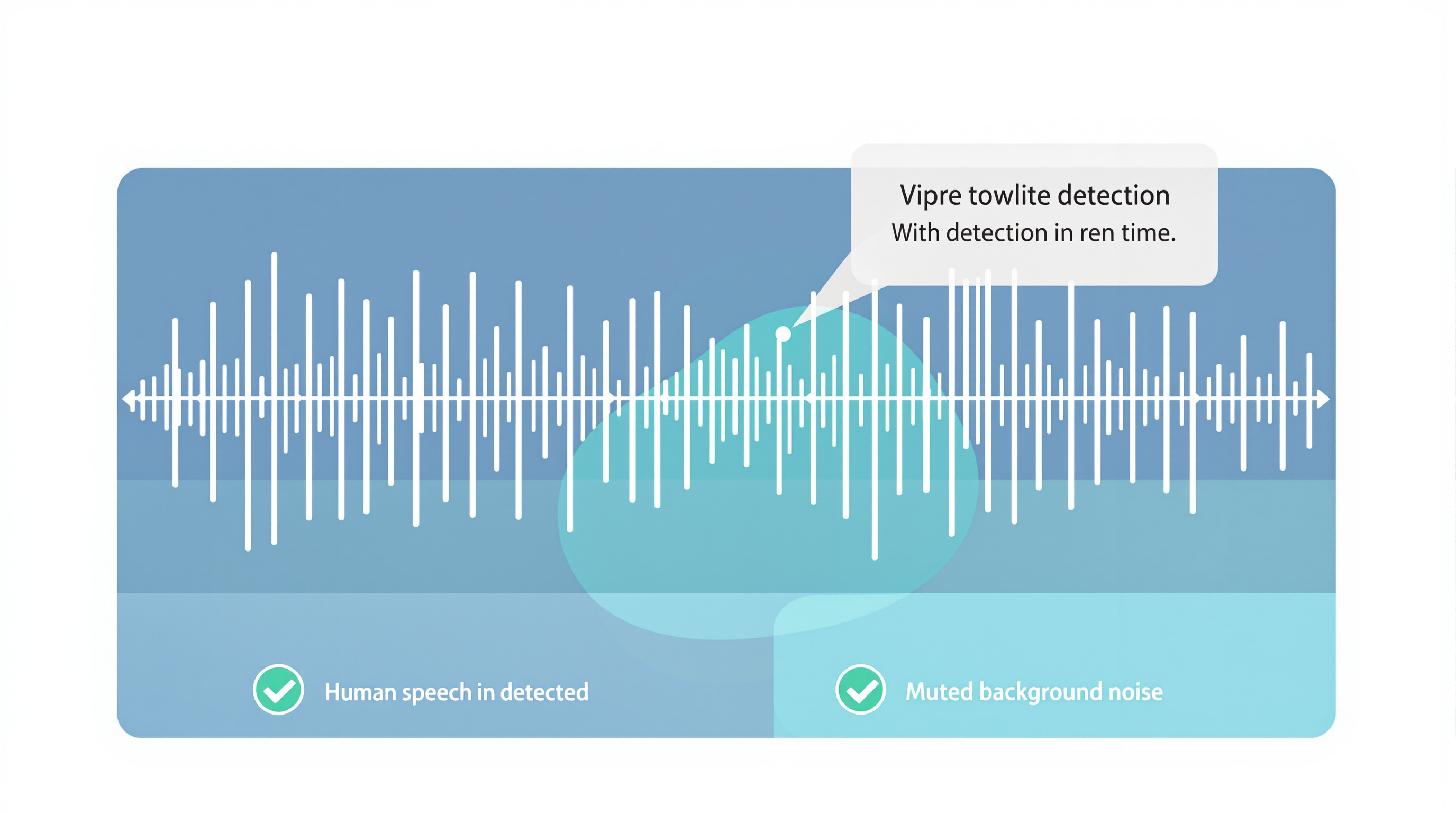
Voice activity detection scanning an audio waveform to separate speech from background noise
What changed in 2026 to make this fixable
Here's the good news: this used to be a hard, custom-engineering problem, and in 2026 it has largely moved into the platform layer. In its August 2026 update, ElevenLabs added explicit voice-activity-detection controls to its agents, including a background-voice-detection setting designed to stop the agent from treating a TV, a coworker, or a second person in the room as the caller. Other stacks now ship noise cancellation that scrubs background distractions before the audio ever reaches the detection layer, plus backchanneling that lets the agent murmur a quick "got it" so callers feel heard without derailing the turn.
Translated for a business owner: the tools to fix interruptions and noise now exist as settings, not science projects. Whether they're switched on and tuned for your environment is a different question — and it's the one you should be asking.
How to pressure-test an agent before it answers your phone
You don't need a lab. You need a few deliberately messy test calls and a willingness to be annoying on purpose. Before you let any agent handle real customers across your locations — whether that's a clinic in Halifax or a contractor's cell in Calgary — run it through these:
- The pause test. Start a sentence, then stop for a full second in the middle, like you're thinking. Does the agent wait, or does it jump in and cut you off?
- The background test. Call from a room with a TV or radio on, or with someone talking nearby. Does the agent stay locked on you, or does it stumble every time it hears the other voice?
- The interrupt test. While the agent is mid-sentence, cut in with a new question. Does it stop cleanly and follow you, or does it finish its script first?
- The backchannel test. Say "mm-hmm" and "right" while it talks. Does it keep its flow, or does it stop dead every time?
If it fails these in a quiet office, it will fail worse in the field. And if a vendor won't let you run these tests before signing, that tells you something too.
Why this matters more than the voice sounding "human"
It's tempting to shop for AI voice agents the way you'd shop for a voice actor — pick the one that sounds warmest and most natural. But a silky voice that talks over your customers is worse than a plain one that listens well. Interruption handling is where callers decide, in the first fifteen seconds, whether they're dealing with a competent system or a robotic wall.
This is also why interruption quality feeds directly into the things you actually care about. An agent that listens cleanly captures more bookings because it doesn't frustrate people into hanging up. It handles multilingual calls more gracefully, since accents and code-switching put extra strain on turn detection. And when you weigh the cost of an agent versus a human receptionist, remember that a good receptionist never talks over a customer — so your bar for the machine should be at least that high.
A quick word on latency versus listening
One trap worth naming: a faster agent is not automatically a better listener. Some platforms chase raw speed and end up more eager to jump in, which actually raises the odds of steamrolling a caller mid-thought. The agents that feel best on the phone are often the ones that wait a deliberate beat, absorb a little background noise without flinching, and only then respond. When you evaluate a vendor, ask not just "how fast is it" but "how does it decide the caller is actually done talking." That second question is the one that separates a system people trust from one they fight with.
The bottom line
An AI voice agent that interrupts callers or panics at background noise isn't a minor rough edge — it's the difference between a system your customers trust and one they route around. The technology to handle interruptions well exists in 2026, and the benchmarks to judge it are public. Before you put an agent on your line, make it survive a few messy, realistic calls. If it can hold a conversation while a caller pauses, thinks, and interrupts — the way a good human would — you've got something worth answering your phone. If it can't, no amount of natural-sounding speech will save the call.
Want to hear how an agent handles a real, messy Canadian phone call — interruptions and all? Book a live demo and try to trip it up on purpose.