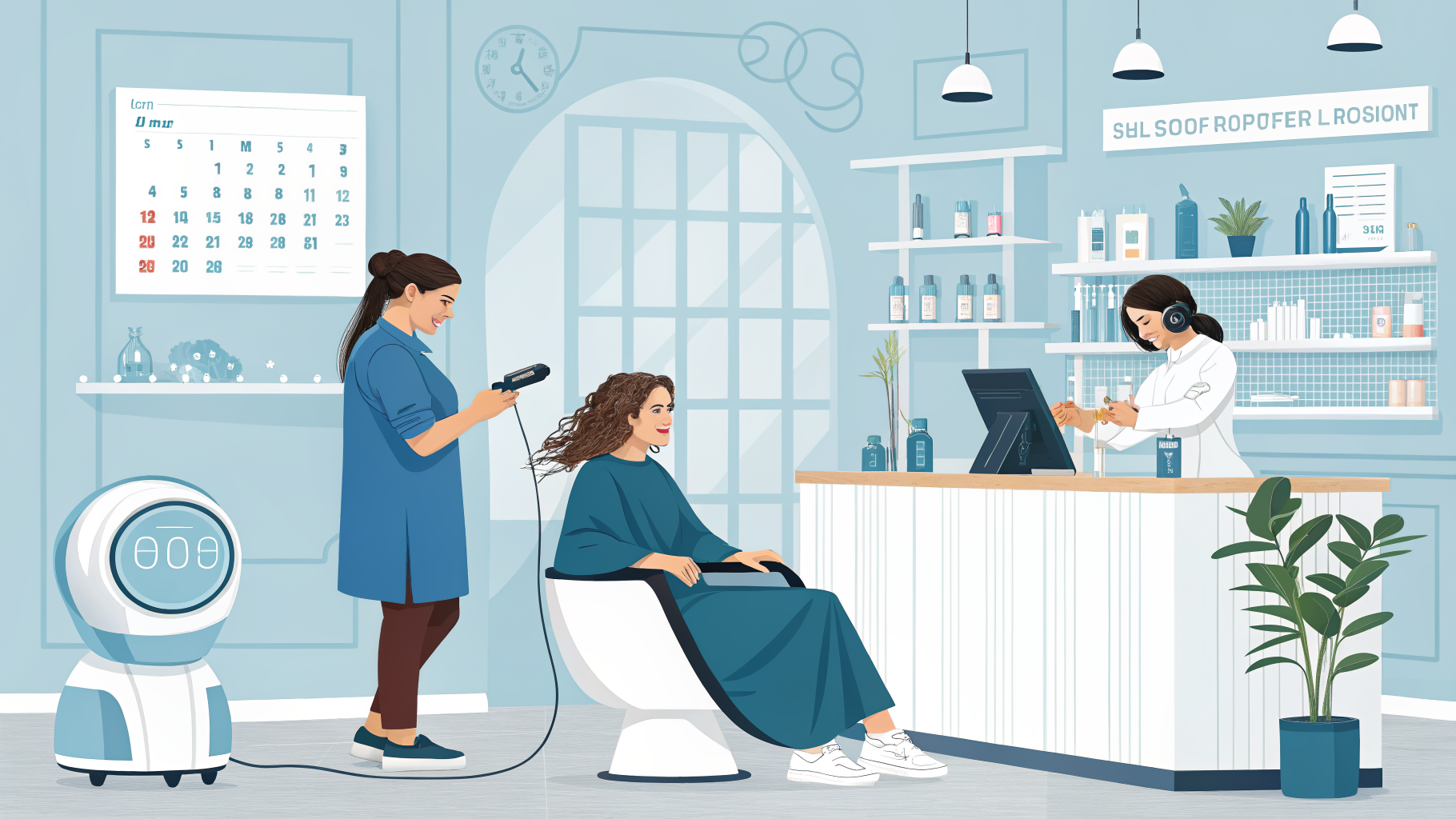
The salon paradox is painfully simple: the more productive your floor is, the less available anyone is to answer the phone. An AI voice agent for salons (Canada) matters most when your team is mid-cut, mid-colour, in a treatment room, cashing out retail, or running behind on a packed Saturday. In Toronto, Vancouver, Calgary, Ottawa, Halifax, and everywhere in between, the calls that come in during peak chair time are often the calls most likely to go unanswered.
Picture a Friday at 4:40 p.m. One stylist is foiling a colour correction, another is finishing a blowout, the esthetician is in a facial room, and front desk is helping a walk-in buy product. The phone rings. Then again. Then stops. That caller may have wanted a same-day bang trim, a spa gift card, or to book a bridal trial for next month. Instead, they move on to the next salon in search results.
North American industry research has been pointing in the same direction for a while: a large share of salon and spa calls go unanswered during business hours, and roughly 69% of clients have abandoned a booking because reaching someone was too difficult. See the call-volume findings from BookingBee and the missed-call client-loss analysis from Hyperleap. So yes, your busiest hours are often your weakest phone hours — and that gap costs money.
Why this problem is so common in Canadian salons and spas
Salons and spas are operationally intense businesses. A men’s cut may take 30 minutes, a blow-dry 45, a balayage two to three hours, and a medspa consultation even longer depending on the service mix. During those blocks, staff are not “sort of available.” They are physically tied to clients, tools, timing, and service quality. Even salons with a dedicated receptionist still hit bottlenecks when call volume spikes during lunch, after work, weekends, and seasonal rushes.
Canadian salons also deal with a broader communication reality than many owners plan for. Across six time zones, clients call at all kinds of hours. In major cities, callers may expect service in English, French, or another language-accented conversation style that still needs patience and clarity. In Ottawa, Montreal-adjacent markets, and bilingual customer corridors, language flexibility matters. In Vancouver or Toronto, multilingual households often call on behalf of family members. The phone isn’t just a phone; it’s your first service experience.
Client expectations have changed too. People want to book quickly, reschedule quickly, and get confirmation without friction. If they have to call twice, leave voicemail, or wait until someone is free, many simply won’t bother. Zenoti’s 2025 consumer booking and communication research for the salon and spa sector reinforces how strongly convenience and responsiveness influence booking decisions in its industry survey. In other words, speed is no longer a nice-to-have; it is part of the service itself.
How an AI voice agent works in a salon or spa environment
An AI voice agent answers incoming calls instantly, speaks naturally with callers, understands intent, and completes a defined task. In a salon or spa, that usually means booking an appointment, moving an existing booking, confirming hours, explaining location details, answering common policy questions, taking a qualified message, or transferring urgent situations to the right person.
The important part is context. A salon is not a generic business with one appointment type. It has cuts, root touch-ups, full colour, gloss, extensions, beard trims, lash services, nail appointments, facials, laser consultations, massage bookings, and gift-card questions. Each service may require a different duration, staff skill set, room type, deposit rule, or prep note. A well-configured agent can be set up around those real-world rules instead of forcing your business into a flimsy script.
It can also connect with the booking tools salons already use, such as Vagaro, Mindbody, Square, Fresha, or Boulevard, while TECHMA handles the setup and integration work for you. That point matters: this is not a DIY software burden dumped on a salon owner after hours. If bilingual call handling is part of your operation, this article on bilingual AI phone service gives useful background, even for Canadian businesses outside Quebec using the same infrastructure.
Where automation delivers the fastest ROI for salons
First: recovering missed calls during peak service hours. Many salons lose 30% to 40% of incoming calls during business hours simply because staff are occupied with clients. An AI voice agent can answer 100% of calls and recover roughly 35% of opportunities that would otherwise disappear. If your salon receives 400 calls a month and just 30 recovered bookings average $80 each, that is $2,400 in protected revenue before you even factor in repeat visits.
Second: reducing no-shows and late cancellations. In beauty and wellness businesses, no-show rates often land between 15% and 30%, especially for longer or premium services booked well in advance. Automated reminders, confirmations, and easy rescheduling can push that number closer to 5%. For a spa losing a handful of 90-minute treatments every week, that difference adds up fast. Our guide on reducing missed appointments with an AI voice agent breaks down the economics in more detail.
Third: handling after-hours demand. Plenty of clients call after closing because that is when they finally have time to think about themselves. A caller at 8:15 p.m. might be trying to book a Saturday colour service, buy a gift card, or ask whether your RMT or esthetician has openings. Why send that person to voicemail when a voice agent can answer immediately, guide the request, and capture the booking path?
Fourth: screening and routing high-priority calls. Not every call deserves the same interruption cost. A quick question about parking or retail inventory should not pull an owner out of a consultation. But a wedding party reschedule, a complaint, or a same-day staffing gap may need immediate escalation. The agent can tell the difference and route accordingly. That means fewer unnecessary interruptions, better front-desk flow, and more productive chair time.
AI voice agent for salons (Canada): the real business benefits
The first benefit is consistency. A caller in Calgary on a Tuesday morning gets the same prompt, professional experience as a caller in Halifax on a Saturday afternoon. No endless ringing. No vague voicemail box. No sticky note that gets lost under product invoices. In service businesses, consistency creates trust long before the first appointment happens.
The second is labour efficiency. Highly trained stylists, colourists, barbers, and estheticians should spend their time delivering billable service and creating a memorable client experience, not repeatedly answering the same five phone questions. Front desk staff are valuable too, but many salons cannot justify full-time phone coverage across every shift. An AI voice layer fills those gaps without adding another full payroll burden.
The third benefit is accessibility across Canada’s communication realities. Some salons need English-first handling. Others need bilingual English-French support. Many need a clear, patient, professional voice that can deal with accents, background noise, rushed callers, and booking uncertainty. The fourth is cost control. For many owners, the monthly cost is modest compared with one part-time hire, especially when setup and integration are handled for them. If you are weighing that comparison, review the pricing guide for AI voice agents to benchmark the economics.
Common salon owner objections — and the practical answers
“My clients want a real person.” Sometimes, yes. But most callers first want a fast answer and a smooth next step. If they are calling to book a haircut, ask about availability, confirm a service, or move an appointment, a good AI voice agent handles that efficiently. Human staff can still step in for nuanced cases, complaints, VIP clients, or sales conversations that truly benefit from a personal touch. Automation works best when it removes repetitive friction, not when it tries to replace every human moment.
“Our booking rules are too complicated.” Usually they are detailed, not impossible. Salons already run on structured rules: service duration, staff specialization, room constraints, deposits, patch-test requirements, cancellation windows, add-ons, and package logic. Those are the kinds of rules an implementation can map. A toner after highlights? A consultation before extensions? A medspa service that only certain providers can perform? That is exactly the level of detail that matters.
“I don’t want it to sound robotic.” Fair concern. The difference is in the configuration, tone design, and escalation logic. A generic bot sounds generic because it was built generically. A salon-focused voice agent is trained around the language of the business: colour appointment, trim, blowout, esthetician, gift card, bridal booking, walk-in, chair availability. Clients can hear that difference.
“Implementation will be a headache.” Not if the service is actually managed. TECHMA handles setup and integration, which is critical for busy owners who do not have time to become software admins after close. That managed approach is one of the biggest reasons this model works for SMEs.
What happens when every call gets answered, even during your rush?
This is where the salon paradox starts to break. The better your team is at serving in-house clients, the worse your phone availability tends to become. More demand creates more missed calls; more missed calls create more lost bookings. Strange business model, right? Yet that is how many salons still operate.
An AI voice agent changes the equation by making phone coverage independent from physical availability. Your staff can stay focused on the client in the chair while the agent handles new inquiries, after-hours calls, routine reschedules, policy questions, and urgent routing. It does not replace hospitality; it protects the path to hospitality. And in a competitive market, that distinction matters.
FAQ for Canadian salon and spa owners
“Can an AI voice agent actually book into our calendar?” Yes. Depending on your workflow and software, it can offer time slots, capture booking details, confirm requests, and work alongside common salon platforms such as Vagaro, Mindbody, Square, Fresha, and Boulevard, with TECHMA managing the technical setup.
“Can it handle bilingual callers?” Yes. That is especially useful for businesses serving both English and French clients, including salons in Ottawa, Gatineau-adjacent markets, and other bilingual customer bases. It can start in one language and switch naturally when needed.
“What about unusual calls like bridal bookings, complaints, or urgent changes?” Those can be identified and escalated. The agent can ask a few qualifying questions, mark the priority, transfer live when appropriate, or capture a detailed callback message so the right staff member responds quickly.
“Is this only for larger salons?” No. Smaller independent salons often feel the missed-call problem more intensely because they have fewer people covering the floor and front desk. If even a few lost bookings per week are being recovered, the ROI can make sense surprisingly fast.
Conclusion: peak-hour missed calls are not a small problem
For Canadian salons and spas, demand is often not the issue. The issue is that demand arrives exactly when your people are busiest and least able to answer. Mid-cut, mid-colour, mid-facial, at checkout, during lunch, after close — those are the moments when revenue slips through the cracks. Every unanswered ring is not just an inconvenience; it is a booking opportunity that may already be heading to a competitor.
An Agent IA Vocal helps your business answer every call, support bookings, reduce no-shows, handle after-hours demand, and serve callers in a way that feels fast and professional across Canada’s real communication landscape. If you want to see what that would look like for your salon or spa, book a demo here: https://agentiavocal.ca/demo.