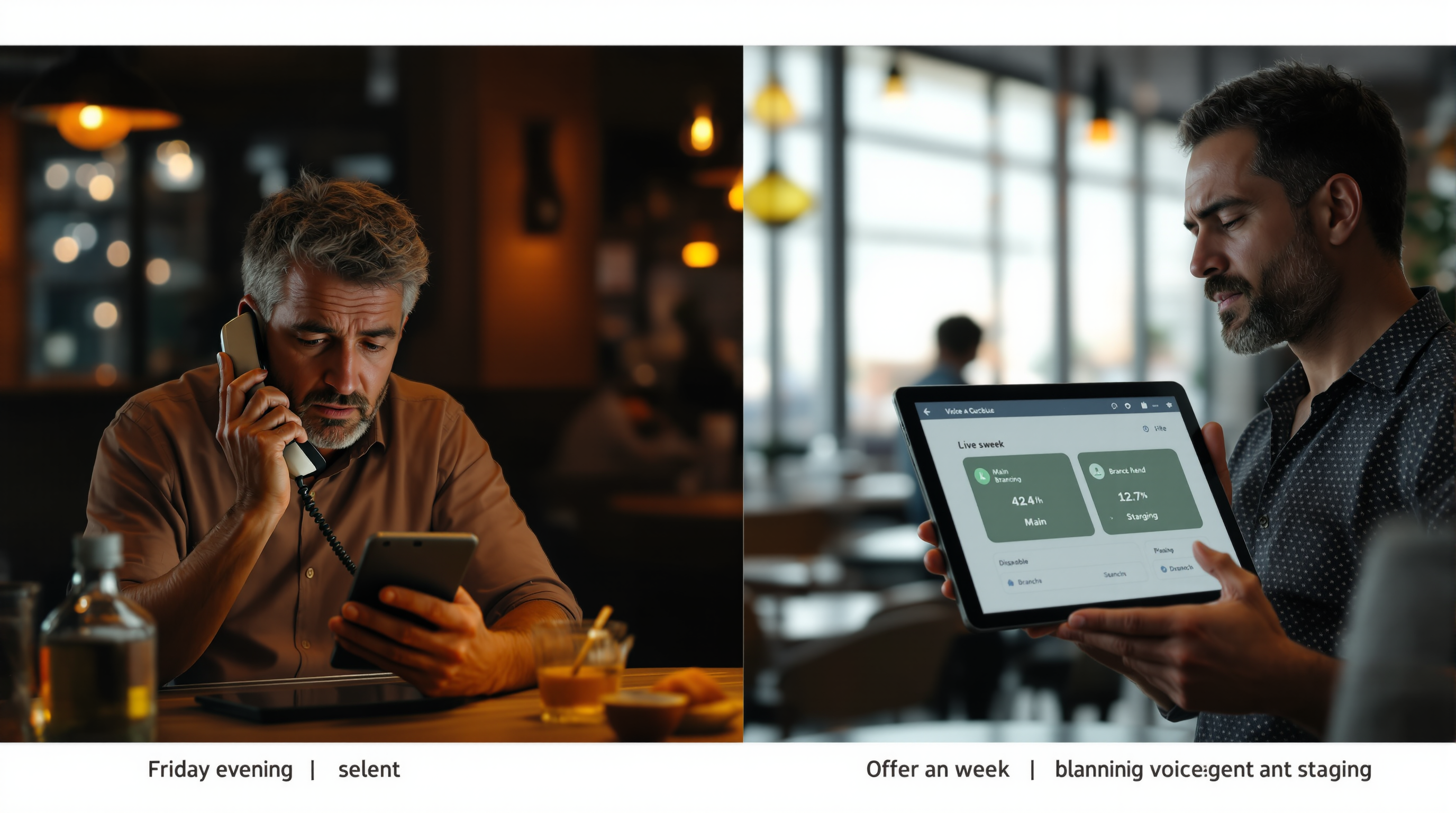
Friday, 7:12 PM. Mathieu, owner of a small restaurant on Montreal's Plateau, sips his coffee. His AI voice agent — the one that's been handling reservations for three months — got a tiny tune-up this morning. A softer tone, nothing dramatic. Except now, since 5 PM, the phone is ringing, the agent answers, but nobody is actually booking. Customers hang up. Mathieu doesn't know it yet. He'll find out tomorrow morning, when Toast shows Friday night service dropped 22% in covers.
That's the silent hell of a voice agent that "breaks" without crashing. And it's exactly what ElevenLabs versioning, rolled into production this spring of 2026, is built to bury once and for all.
The real problem: 60% of agent failures come from an update
A recent study on AI agent lifecycle in production put a number on it: 60% of production agent failures trace back to a tool, API, or prompt change. Not the model. Not the network. A change someone thought was harmless.
For a Quebec small business, what does that actually look like? Three symptoms that show up monthly across our TECHMA clients:
- The agent stops "seeing" the CRM. Someone renamed a field in Zoho. The
book_appointmenttool silently returns an error. The agent improvises. The customer leaves frustrated. - The tone drifted. A prompt tweak that seemed reasonable now makes the agent too formal — or too chatty. Calls jump from 90 seconds to 4 minutes. The ElevenLabs bill climbs, and customers find it long.
- The human transfer breaks. A new "if urgent, transfer" condition got added. Except it now fires for 40% of calls. The person at the counter can't stop picking up.
In each case, the previous version worked fine. A 30-second rollback would have fixed everything — if rollback had been possible. Before versioning, it wasn't. You re-edited the prompt blind, you tested in prod, and you prayed.
What ElevenLabs shipped (and why it changes everything)
Since the update, every ElevenLabs agent now has:
- A Main branch — that's production. It can't be deleted or archived. Your permanent safety net.
- Secondary branches you can spin up from any version of Main. Think of them as safe drafts. You change the prompt, the tools, the voice, the knowledge base — without touching prod.
- Immutable versions: each snapshot captures the whole system (prompt, LLM, voice, tools, RAG, safety settings, widget, data collection). Once frozen, a version never moves. You know exactly what was live at 2:03 PM on May 12th.
- Percentage-based traffic split, deterministic: if you send 10% of traffic to the "staging-v2" branch, a given customer always lands on the same branch across calls (routing keyed on conversation ID). That's the mechanics of a clean A/B test.
For technical teams: configs serialize into separate files, tracked in an agents.json, fully git-friendly and CI/CD-ready via the official ElevenLabs CLI. For SMB owners: you don't need to parse that sentence. TECHMA handles it. What you get is an agent that doesn't break anymore.
3 scenarios where versioning saves a Friday night
Scenario 1 — The restaurant testing a new reservation script
Mathieu (let's keep our Plateau restaurant) wants to try a friendlier, more "neighborhood buddy" tone, less "gala host." Before: you'd change the prompt live, wait two weeks, see if covers went up. No clean way to compare.
Today, the TECHMA sequence:
- Spin up a
neighborhood-script-v1branch from version 14 of prod. - Drop in the new prompt + a slightly warmer voice.
- Route 20% of traffic to that branch for 10 days.
- Measure: completed-booking rate, average call duration, human transfer rate.
- If the new branch wins on all three → roll 100% of traffic. Otherwise, archive it. Prod was never touched.
No customer was an unwitting test subject. The margin of error is known. And if the branch breaks mid-test, rollback is instant — we pull the 20% back to Main.
Scenario 2 — The dental clinic adding a reminder tool
On a recent dental deployment, we wanted to plug in a new automated reminder tool (Quebec RGAQ-compliant + SMS confirmation 24 hours before). Before, that would have meant: edit the prompt in prod to explain the new tool, cross fingers, fix bugs as patients complained.
Today: sms-reminder-v1 branch, hook up the tool, simulate 30 calls via the ElevenLabs sandbox, route 10% of real traffic. If hallucinations stay under threshold for 48 hours (see our 7-step protocol to prevent AI voice agent hallucinations), bump to 50%. Then 100%. Production never blinked.
Scenario 3 — The law firm staying Law 25-compliant
Here versioning becomes a compliance argument, not just a quality one. Quebec's regulation requires you to prove, at any date, how you were handling personal data. With dated immutable versions, you literally have a cryptographic timestamp of every configuration snapshot. If the CAI asks "what was your retention policy on February 3rd?", you point to version v07-feb-03 and you're done.
(For the full compliance breakdown, we already published a 9-step guide to deploying a Law 25-compliant AI voice agent. Versioning makes step 7 — traceability — almost trivial.)
How TECHMA ships an update using branches (no jargon)
The client does nothing. Worth repeating. Here's what happens on our side, in plain language:
- We copy production into a separate branch. Zero risk to your live calls.
- We apply the requested change (new prompt, new voice, new CRM tool, schedule adjustment).
- We cold-test with 20 to 30 representative call simulations.
- We send a small share of real traffic to the new branch, typically 10 or 20%.
- We watch three metrics: task completion rate, average call duration, human transfer rate. Any one of them drifting more than 15% → automatic rollback.
- If things look good after 5 to 10 days, we ramp traffic to 100% and the branch becomes the new prod.
- The old version stays archived. A month later, if you decide it was better before, we flip back.
Notice the detail that changes everything: observability. Without branches, we couldn't compare the new config to the old one while they ran side by side. We couldn't isolate the effect of a single change. Today we can. That's the difference between "I feel like it's working better" and "branch v2 books 14% more reservations across 387 calls, p < 0.05".
Why this matters more in Quebec than elsewhere
Three reasons specific to the Quebec market:
Language. An agent that drifts toward Parisian French (because an LLM was fine-tuned on European content) loses a Trois-Rivières customer's trust in three sentences. Versioning lets you test a new voice or LLM on a subsegment before pushing it on everyone. New models available since the update (Gemini 3.1 Pro, Qwen 35) demand exactly that kind of careful test — for the model selection trade-offs, see our GPT-4o vs Claude 4.6 vs Gemini 3.1 Pro comparison for AI voice agents.
Seasonality. Restaurant doubling revenue in summer, clinic seeing call volume explode in September, accounting firm hitting +300% in March-April. You don't want to test an update during a peak. With branches, you deploy in April, run the branch in parallel through the peak, and switch in June if results hold.
No internal tech team. 87% of Quebec service SMBs (restaurants, beauty, healthcare, legal, accounting) have zero internal DevOps resource. Versioning makes engineering discipline possible without having to hire an engineer. That's exactly what we deliver — at roughly the cost of a daily coffee.
What changes for you next month, concretely
If you're already a TECHMA client with a voice agent in production, the transition happens in the background. Your current agent is already re-wrapped as a versioned Main branch. Every future change will go through the branches → graduated traffic → switchover pipeline. You'll mostly see it in two places:
- The monthly report will now include an "experiments in progress" section: what we're testing, on what traffic share, and the early numbers.
- Changes will get approved faster — because we no longer have to fear the worst. A prompt edit that used to need three days of validation now takes two hours, because rollback is free.
If you're not a client yet: this is probably the right moment to start. The technical barrier to running a serious voice agent just dropped a notch. The first-mover advantage in your vertical (restaurant, dental, legal, beauty) still holds for a few more months — see also how we connect your agent to a CRM in 1 hour using the MCP protocol.
The detail competitors won't tell you
Plenty of voice agent providers (VAPI, Retell, Bland, etc.) have been talking about "zero-downtime deployment" since 2024. But native platform-level versioning, with cryptographic immutability and deterministic traffic split — ElevenLabs is the first to ship it at this level of polish. The official documentation shipped in March 2026 and is now fully wired into the production pipeline. It's one of three or four technical reasons we standardized on ElevenLabs at TECHMA for SMB deployments — the other big one being latency (see our benchmarks at the critical 700ms threshold).
Quick FAQ
What does it cost extra? Nothing. Versioning ships with the standard ElevenLabs Agents plan. The operational cost is in setup and monitoring time — that's already inside your TECHMA package.
How many parallel branches can I run? Several dozen. In practice we use 2 or 3 max: Main (prod), one for testing, sometimes a "legacy" for fast rollback.
If TECHMA stops working with me, do I keep my versions? Yes. Everything is stored in your ElevenLabs account. Portable, exportable, and the history stays with you.
What if I just want an agent that works, with no testing? Perfect. We set up Main, no branches, and you get a stable agent. Versioning is a tool — not an obligation. But having the option is what makes the difference when something goes sideways at 7 PM on a Friday.
Curious what your own versioned AI voice agent would look like? Book 15 minutes with the TECHMA team — we look at your call volumes, your seasonal peaks, and we tell you honestly whether it's worth it for your business.