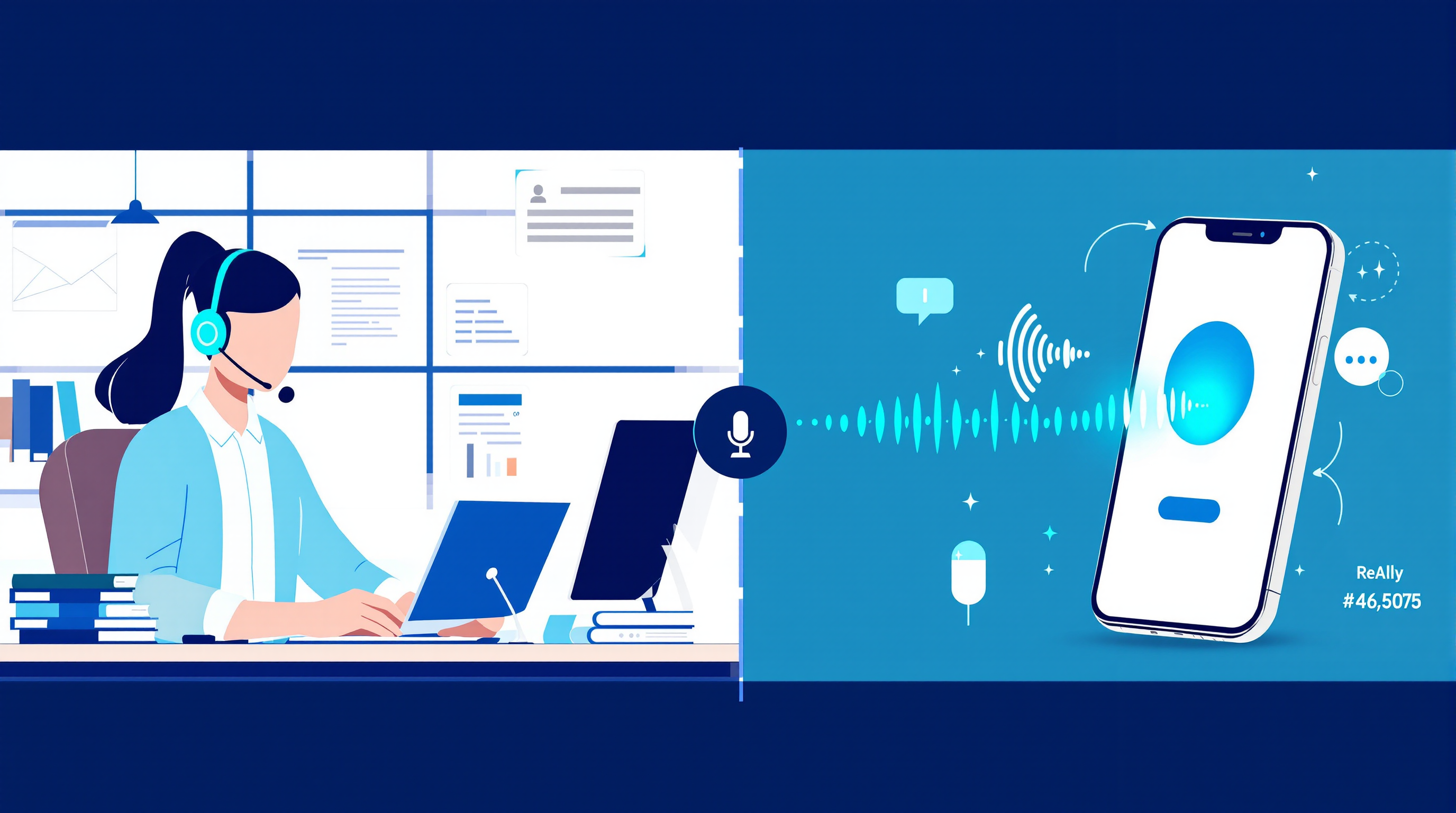
Picture two identical Tuesday evenings. Same business, same call coming in at 6:40 PM, same rushed customer who wants to move their appointment. The only difference: who picks up. On one side, a traditional answering service — a live operator in a call center somewhere, taking a message. On the other, an AI voice agent that settles the matter before hanging up. The outcomes are anything but identical.
Plenty of business owners across Canada are weighing exactly these two options. Choosing between an answering service and an AI voice agent isn't about chasing a trend — it's about cost, speed, and above all what actually happens to the customer on the line. Here are six concrete differences, with no sugar-coating.
Setting the Ground Rules Before We Compare
An answering service is a human in a call center who answers in your name, follows a script, and relays you a message. The model has been around for forty years, and it works — it has just stayed more or less the same the whole time.
An AI voice agent doesn't take a message: it handles the request. It understands natural language, checks your calendar in real time, and closes the call. To compare them fairly, we'll put them head-to-head on six criteria that genuinely matter to a business: cost, availability, what gets resolved during the call, language, consistency, and the data you get afterward.
Difference 1: Cost, and It Isn't Marginal
Let's start with the money. An answering service typically bills per call or per operator-minute — often $0.80 to $2.50 a minute — with a 25% to 50% surcharge added evenings, weekends, and holidays. A business taking 500 calls a month commonly pays $500 to $1,500 monthly.
The AI voice agent knows neither peak hours nor night rates. A call at 3 AM costs exactly what a call at 3 PM does. According to Aircall's cost breakdown, the total reduction lands around 70% to 85% versus a human service. That gap isn't a discount — it's structural.
Difference 2: "Available" Doesn't Mean "Immediate"
Most answering services offer 24/7 coverage. On paper, that's reassuring. In practice, "available" and "immediate" are two different things.
During busy periods, your caller might wait 30 to 90 seconds before an operator picks up. Then they have to open your file, read the script, and grasp the request. On a snowy day in Calgary or a holiday, that wait stretches further. And every second of waiting is a customer deciding whether to hang up.
The AI voice agent answers on the first ring, whether one person calls or fifty call at once. No hold queue, no peak-hour degradation. And we know how heavily unanswered calls weigh: we put a real number on their impact on your reputation in our analysis of missed calls and your Google rating.
Difference 3: Taking a Message vs. Solving the Problem
This is where the two models truly diverge. An answering service is, at heart, a relay: the operator notes your request and forwards it by email, text, or portal. You then have to call the customer back. The call resolved nothing — it added one more task to your list.
The AI voice agent acts during the call. It plugs into your systems: it checks real availability in your calendar, recognizes a regular in your database, confirms a booking that lands in your calendar instantly. We walk through that whole connection layer in our guide to calendar and CRM integration.
The difference boils down to one sentence: one leaves you work to do, the other has already done it.
Difference 4: English, French, and the Right Tone
In a country that's officially bilingual and home to cities where dozens of languages are spoken — Toronto, Vancouver, Mississauga, Montreal — this criterion is no small thing. An answering service usually offers English and, sometimes, French or Spanish, but switching languages depends on which operator is free; for a third language, you're often bounced to an interpretation line, with delay and added cost.
An AI voice agent detects the language in the first few words and continues in the caller's language, even switching mid-call. For a market where customers naturally move between languages, that's exactly what you want — no interpretation line, no surcharge, no delay.
A small bonus: the tone stays constant. No operator running low on patience at the end of a shift. The greeting sounds the same at 9 AM and 9 PM.
Difference 5: Consistency, Call After Call
Humans make mistakes — that's normal, and it's no insult. An operator can mishear a name, transpose two digits of a number, misjudge urgency. Studies of medical answering services find message-accuracy rates of 75% to 85%, meaning 15% to 25% contain an error in a name, a callback number, or the nature of the request.
The AI voice agent follows its logic with perfect regularity. It confirms names and numbers by repeating them, classifies urgency by precise rules rather than gut feel. It isn't infallible — heavy background noise or an unusual name can trip it up — but its errors are systematic and correctable, not random.
Difference 6: What You Learn After the Call
An answering service gives you basic reporting: call volume, average duration, messages delivered. Useful, but thin.
An AI voice agent generates, for every call, a full transcript, the caller's intent, a resolution status, and metrics tied to your business: appointments booked, quote requests, the most common reasons people call. After a month, you no longer just know how many calls you got — you know what your customers actually want. Read well, that data is often worth more than the agent itself.
The Verdict: When to Choose Each
Let's be fair: the answering service still makes sense in some cases. If your calls are almost always emotional or highly sensitive — a practice handling grief, say — a human voice from the first second has real value.
The backdrop favors AI too: according to a roundup of small-business AI adoption statistics, the share of small businesses using AI regularly climbed from 48% to 68% in a single year. Your competitors aren't waiting.
For the vast majority of businesses, though, most calls are routine: book or move an appointment, give the hours, qualify a request, route an emergency. On that ground, the AI voice agent wins on cost, speed, resolution, and data. And it forces no one into all-or-nothing.
The Hybrid Approach: Best of Both Worlds
The best setup in 2026 is almost never "100% AI" or "100% human." It's AI on the front line absorbing the 80% of routine calls, with a smart transfer to a human — your team or an on-call person — for the 20% that need real judgment. We compared plain voicemail to this logic in detail in our voicemail vs. AI voice agent face-off.
You set the boundary: emergencies, key accounts, specific keywords. Anything you want reserved for a human gets routed there automatically, with a summary of the call so they don't start from scratch.
A Concrete Scenario: An Independent Garage
Take an independent garage with three mechanics and a swamped front counter. With an answering service, a customer calling for a tire swap leaves a message; someone calls back two hours later, sometimes the next day. Half those customers have already booked elsewhere.
With an AI voice agent, the same customer is served on the spot: the agent offers a real open slot, confirms it, and texts a reminder. The counter wasn't interrupted, the mechanic didn't wipe his hands to grab the phone, and the appointment is in the system. Multiply that by twenty calls a day, and you can see where the gap goes.
Frequently Asked Questions
Do I have to configure the agent myself? No. The TECHMA team builds everything: training the agent on your services and pricing, connecting it to your calendar and CRM, testing, and going live on your current number. Your part is about twenty minutes of questions.
Will my customers hate talking to an AI? For routine requests, most don't mind — what matters to them is that the call gets handled fast. And a transfer to a human is always available.
What if I keep my answering service for overflow? Entirely doable. Many businesses start the agent on after-hours calls, keep humans during the day, then adjust based on results.
How long before it's live? About a week between the TECHMA build and go-live.
The Right Choice Depends on Your Calls — Not the Trend
Answering service or AI voice agent: the real question isn't "which is more modern," but "which serves your customers best at the best cost." For most Canadian businesses, the answer leans clearly toward an agent that resolves the call instead of noting it.
Curious to hear the difference on YOUR calls? Book a 15-minute demo — we'll play you a real call — or see our plans starting at $49/month. We build the whole thing; you get to compare with your eyes open.