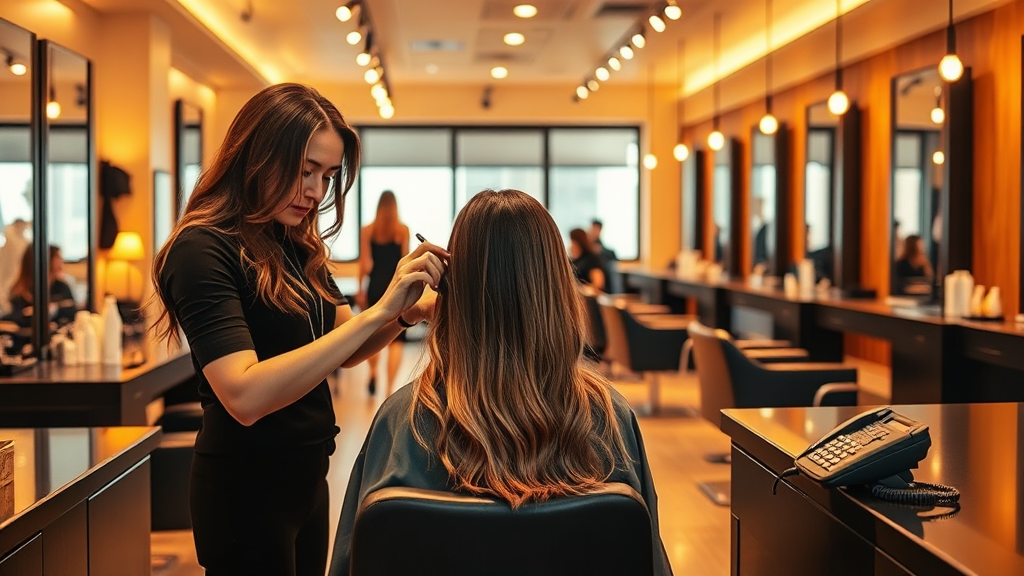
You're halfway through a complex balayage, hands deep in lightener. The phone rings. Once. Twice. Three times. Then silence. Your next client just hung up — and she's probably already calling the salon down the street.
This is the reality for most hair salons and spas in Quebec in 2026. Not because of a lack of professionalism, but because of simple physical constraints: you can't hold a phone when your hands are creating. Beauty salons lose an average of 23% of their incoming calls during peak hours — between 10am and 4pm, Tuesday through Saturday, exactly when your team is most in demand.
The consequences show up as lost appointments, clients who never call back, and revenue that evaporates without a trace. But there's now a solution Quebec salons are beginning to adopt to close this gap: an AI voice agent that answers every call, at any time, with the tone and information specific to your business.
The problem unique to hair salons and spas
Other industries suffer from missed calls too — Quebec dental clinics lose up to $50,000 per year because of unanswered calls — but the beauty sector has a defining challenge: the physical impossibility of answering the phone during a service.
A dentist can pause between procedures. A pharmacist can hand a patient to a colleague. But a hairdresser mid-permanent color, or an esthetician during a facial, can neither stop nor delegate the call in 15 seconds. Most salons operate with two to four employees, often with no dedicated receptionist. The business model demands it: every chair needs to be productive.
Layer on top of that a Quebec-specific dynamic: booking habits. Unlike some American markets where clients schedule almost exclusively online, a meaningful portion of Quebec's beauty clientele — particularly the 40-65 demographic that often represents a salon's most loyal, highest-spending regulars — still prefer to call and speak to someone when booking.
A salon losing 8 to 15 calls per day loses roughly 3 to 5 new appointments per week. At $85 average per service, that's $255 to $425 in revenue gone every week — or $13,000 to $22,000 per year, not counting loyal clients permanently lost to a competitor who picked up the phone.
How an AI voice agent works in a salon or spa
An AI voice agent for a hair salon is a bit like hiring a receptionist available 24/7, who knows your full service menu, your pricing, your available stylists, and your cancellation policy — without ever calling in sick or showing up late.
Here's what actually happens when a client calls your salon on a Sunday night at 8pm:
- The agent picks up on the first ring with your personalized greeting (in French, English, or both, depending on your clientele)
- It identifies the need: booking a new appointment, asking about services, checking pricing, requesting a cancellation
- If it's a booking, it checks your real-time availability through your scheduling system (Fresha, Square, Vagaro, etc.)
- It proposes time slots based on the client's preferences, confirms the appointment, and automatically sends an SMS confirmation
- All information is logged so you find everything organized the next morning
For spas, the flows are a bit more nuanced: the agent can handle variable service durations, therapist preferences, pre-treatment protocols (no eating two hours before a deep-tissue massage, for example), and even guide a client toward the right treatment based on what she describes.
One important distinction: the agent is configured by TECHMA's team specifically for your business. It's not software you install yourself — it's a custom-deployed solution built with your vocabulary, your services, and your brand personality.
4 concrete opportunities for your salon or spa
1. Capture calls during peak hours
Between 10am and noon and again between 2pm and 5pm, your team is running at full capacity. Those are also exactly the hours when your phone rings the most. The AI agent handles all those calls simultaneously, with no hold music, no voicemail black holes. A client calling to book a color appointment on Saturday at 2:30pm gets the same quality of response as if she'd called on a Tuesday morning when the salon just opened.
2. Recover last-minute cancellations and fill schedule gaps
A cancellation call comes in? The agent handles it, marks the slot as available, and can immediately offer it to clients on the waitlist. For salons using Fresha or Vagaro, this syncs automatically. The same logic that works for Quebec restaurants recovering lost reservations applies perfectly to salons: fewer gaps, more recovered revenue.
3. Handle repetitive questions without interrupting your team
"How much is a full balayage?" "Do you do keratin extensions?" "Is there parking nearby?" These questions come in dozens of times a week. The agent handles all of them, freeing your team to focus on clients in the chair rather than juggling the phone. Some salons report saving 2 to 3 hours a day just from eliminating these interruptions.
4. Reduce no-shows with automated reminders
A no-show costs a salon between $60 and $180 depending on the service booked. The AI agent automatically sends SMS reminders 48 and 24 hours before the appointment, with a link to confirm or cancel. Salons using this feature report a 30 to 50% reduction in no-shows, according to a Cekura AI industry analysis. Over a full year, that's often several thousand dollars recovered.
The return on investment: real numbers for a Quebec salon
Picture a mid-sized salon in Laval: four stylists, annual revenue around $350,000, averaging 15 missed calls per day. Converting just 30% of those calls into bookings — a conservative estimate — means 4 to 5 new appointments per week at $90 average, or roughly $400 per week, totaling $20,800 in additional annual revenue.
As detailed in our complete ROI analysis for Quebec SMEs, the monthly cost of an AI Voice Agent solution typically runs between $200 and $500 depending on call volume. Return on investment happens in an average of 6 to 10 weeks for an established salon. According to data published by Retell AI, the AI virtual receptionist market reached $4.64 billion in 2026, with the beauty sector among its fastest-growing segments.
Common objections from salon owners
"My clients will find it impersonal"
This is the number-one concern, and it's legitimate in such a relationship-driven industry. But let's look at reality: your clients aren't calling to have a conversation. They're calling to book. An agent that picks up in one ring, knows your services, and confirms the appointment in 90 seconds flat is far more satisfying than a phone that rings into the void or a voicemail nobody returns.
Human connection stays intact during the visit. That's where the client relationship actually lives — not on the phone.
"It's too complicated to set up"
This is where Agent IA Vocal differs from software you install yourself. TECHMA's team configures everything: they integrate with your existing booking system, program responses specific to your services, and adapt the tone to your brand voice. Setup typically takes one to two weeks, with no training required from your staff — you keep working normally throughout the entire deployment.
"What if a client really wants to speak to a real person?"
The agent detects situations requiring human intervention — a frustrated caller, an out-of-script request, an urgent situation — and transfers the call to your team or offers a callback within a specific window. It's not a wall between you and your clients. It's an intelligent filter that handles 85 to 90% of calls on its own and escalates the remaining 10 to 15% smoothly.
Frequently asked questions — Hair salons and spas in Quebec
Can the agent handle bookings for services with very different durations (e.g., a 3-hour balayage vs. a 45-minute cut)?
Yes. The agent is configured with the estimated duration of each service on your menu. It blocks the right time slot based on the requested service type, accounting for specific stylists who specialize in certain techniques. You set the rules once — the agent applies them on every call.
What about clients who already book online?
The AI voice agent is complementary to your online booking system. It handles phone calls while your platform handles web bookings. Both sync to prevent double bookings and maintain a consistent schedule.
Can the agent respond in English if an anglophone client calls?
Yes. For salons in bilingual areas — Montreal, Laval, Gatineau, the Eastern Townships — the agent can detect the client's language within the first few seconds and respond accordingly. Some salons opt for a bilingual greeting from the start.
My salon is small (2 stylists). Is it worth the cost?
A two-stylist operation is often the ideal fit. No dedicated receptionist, near-total inability to answer calls during services, and a loyal clientele that calls to rebook regularly — this is exactly the scenario where the AI agent generates the most value proportionally to its cost.
Stop letting calls ring into silence
Every unanswered call is a client choosing your competitor. Not because you don't want to answer — but because you're doing the hands-on work that actually defines your craft.
An AI voice agent doesn't replace your expertise, your creativity, or the human relationship that keeps a client coming back for ten years. It handles what you physically cannot handle while you work: the phone. So you can focus on what matters most — the client in your chair.
TECHMA's team configures Agent IA Vocal for Quebec hair salons and spas. Book a free demo and find out exactly how many calls your salon is losing every month.