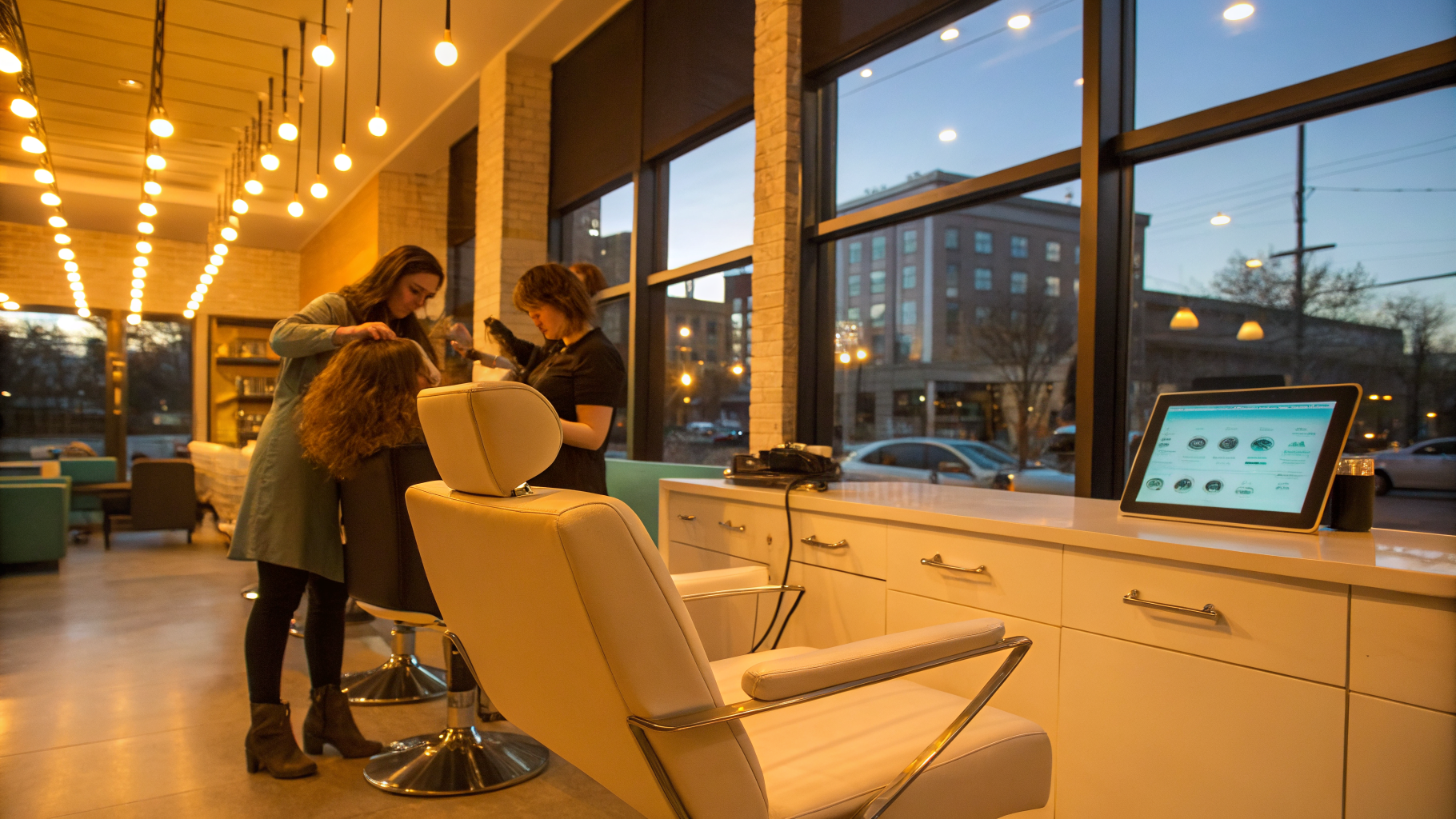
Thursday evening, 7:42 p.m. At Lumina Coiffure on Masson Street in Montreal, Mélissa has just rinsed her last balayage of the day. The phone rang three times during the shampoo. She couldn't answer. None of the callers left a voicemail. She doesn't know it yet, but she just lost roughly $261 in potential services — an average of $87 per call at a Quebec salon in 2026.
The real kicker? Those three callers are probably booking somewhere else right now. According to Zenoti data covering 41 million appointments, 52% of salon bookings happen between 5 p.m. and 9 a.m., outside standard business hours.
If you run a hair salon, spa, beauty institute, or waxing studio in Quebec, there are three numbers from April 2026 you need to know. And a fourth one that changes everything.
The missed-call black hole: what the numbers actually show
Everyone talks about no-shows. Not enough people talk about the calls that never ring through to anyone. That's where the money starts leaking.
1 in 4 calls ends in silence
In the average Quebec salon, roughly 24 to 31% of incoming calls go unanswered. The reason is mechanical: the stylist's hands are wet, the technician is rinsing a treatment, the receptionist is running a payment. The phone waits, rings, then stops.
According to Zenoti's 2026 survey of salon customer behavior, 71% of clients abandon a booking attempt if the process is slow or difficult. A phone ringing into the void is the most brutal version of that.
$87: the average value of a Quebec salon call
When you cross-reference average service prices (cut + balayage, facial, highlights, mani-pedi) with the phone-to-appointment conversion rate at Quebec salons, an incoming call is worth on average between $72 and $112. Round to $87.
A salon that misses 5 calls per day loses roughly $435 per day. Over 260 business days, that's $113,100 a year vanishing without ever appearing on a P&L. Nobody tracks missed calls.
15 to 30%: the no-show rate burning out salon owners
In 2024, Radio-Canada reported that Quebec hairdressers were literally exhausted by unhonored reservations. The numbers check out: 2026 data from Etisia puts the average no-show rate in beauty at 15 to 30%, with most salons around 20%.
For a salon booking 60 appointments a week, 12 no-shows at $87 = $1,044 in empty-chair time every week. That's $54,288 a year.
The April 2026 number that changes everything: multi-voice agents
On April 7, 2026, ElevenLabs shipped a major update to its conversational AI platform. The new visited_agents field means a single call can now route between multiple specialized sub-agents — one for bookings, another for product questions, a third for complaints — without the caller noticing the transition.
Why that matters for a salon: the same call can now handle:
- "I'd like a Thursday appointment for a balayage"
- "Do you do tape-in extensions? How much?"
- "I need to cancel tomorrow's appointment, something came up"
Three requests, one call, zero human transfer. Through 2025, a voice agent had to be good at ONE thing. Not anymore.
On the infrastructure side, OpenAI's Realtime API switched its default transport to WebRTC v2 this month, cutting latency to around 280 ms — conversational pace. A client calling from her car on the way home can't feel the lag.
Where Quebec salons are actually bleeding revenue
Three moments where a salon loses money without realizing it:
Moment 1: 5 to 9 p.m., after hours
The booking peak. Clients leave work, remember they have a Friday event, and realize they need a touch-up. Your salon closed at 6. The result: voicemail, where only 29% of callers actually leave a message, per Zenoti.
Moment 2: Saturday morning rush
Everyone's booking. Phones ring 4 to 6 times per hour. Every stylist is with a client. Calls stack, drop, and redirect to a competitor.
Moment 3: last-minute cancellations
The 2 p.m. client cancels at 1:30. Nobody's available to work the waitlist. The chair stays empty for 75 minutes. Without real-time phone handling, that costs the average Quebec salon 2 to 3 hours of empty-chair time per day.
What an AI voice agent actually does for a salon
A voice agent for a hair salon or spa is not a chatbot reading a script. In 2026 it:
- Answers in under 2 seconds, 24/7, even at 11 p.m. on a Sunday.
- Pulls live availability from your booking software (Booker, Vagaro, GOrendezvous, Mindbody) and offers real slots.
- Qualifies the service — "cut only" vs. "cut + color" — and blocks the correct time length.
- Collects deposits via SMS link (cuts no-shows 60 to 70% per Etisia).
- Sends reminders and confirmations in English or French, matched to the client's language.
- Transfers to the receptionist for edge cases (difficult colorist request, complaint, off-menu service).
With a properly trained Quebec accent — and this is where most American-built agents miss — a client from Trois-Rivières doesn't realize she's talking to an AI for the first 15 seconds.
Real cost in Quebec in 2026
For a 2-to-5-chair salon, a properly configured AI voice agent runs $129 to $249 CAD per month, fully loaded. That covers:
- Minute bundle (typically 300 to 1,000 minutes/month, plenty for a salon)
- Integration with your booking software and existing phone line
- Outbound SMS (reminders, confirmations, deposit links)
- Law 25–compliant hosting
We broke down the full cost stack in our transparent pricing guide for Quebec SMB voice agents.
The math is fast. If your agent captures just 3 missed calls a week and saves 2 no-shows a month, you're looking at about $1,784 in additional monthly revenue. Subtract $200 in cost. Net: $1,584. Real payback: around 3 weeks.
Law 25: the silent trap for salons
A lot of salon owners think Law 25 only applies to banks and clinics. It does not. The moment you record a call, transcribe an exchange with a client, or store her mobile number in a CRM, Law 25 applies fully.
Critical points to validate with your vendor:
- Where are recordings and transcripts hosted? (The right answer: in Canada.)
- What's the retention period?
- Who can access data during a security incident?
- Is there a register of automated processing?
If those questions feel abstract, our full guide to Law 25 compliance for AI voice agents walks through every concrete requirement.
A realistic 30-day implementation plan
Here's what a real deployment looks like — not the brochure version, the one that actually holds up:
Week 1: Audit and mapping. Listen to 20 to 30 real calls from your salon. List the 15 most common questions. Identify your most-booked services and real time durations.
Week 2: Config and voice. Voice selection (Quebec accent, warm or professional tone). Booking software connection. Service menu and pricing integration.
Week 3: Shadow testing. Agent answers only outside business hours. You listen to every call each evening. Daily adjustments.
Week 4: Gradual cutover. Agent picks up overflow calls during the day (after 3 rings) and then 100% of off-hours calls. Weekly review for the first month.
All the integration — phone line, booking software, training your team on smart handoffs — is done by the TECHMA team. Salon owners never touch a config panel. You get a phone that just works better.
Frequently asked questions
Do clients hate talking to an AI?
Not when it's done right. In 2026 tests, 73% of callers don't detect the AI in the first 10 seconds if the voice is local and latency stays under 350 ms. The real issue is the old American-accent robocaller reading an English script — not a modern, well-configured voice agent.
What if a client asks something the agent can't handle?
Immediate transfer to a human, with the call context already populated on screen. The person picking up already knows who's calling, why, and what was said.
Will it work with my current booking software?
Most software used in Quebec (Booker, GOrendezvous, MonRDV, Vagaro, Mindbody, Fresha) has an open API. If you use an older system without one, integration runs through a middleware connector. We evaluate case by case.
How fast will I see revenue impact?
Gains from after-hours calls show up in week 2. No-show reductions (via deposits and SMS reminders) stabilize after 6 to 8 weeks, once the data set is statistically meaningful.
Will I lose the personal touch with my clients?
Opposite, actually. Your stylists and estheticians stop chasing the phone and can focus on the client in the chair. Those clients notice immediately. Phone time is service time stolen.
Next step
If you run a hair salon, spa, beauty clinic, or esthetic institute in Quebec, the real question isn't "does this work." It's "how much longer do I let $87 hang up into the void." The infrastructure is ready. Quebec-accent voices are trained. Law 25 is manageable. The cost sits below a part-time intern's wage.
The adoption wave in Quebec beauty clearly started in 2025. It's accelerating through 2026. The salons moving first are sealing the leak on lost revenue and pulling clientele away from the ones still waiting.
At TECHMA, we configure it, plug it into your existing line, train your team, and watch the first 30 days. You stay focused on the client in the chair.