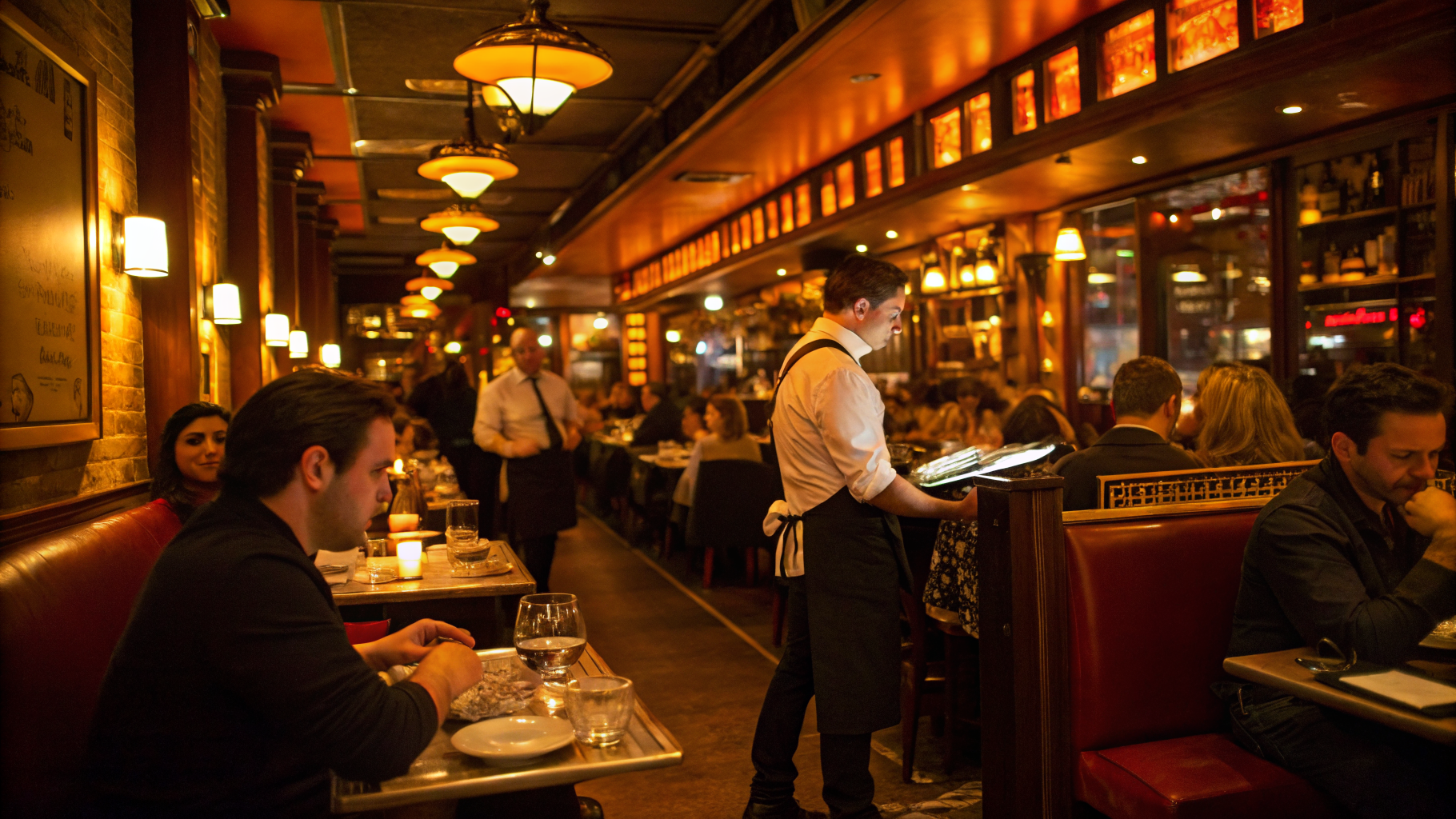
It's Friday night, 7:30 PM. Your Montreal restaurant is 80% full. Your servers are in the weeds. The phone rings. Nobody can pick up. The ringing stops.
That table of four just called your neighbour down the street.
This scenario repeats itself 15 to 25 times a week at most mid-sized Quebec restaurants. The National Restaurant Association estimates that restaurants lose between 20% and 30% of their phone reservations during peak hours — simply because no one can answer. Over a year, that translates to $10,000–$25,000 in evaporated revenue.
The good news? An AI voice agent solves this problem concretely — not theoretically, not eventually — within 24 to 48 hours.
Here's how it works, step by step.
Before You Start: What You Need
This guide is written for restaurant owners and managers across Quebec — whether you run a craft brewery in Laval, a fine dining room in Old Quebec City, or a café-bistro in Longueuil. No technical knowledge required. TECHMA IT's team handles all the setup.
What you'll want to have ready before the kickoff call:
- Your complete hours of operation, including statutory holidays and terrace season dates
- A general overview of your menu — key allergens, signature dishes, prix-fixe menus
- Your current reservation system (Google Calendar, OpenTable, Resy, or paper book)
- Your existing phone number (no changes required)
- About 30–45 minutes for an initial Q&A session with the TECHMA team
That's it. Let's walk through the five steps.
Step 1: Calculate What Missed Calls Are Actually Costing You
Most restaurant owners know they're missing calls. Very few know the dollar figure. Here's how to measure it in under 20 minutes.
Pull your call logs from the last 30 days — via your business phone app or your telecom provider's online portal. Filter for unanswered inbound calls during service windows: Friday and Saturday evenings from 5 PM to 10 PM, and weekday dinner shifts from 6 PM to 9 PM. These windows typically account for 70% of your reservation calls.
Run the math:
- Unanswered calls per week (e.g., 18 calls)
- Estimated conversion rate — about 65% of those calls would have led to a booking
- Average reservation value (e.g., table of 3 × $45 = $135)
In this example: 18 × 0.65 × $135 = $1,579 lost per week, or roughly $82,000 annually. For a deeper breakdown of this math, see notre analyse coût-bénéfice complète on the full cost-benefit picture for Quebec SMEs.
These numbers are uncomfortable. They're also essential. They give you a concrete baseline to evaluate whether automation makes sense for your specific operation.
Step 2: Define What the Agent Should — and Shouldn't — Handle
A well-configured AI voice agent isn't trying to do everything. Its strength comes from specialization. For restaurants, the scenarios to automate first are straightforward:
What the agent handles with confidence:
- Standard reservations — date, time, party size, name, callback number
- Common FAQ — hours, address, parking, wheelchair access, terrace availability, current specials
- Allergen information — the agent flags the main allergens in your menu and recommends staff confirmation for severe cases
- Waitlist — if you're fully booked, the agent offers to add the caller to the evening's waitlist
- Callback requests — for off-menu questions or large parties, the agent logs the request and promises a 24-hour callback
What the agent escalates to a human:
- Groups of 10 or more
- Private events or parties with custom setup requests
- Customer complaints or dispute resolution
- Complex modifications to existing reservations
This boundary is everything. The restaurants that see the best results are the ones who define it clearly at the start. For details on configuring smooth handoffs, the guide on les transferts vers un humain walks through exactly how to set this up so the transition feels seamless to the caller — not like a dropped call.
Step 3: Let the TECHMA IT Team Configure Your Agent
This is where the actual work happens — and where you don't have to do anything technical.
TECHMA IT's team sets up your ElevenLabs-powered AI voice agent directly on your account. Here's what's included:
Voice personality: You choose a voice that matches your restaurant's feel — warm and relaxed for a bistro, more polished for fine dining. The team presents three to five options, runs audio quality tests, and gets your sign-off before going live.
Bilingual setup: In Quebec — especially Montreal — your callers speak both French and English. The agent detects the language within the first few seconds and switches seamlessly. No English-speaking caller ever feels like an afterthought.
Law 25 compliance: The agent only collects what's strictly necessary for the reservation: name, time, date, party size, callback number. No data is sold or retained beyond operational need. Your setup aligns with Quebec's Law 25 on personal information protection from day one.
Wondering how long setup takes? According to a Certus AI study covering hundreds of North American restaurants, the configuration phase takes 3 to 8 hours on the technical side — but for you as the owner, it means 30 to 45 minutes of Q&A with the technical team. The professionals handle the rest.
Step 4: Connect the Agent to Your Reservation Calendar
An AI agent that books reservations without syncing to your existing system is a recipe for double-bookings. This step prevents that entirely.
TECHMA IT connects your agent to your booking tool:
- Google Calendar — The simplest integration. The agent checks real-time availability before confirming any time slot.
- OpenTable, Resy, SevenRooms — Native integrations available. Bookings appear directly in your reservation dashboard.
- Proprietary or basic systems — If you're working from an Excel sheet or a paper book, TECHMA can set up a simple Google Sheets-based system with automatic notifications.
Why does this matter so much? Because your agent will process calls simultaneously. Two customers could call at the exact same moment for the last 8 PM slot on Saturday night. Without real-time sync, you get a double-booking — exactly the kind of problem automation was supposed to solve. This calendar integration approach is the same one Quebec dental clinics have deployed for appointment scheduling — same logic, applied to a different context.
Step 5: Activate Automatic SMS Reminders to Cut No-Shows
No-shows hurt. A table of four that doesn't show up on a Saturday night is $180–$250 in lost revenue, plus the food that was prepped. And unlike missed calls, no-shows are largely preventable.
Here's how it works: the moment a reservation is confirmed by your voice agent, an automatic SMS goes to the caller with:
- Reservation confirmation — date, time, party size, restaurant name
- Address and parking instructions if applicable
- A one-tap confirmation or cancellation link
Twenty-four hours before the reservation, a second reminder SMS fires automatically. According to a Famulor analysis tracking thousands of restaurants using this feature, automated reminders reduce no-shows by 35% on average. For a restaurant handling 40 reservations per week with a typical 12% no-show rate, that's two to three tables recovered every single week — automatically.
One important detail: SMS reminders go out from a number associated with your restaurant, not a generic platform number. Your customers see your establishment's name, which significantly increases open and response rates.
Common Mistakes to Avoid From Day One
These three mistakes come up consistently in early deployments. All three are easily preventable.
Mistake 1: Overloading the agent at launch. Some restaurant owners want the agent to handle reservations, takeout orders, catering inquiries, wine list questions, and the daily special all at once. The result: the agent responds hesitantly, callers lose confidence. The golden rule — start with reservations and FAQ, then expand after 30 days of stable operation.
Mistake 2: Forgetting to update the agent when hours or menus change. Your restaurant closes for a private event? Your terrace opens May 17? The agent needs to know. A quick email or message to the TECHMA team updates the information within a few hours.
Mistake 3: Skipping the human handoff configuration. Even the best voice agent can't handle every situation. If a caller asks about a 30-person private dinner and the agent doesn't know what to do, frustration is immediate. The handoff protocol must be defined, functional, and tested before launch day — not improvised on the fly.
The Results You Can Realistically Expect
Restaurant owners who deploy an AI voice agent for phone reception typically see three measurable changes within the first 30 days:
- 100% call answer rate — Every call gets a response, 24/7, including during the busiest Friday and Saturday dinner services and overnight.
- 30–40% reduction in no-shows — Automated SMS reminders recover a significant share of tables that would otherwise be abandoned.
- Staff freed from phone interruptions — No more servers breaking from table service to answer routine reservation calls. Your front-of-house team stays focused on the in-room experience.
And for those who ran the math in Step 1: if you recover even half the missed reservations you identified, ROI is typically achieved within a few weeks of deployment.
Frequently Asked Questions
Can the agent handle calls in English as well?
Yes. The agent is configured bilingual by default for all Quebec clients. It detects the caller's language within the first few seconds and switches automatically. Some Montreal clients have even set up tri-lingual agents for highly tourist-facing neighbourhoods.
What happens if a customer calls about something special — like a birthday with custom decorations?
The agent notes the request and offers to have a team member call back within 24 hours to confirm details. No promises are made on your team's behalf. The handoff protocol ensures complex situations always return to a human.
Is the agent compliant with Quebec's Law 25?
Yes. Data collection is limited to what's strictly necessary for the reservation. Nothing is sold or shared. TECHMA IT can provide compliance documentation on request.
How long before the agent is live and taking calls?
Typically 24 to 48 hours after the initial configuration session with TECHMA IT. Your existing phone number doesn't change. No service interruption, no complex transition.
Terrace Season Is Here. Your Next Booking Isn't Waiting.
Friday and Saturday evenings from May through September are the most valuable nights of the year for your restaurant. They're also the nights when your team is at maximum capacity — and when your calls are most likely to go unanswered.
An AI voice agent doesn't replace your team. It frees your team to do what they do best: welcome guests, deliver exceptional service, build loyalty. The rest — phone reception, reservation intake, SMS confirmations — can be automated cleanly, in a matter of days, without disrupting your operation.
Book a free demonstration with the TECHMA IT team. In 30 minutes, you'll know exactly what an AI voice agent can bring to your restaurant — and what it can't do yet.