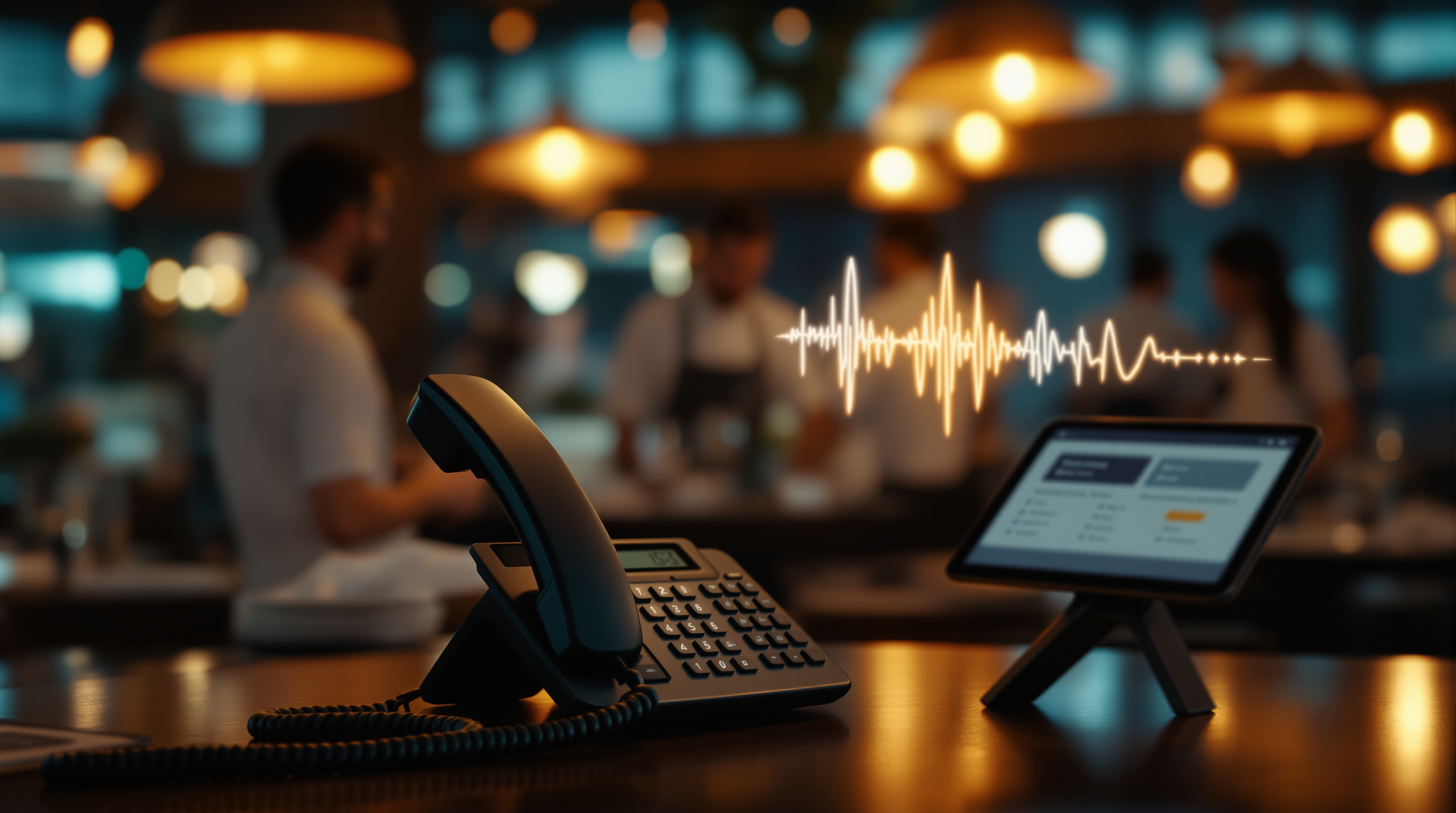
Friday night, 7:32 PM. Your kitchen is in the weeds, two servers just walked out, and the phone has rung four times in eight minutes. Nobody picks up. Maybe it was a regular trying to push back his reservation. Maybe a party of six choosing between you and the place next door. You'll never know.
This scene isn't an outlier. Industry data shows restaurants miss roughly 32% of incoming calls between 5 and 8 PM — exactly when 47% of a restaurant's daily phone orders come in. And in Quebec, the 2026 context is turning what used to be an operational nuisance into a problem of compliance, revenue, and competitive position.
The actual cost of a phone ringing into nothing
The cost of missed calls has been minimized for years. "They'll call back." Except in 2026, they don't. They open Google Maps, they open OpenTable, and they book somewhere else within 90 seconds.
The numbers from Slang AI and QSR Magazine line up: an average restaurant loses around $1,200 per week in direct revenue from missed calls — that's over $34,000 per year. For a mid-size Quebec restaurant, that's a month of commercial rent in Montreal, or a part-time evening cook's annual salary.
What makes this particular to Quebec is what happens at the other end of the missed call: a no-show on a confirmed reservation. And that's where the OPC stepped in.
The $10 per person rule: what the OPC really changed
Since July 17, 2025, Quebec's Office de la protection du consommateur has allowed restaurants to charge up to $10 per person in no-show fees, provided the reservation involves at least two people. The regulation was framed as a tool for restaurateurs, but in practice, most establishments can't apply it. Why?
Because billing requires a paper trail. A trace of the reservation, a trace of the conditions communicated, a trace of the no-show itself. When your only proof of a booking is a Post-it scribbled by a stressed server between two services, you have nothing to show your payment processor when the customer disputes the charge.
One Laval restaurateur recently described trying to apply the $10 fee to a party of eight that never showed on a Saturday night. The reservation had been taken by phone at 4:55 PM during peak rush. The employee hadn't recorded the card number, hadn't verbally communicated the conditions. The customer disputed, the processor refunded. The restaurant lost twice: the empty table AND the chargeback fees.
Why 2026 is the year this finally works
Three things changed in the past twelve months. And it's their combination that makes the AI voice agent no longer a gadget but a serious operational tool for a Quebec restaurant.
One: voice quality. The 2026 models — gpt-realtime on the OpenAI side, ElevenLabs v3 on text-to-speech — now pass the phone test. A customer calling your restaurant and reaching an AI voice agent no longer hangs up after 5 seconds saying "not with a machine." Latency dropped under 800 ms, and the tone isn't mechanical anymore. For the first time, the conversation holds up against the background noise of a moving car.
Two: POS integration. In March 2026, Sadie AI and Payfacto announced direct integration with Maître'D, Veloce, and Virtuo — the three POS systems most used by Quebec restaurants. For the first time, an AI voice agent can drop an order straight into the kitchen station without an employee retyping items. Transcription errors leave the equation.
Three: the MCP protocol on the ElevenLabs side, which lets a voice agent book live in a calendar without a duct-taped webhook. We covered this recently in our guide on MCP appointment booking, and the same mechanism applies to reservation systems like OpenTable, Libro, or Restoloco.
What an AI voice agent actually does for a Quebec restaurant
Setting marketing aside, here's what a properly configured AI voice agent does during a typical Thursday evening:
- Picks up before the second ring, in French by default, with automatic switch to English if the caller starts with "Hi."
- Takes the reservation by confirming date, time, party size, name and phone number, then pushes the data straight into Libro or OpenTable.
- Reads the no-show conditions aloud ("If you don't show up, fees of $10 per person may be charged to the card on file"), and generates an audio trace archived for 12 months.
- Captures takeout orders, reads the menu if asked, handles modifications ("no onions, nut allergy"), and sends the order to the POS without human intervention.
- Transfers to a human the moment it detects a complaint, an off-script question, or an angry customer — with full conversation context handed to the manager.
That last point is often what shifts perception. The AI voice agent isn't there to replace your maître d'. It's there to handle the raw flow — the "are you open tonight," "do you have gluten-free options," "I want to move my Saturday 8 PM reservation" — so your team is freed from repetitive calls during rush.
The Quebec accent and the "France French" trap
One detail that derails many deployments: most AI voice agents on the market were trained on Hexagonal French — Parisian, formal. When a customer from Saint-Hyacinthe calls to book and says "j'aimerais venir souper jeudi avec ma blonde," the agent might transcribe "ma blonde" as a hair color and lose the thread.
We've covered this problem in detail in our piece on the Quebec accent and speech recognition. Short version for a restaurateur: demand real tests with recorded calls from your regular clientele before signing anything. If the vendor balks or only offers Parisian-French demos, that's a red flag.
Law 25 and call recording: the silent trap
Quebec's Law 25 requires explicit consent before any voice recording. For an AI voice agent, that means the very first message — before even taking the reservation — must clearly announce that the conversation is recorded and processed by an automated system, and offer the option to speak to a human.
Most restaurants enabling this kind of system forget this detail, or worse, copy an English-language script that doesn't respect the Quebec phrasing. The CAI can open an investigation on a single complaint, and administrative fines start at $15,000. For an independent restaurant, that's not negligible.
What we configure at TECHMA for our restaurant clients is a bilingual greeting that mentions recording, data use restricted to the reservation only, and that proposes from the first sentence "to speak to a human, say employee." The human option must always remain accessible — that's a requirement, not a courtesy.
Where it still breaks in 2026
Let's be honest: an AI voice agent isn't magic. Here are the three areas where it's still weak, and where you must plan for a human protocol:
Groups larger than 12. Too many variables (multiple allergies, special requests, audio-visual needs for a birthday). Better to have the agent confirm availability and transfer to your maître d' to close.
Emotional complaints. An unhappy customer calling because they found a hair in their soup last week doesn't need a robot. The agent must detect the tone and transfer within 15 seconds, with a "customer complaint, requesting human" context handed to the manager.
Highly specific ingredient questions. Severe allergies (peanuts, shellfish) should never rely solely on the agent's knowledge base. The rule we impose on our clients: on a severe allergy question, the agent only confirms with "I'm transferring you immediately to a team member for an exact answer."
The cost for an average Quebec restaurant
For a 60-seat establishment in Quebec City or Montreal handling 200 to 400 calls per week, deploying a managed AI voice agent (configuration, POS integration, ongoing supervision) runs around $350 to $600 per month. Compared to the $1,200 per week lost in missed calls, ROI happens in three to four weeks.
We recently published a full TCO comparison between a human receptionist and an AI voice agent for Quebec SMBs — the numbers also hold for restaurants, with a small adjustment for peak call volume.
Important to note: at TECHMA, we don't ship a self-service platform. Configuration, POS integration, bilingual testing with Quebec accents, Law 25 compliance, and human transfer tuning are all delivered as a managed service. You don't touch the platform — you call us when something changes in your menu or hours, and we update it.
The test to run before signing with any vendor
If you're evaluating an AI voice agent for your restaurant this year, demand three specific things from the vendor:
1. A live demo with a call from one of your employees speaking everyday Quebec French — not a prepared script.
2. Written confirmation that voice data is stored in Canada (Law 25) and that on-demand deletion is documented.
3. A tested integration with your exact POS (Maître'D, Veloce, Virtuo, Lightspeed, Square) — not an "integration possibility" through Zapier.
If any of these three points makes the vendor pull back, you know what you're walking into.
Bottom line: the ringing phone is still the #1 channel
Despite all the chatter around chatbots, SMS, and online reservations, the phone remains the primary booking channel for 60 to 70% of independent Quebec restaurants. And it's exactly the channel where you miss 1 in 3 calls during peak service.
The 2026 AI voice agent isn't the disappointing 2023 experience anymore. With gpt-realtime, ElevenLabs MCP, and Payfacto POS integrations, we've moved from marketing gadget to operational tool. What remains is configuring it correctly for your market — Quebec accent, Law 25, no-show fees, human transfers — and measuring.
Want to see what this looks like for your specific restaurant? Book a free phone audit — we call your main line during Thursday-night rush and send you the report with the exact percentage of missed calls over the week. No commitment, just the numbers.