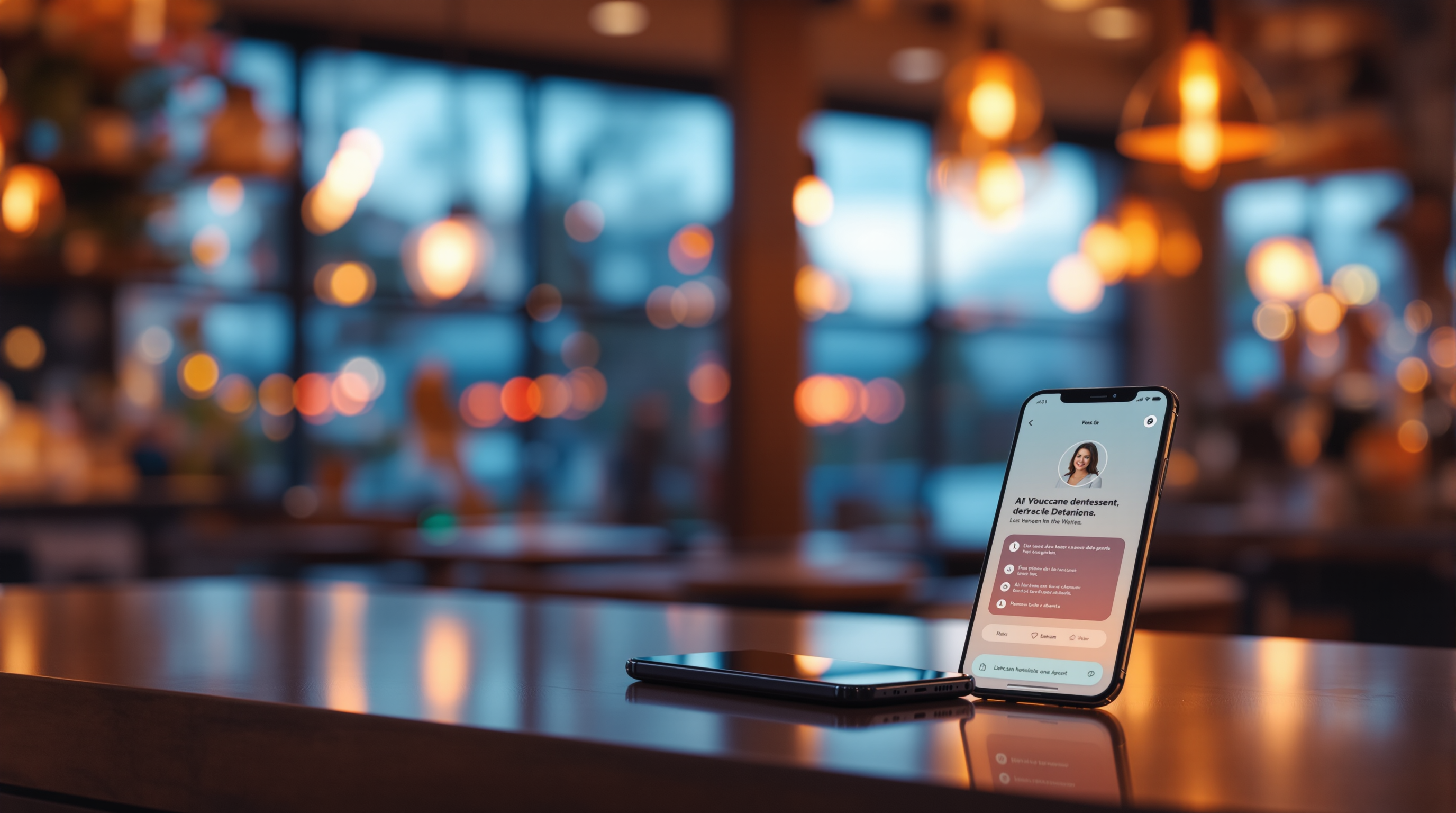
Friday night, 6:47 p.m. A table of four is torn between your restaurant and the one across the street. They dial your number. It rings. Rings again. Nobody picks up — both of your hostesses are tied up with a large Saturday group and a supplier confirming tomorrow's delivery. Third ring, fourth. The table of four hangs up and calls your neighbor.
That scenario plays out multiple times a service. The recent numbers out of Quebec and Canada don't leave room for debate: 43% of incoming restaurant calls go unanswered, and roughly 25% of reservations are made outside business hours. Compiled across North American voice AI platforms, the estimated annual loss for a mid-volume establishment lands at $76,000 CAD.
And in 2026, something just moved the goalposts. On August 28, OpenAI released gpt-realtime into production for every developer, cut pricing by 20%, and added two new voices (Cedar and Marin). The model was specifically trained to follow complex instructions, read scripts word-for-word, and switch languages mid-sentence — three capabilities that happen to be exactly what a bilingual Quebec restaurant needs.
This article unpacks what that actually means for a Quebec restaurateur: how many calls you're really losing, what a next-generation AI voice agent can recover, and where the traps are before you sign with a vendor.
The real cost of missed calls in a Quebec restaurant
Let's talk real numbers, not marketing projections. A Montreal or Quebec City restaurant with 80 seats averages 1,200 to 1,500 incoming calls per month. Between 40% and 43% never get picked up — documented across Canadian voice platform operators.
Of those missed calls, 60 to 70% are customers trying to book a table or place an order. Do the math: $55 average check in Montreal, 800 missed calls a month, a third converting to two-seat reservations. That's $29,000 in evaporated monthly revenue — close to $350,000 a year for an independent restaurant.
And it gets worse. The MICHELIN Guide officially landed in Quebec in 2025. Some Montreal restaurants saw reservation inquiries spike 400% in the weeks after the announcement. The ones that couldn't absorb the wave on the phone simply handed those customers to their competitors.
Three main sources feed these losses:
- Service hours. Your team is on the floor, not on the phone.
- After hours. 25% of inquiries hit between 10 p.m. and 10 a.m. — when literally nobody is there to answer.
- Seasonal peaks. Valentine's Day, Mother's Day, holiday season. Call volume doubles, and even your best hostess can't cover three lines at once.
A 2026 Forbes report mentions $3,000 to $18,000 in additional monthly revenue per location for restaurants that switch to an AI host capturing 100% of calls. Those are U.S. numbers, but the mechanics are the same: fewer missed calls = more filled tables.
What gpt-realtime technically changes for restaurants
Before August 2025, most AI voice agents had two critical problems for a restaurant use case: latency and bilingual handling.
Latency is the delay between the end of your sentence and the start of the agent's reply. Under 800 ms, it passes for natural conversation. Above that, the customer hangs up. We wrote a full guide on why 800 ms stays the critical threshold if you want to dig deeper.
Bilingualism is the whole Quebec market. A customer calls in French, switches to English mid-conversation to spell their last name, then switches back. Earlier models got confused. gpt-realtime was specifically trained to switch between languages mid-sentence without breaks, per OpenAI's official release notes.
Three other updates matter for your use case:
- Improved complex instruction following — the agent reads your cancellation or deposit policy word-for-word, without improvising, without dropping a clause.
- Precise tool calls — when the agent has to query your reservation system (Libro, OpenTable, Resy) or POS (Lightspeed, Toast), the trigger and parameters come out right on the first try.
- Cost reduction — $32 per million audio input tokens and $64 on output, a 20% drop from before. For a 1,500-call/month restaurant, that translates to a few dozen dollars saved monthly on infrastructure.
ElevenLabs didn't sit still either. Their Conversational AI 2.0 update and April 2026 features (multi-agent tracking, scope-based conversation evaluation, tests organized into folders) give integrators sharper tools to measure and correct agent behavior — historically a tedious exercise.
For a restaurateur, what this means in plain English: the 2026 agent finally resembles the good human host you'd love to clone.
Three real scenarios a 2026 AI voice agent handles without flinching
Scenario 1 — The standard bilingual reservation at 10:30 p.m.
A couple is leaving the movie theater. One of them wants dinner at your place on Sunday for brunch, the other asks about the vegetarian menu. The whole call is in French with English terms tossed in ("le brunch", "takeout", "pancakes"). The agent responds in French, confirms availability via Libro or OpenTable, sends the confirmation by SMS and email. Call duration: 1 min 40 sec. Infrastructure cost: roughly $0.18. While your hostess finishes her service.
Scenario 2 — Takeout orders on a storm night
Nobody wants to go out. Your phone rings every two minutes. An AI voice agent handles up to 100 to 200 simultaneous calls depending on the platform, takes orders, pushes them into your POS, and handles recurring questions ("is the arrabbiata sauce spicy?") with the same consistent answers as if it were you on the line.
Scenario 3 — The 12-top on a Tuesday
A corporate meeting organizer calls to book a 12-person group for Tuesday lunch. The agent recognizes this is outside its autonomy scope (groups of 8+ = human review), captures the contact details, fires an instant alert to your floor manager, and confirms to the customer that they'll be called back within the hour. No customer lost, no negotiation missed.
The four Quebec traps nobody explains
Before you sign with any AI voice agent vendor, look these four points square in the face. We see them every week at TECHMA.
1. Bill 25 (Loi 25) is not optional
Your restaurant collects names, phone numbers, dietary preferences (sometimes indirectly health-related, like allergies). Since September 2023, Quebec's Loi 25 requires explicit consent, documented processing purposes, and a designated privacy officer. An AI voice agent that records these calls has to be configured accordingly, ideally with servers hosted in Canada. Here's the detailed guide to staying compliant — read it before signing, not after.
2. Integration with your existing stack
Lightspeed, Veloce, Maître'D, Libro, OpenTable, UEAT — Quebec has its own ecosystem. An AI voice agent that speaks beautifully but can't push a reservation into your booking system is an agent that forces you to re-enter everything manually. You haven't gained anything. Our integration guide covers the questions to ask before signing.
3. The real all-in price
Vendors often advertise "starting at $299/month". In reality, once you factor in conversation minutes, integrations, initial setup, and updates, a Quebec SMB typically pays between $400 and $900/month for an Agent IA Vocal that actually works. Our transparent 2026 pricing guide breaks it all down — with real-world examples for three restaurant sizes.
4. Quebec French, not generic international French
There's a difference between "Bonjour, réservation pour ce soir ?" and "Allo, vous avez-tu d'la place à soir ?" — the second is what many of your customers actually say on the phone. A poorly trained agent misreads regional phrases, anglicisms, and Quebecois idioms, and it drives customers away. Ask for demos in Quebec French, not European French.
The simple ROI math for your restaurant
Run this on your own operation over 30 days:
- Monthly incoming calls × 40% = missed calls
- Missed calls × 65% = prospects who wanted to book/order
- Those prospects × average check × estimated conversion rate (20-30%) = lost revenue
On 1,500 calls, with a $60 average check and a 25% conversion rate, you're looking at about $23,400 in recoverable monthly revenue. Against an AI voice agent cost of $500-$700/month, the payback is obvious within the first weeks.
One golden rule: never sign without first testing the agent on 5 to 10 real operational scenarios. We published the 5 critical scenarios to expose vendors who demo well but perform poorly.
The 2026 takeaway
Quebec restaurants taking a position on Agent IA Vocal right now are doing it for three concrete reasons, not for the tech buzz. First, because 43% of missed calls has become an intolerable number with MICHELIN raising the service-quality bar. Second, because gpt-realtime and the 2026 generation of models finally fix the two real problems — latency and bilingualism — that doomed the earlier attempts. Third, because 25% of reservations happen when nobody is on the phone, and those customers just go somewhere else.
The real question isn't "is the tech ready?" anymore. It's: who's going to answer your calls tonight at 10:47 p.m., when your hostess takes her apron off?
External sources and resources
- OpenAI — Introducing gpt-realtime (August 2025) — official model announcement.
- ElevenLabs — Conversational AI 2.0 — major update for voice agents.
- Sadie — Voice AI for Restaurants in Canada: A 2026 Landscape Comparison — recent Canadian statistics.
TECHMA designs, deploys, and maintains the full Agent IA Vocal infrastructure for your restaurant: connection to your existing line, Libro/OpenTable/Lightspeed integration, Quebec-French bilingual configuration, Loi 25 compliance setup. You configure nothing yourself — our teams handle it end-to-end.