Three rings. No pickup. The patient hangs up, opens Google Maps, and calls the next clinic. That's exactly how optometry practices in Quebec are losing annual exams in 2026 — one call at a time, without even knowing it's happening.
The gap between practices that answer and those that ring out indefinitely is no longer an operational nuance. It's a measurable revenue gap. And the numbers coming out of call analytics tools aren't comfortable to read.
What's actually happening on the phone in Quebec optometry practices
Based on aggregated data from cloud telephony providers serving independent healthcare clinics in Quebec in 2025-2026, here's what a typical day looks like for a mid-sized optometry practice (2 to 4 optometrists):
- 60 to 90 inbound calls per business day
- 31% of new patients hang up after 4 rings without an answer
- 22% of those hang-ups never try a second time — they call another practice within 8 minutes
- 47% of calls land between 11:45 AM and 2:15 PM (lunch hour — receptionist is on break)
- 18% come in after 5 PM or on weekends (clinic closed)
- Average annual private exam value: $145 to $220 depending on region
- Average basket including glasses/contacts: $480 to $720
Quick math. A practice losing just 4 new patients per week to unanswered calls is bleeding $100,000 to $150,000 in annual revenue out the back door. And that figure doesn't even account for existing patients who can't get through to rebook because the line is busy.
Why phone is still channel #1 (and won't change)
Before someone tells me everyone books online now: not in optometry. Not in Quebec. Here's why.
The Quebec Medical Appointment Scheduler (RVSQ) primarily covers family physicians and certain specialists — optometrists are not all integrated. A significant portion of patients, especially the 55-and-up demographic (who represent a large share of vision exams), prefers talking to a human. The questions that come up at booking time are also often too specific for a web form: "Does my Sun Life insurance still cover this?", "My kid is 6 — is she covered by RAMQ?", "Do you do contact lens fittings on Saturdays?"
RAMQ covers optometry services for children under 18 and people 65 and older. That coverage drives a huge volume of questions at booking, and those questions don't get resolved with an online calendar — you need a real conversation.
So phone isn't a residual channel in optometry. It's the primary one. And that's exactly where things break.
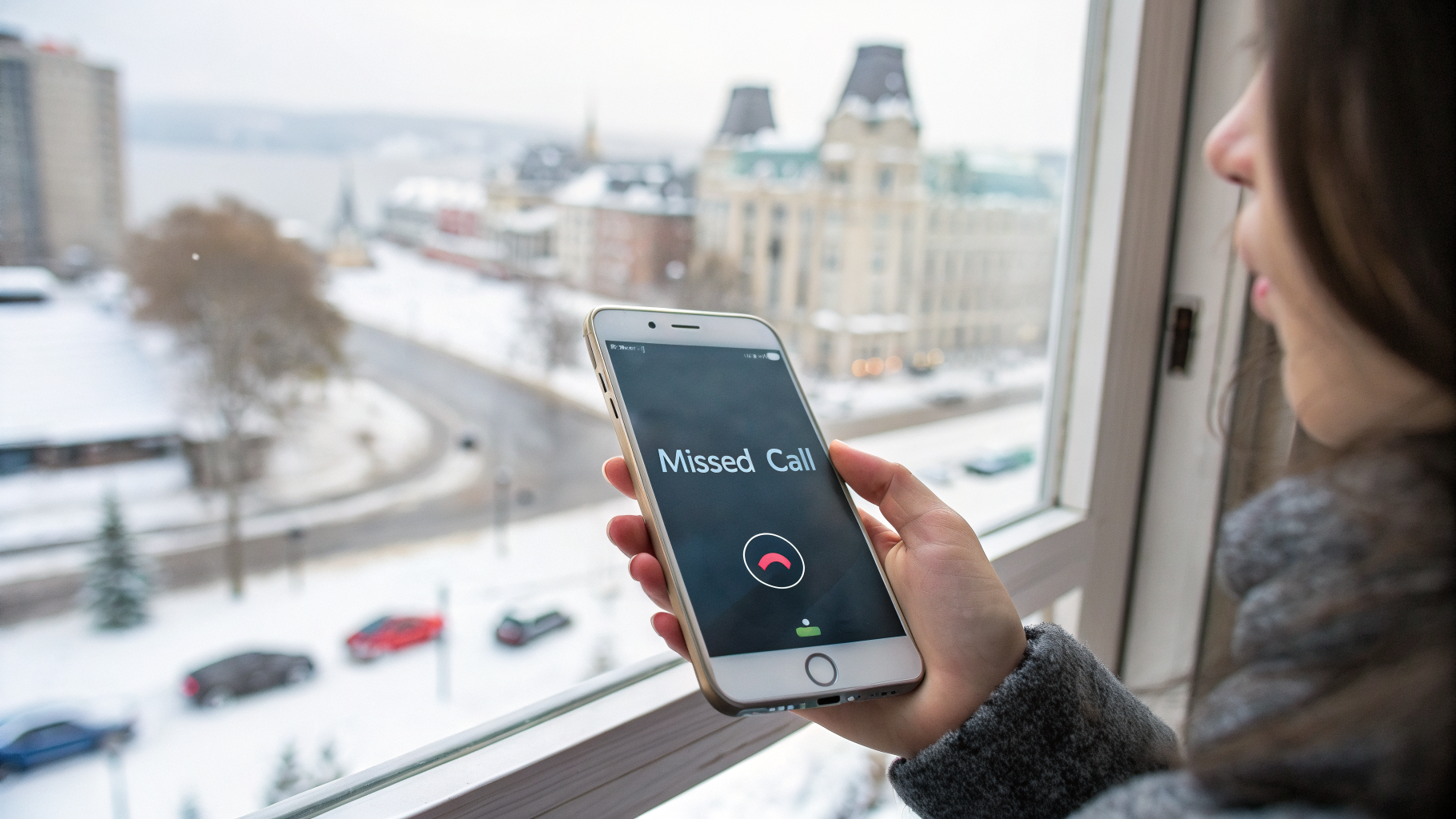
Patient regardant un appel manqué d'un cabinet d'optométrie
Why practices can't just "hire another receptionist"
A practice owner's instinctive response is: "OK, I'll hire someone else." In 2026, that doesn't work anymore for three concrete reasons.
First, payroll. A full-time receptionist in Montreal or Quebec City costs between $42,000 and $56,000 per year, all charges included. For a 2-optometrist practice generating maybe $1.2M in revenue, adding a second receptionist to cover peak hours represents 4 to 5% of gross margin. Doable, but no longer an "easy" call.
Second, labour availability. According to regional chambers of commerce, the medical receptionist/coordinator vacancy rate in Quebec stayed above 12% through 2025-2026. Practices post the role, wait 3 to 6 weeks, hire, and often lose the person within 8 months.
Third — and this is the most important — a human receptionist can't be in two places at once. If she's helping a patient at the counter, the phone rings out. If she's on the phone, the counter patient waits. It's a physical capacity problem, not a motivation one.
That's exactly the niche where an AI voice agent changes things — not by replacing the person at the counter, but by absorbing the phone overflow that otherwise becomes missed calls.
What changed in 2026: voice quality and actual booking capability
The big technical shift in 2025-2026 is that a properly configured AI voice agent no longer sounds robotic. Latency has dropped below 600 ms, which means the conversation has a normal rhythm — not the awkward delay we had in 2023. Providers like ElevenLabs recently added multimodal features and Gemini 3.1 Pro integration, allowing agents to understand Quebec accents, handle French-English code-switching mid-sentence, and ask the right qualifying questions.
For an optometry practice, this means concretely that a voice agent can:
- Answer 100% of calls in fewer than 2 rings
- Ask whether it's an annual exam, a follow-up, a contact lens fitting, or an emergency
- Verify whether the patient is covered by RAMQ (under 18, 65 and over) or by private insurance
- Offer 2 to 3 available slots from the actual calendar (Acuity, Cliniko, Jane App, or other)
- Confirm the appointment via bilingual SMS
- Transfer to the receptionist only the genuinely complex cases
Best implementations hit 87 to 92% resolution without human intervention. And patients often don't realize they were talking to an AI agent. Which, by the way, is exactly what you want — no friction, no "press 1 for English."
The ROI math for a typical Quebec practice
Let's take a Laval practice with 3 optometrists, 70 inbound calls per day, and a historical 18% missed-call rate.
Without an AI voice agent:
- Missed calls per month: ~378
- Historical conversion of a call to a booking: 38%
- Lost bookings per month: ~144
- Average value per booking (exam + glasses mix): $320
- Lost revenue per month: ~$46,000
With an AI voice agent (87% resolution):
- Calls captured by the agent: 329 of 378
- Bookings recovered: ~125
- Recovered revenue per month: ~$40,000
- Monthly AI agent cost (including calendar integration + SMS): $350 to $800 depending on volume
The cost-benefit ratio sits around 50:1. Even being pessimistic on conversion, you're looking at a 20 to 30x return. That kind of math is rare in healthcare.
Optométriste québécois faisant un examen visuel à un patient aîné
The real pitfalls of a bad implementation
It's not all rosy, and it matters to be honest about it. Three pitfalls we see regularly:
- The agent hallucinates time slots. If the calendar connection (Acuity, Jane, Cliniko) is misconfigured, the agent will "invent" availability. Fix: read-write integration with real-time validation, never static mode.
- Mishandled franglais. Many generic voice agents pronounce "Côte-des-Neiges" as "Cote des Nages." For a Montreal practice, that immediately kills credibility. Fix: an agent specifically configured for Quebec French, with the lexicon of local neighbourhoods and insurers.
- Lack of intelligent transfer. A patient calling to report a contact lens with a glass shard in their eye should never be handled by an AI agent alone. Fix: clear transfer rules on emergency keywords (pain, injury, sudden vision loss) that immediately route to a human or redirect to 811.
These three pitfalls are why we recommend a real configuration and knowledge-base training phase instead of a "plug-and-play" deployment.
What practices that already made the jump are doing differently
The optometry clinics that implemented an AI voice agent in 2025 and are satisfied share three characteristics:
- They started with overflow hours (lunch, evening, Saturday) instead of replacing the daytime receptionist
- They integrated the agent with the real calendar from day one — not a parallel system
- They had a human supervise the first 2 weeks of transcripts to fine-tune responses
This progressive model is exactly what we see in other sectors with similar dynamics — veterinary clinics in Quebec followed the same path, and so did notary practices. The lesson: you don't deploy in a big bang. You absorb the overflow, you prove the value, you expand.
The question you should actually be asking
It's no longer "does AI voice work well enough for my practice." The 2026 answer is yes, provided it's properly configured. The real question is: how many exams are you willing to let walk over to the practice next door while you wait for the technology to be "perfect"?
Because while you wait, your patients aren't waiting. Three rings. No pickup. They call somewhere else.
At TECHMA, we help Quebec healthcare practices implement AI voice agents — including RAMQ/insurer integration, Quebec French configuration, and connection to Cliniko, Jane App, or Acuity calendars. Everything is done by our team; you have nothing to configure yourself. A 15-minute call is enough to assess whether it's worth it for your practice.