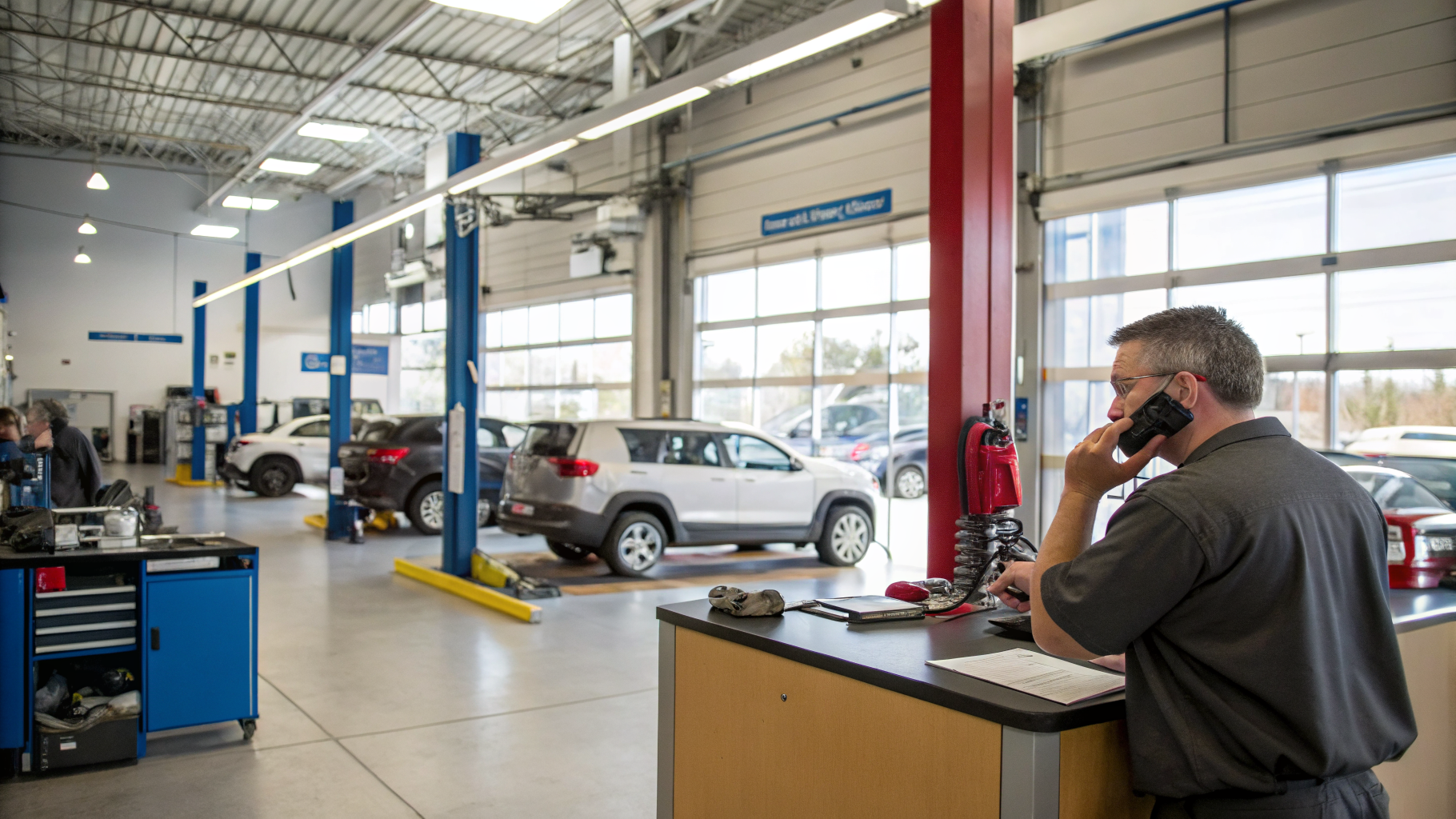
An independent auto repair shop in Quebec can lose 1 in 4 calls during business hours. Not overnight. Not on Sunday. While the bays are full and the counter is busy. According to the Automotive Service Association, about 25% of calls to repair shops go unanswered.
Run the math for a second. The average repair order is around $428 USD, roughly $580 CAD in 2025. And when a call is missed, the average revenue loss per call often lands between $100 and $200. For a typical shop, that can add up to $75,000 a year in lost revenue. Let's be honest. This is not a mechanical skill problem. It's a phone availability problem.
Quebec has more than 7,000 repair shops. Most are small. One to three bays. One service advisor at the counter, maybe two on a good day. In-person customers always come first. Of course they do. But the caller looking for a brake quote, a tire estimate, or an OBD diagnostic doesn't wait very long. Why would they?
Here are the 6 most common reasons shops lose calls and $400 to $800 estimates, and how an AI voice agent auto repair shop Quebec solution, deployed turnkey by Agent IA Vocal and installed by TECHMA, helps recapture those opportunities without adding chaos to your day.
1. The service advisor is buried in a live customer file at the counter
The scene is painfully familiar. A customer walks in with a check engine light. Another is waiting for an invoice. The phone rings. Then it rings again. The service advisor glances at the screen, then keeps explaining a $760 suspension estimate to the person standing right there. That's normal. The customer in front of them wins.
Inside a real shop, the front counter absorbs everything. Warranty questions. Repair approvals. Parts coordination. technician updates. Supplier calls. Courtesy car logistics. The phone becomes the thing that gets pushed aside. Not because no one cares. Because there are only so many hands available.
The caller doesn't see any of that. They hear ringing. Or hold music. Or voicemail. And the 2026 phone statistics for the industry are rough: 75% of callers sent to voicemail never call back, and about 85% of callers who don't get an answer contact a competitor. Brutal, yes. Also predictable. If your brakes are grinding, patience is not your strategy.
Picture a simple inbound lead. “Hi, I need a quote for front brakes on a 2018 Civic.” If nobody answers within 20 to 30 seconds, that person moves to the next shop on Google Maps. This is not an abstract loss. It may be a $450 job, a $600 job, sometimes an $800 job once rotors, pads, labor, and taxes are involved.
Other trades see the same pattern. Plumbers, electricians and HVAC contractors lose calls when field work takes over. In auto repair, the difference is volume. The phone does not stop.
2. The 7 a.m. to 9 a.m. rush swallows the day's best scheduling calls
From 7 to 9 in the morning, the shop is in survival mode. Customers are dropping off vehicles. Someone wants to know if their car will be ready by 4. Another asks if they can wait on site for an oil change. A vendor is calling about parts. And new prospects? They call during that same window.
Why then? Because that is when people organize their day. Before work. Before errands. Before traffic gets worse. If they hear a wheel noise, have a slow leak, or suspect a weak battery, they call early hoping to get into the day's schedule. If there is no answer, they do not usually think, “I'll try again at 11:40.” They call the next shop.
In a small one- to three-bay shop, one person at the counter may be handling 5 to 10 interactions almost at once during that period. Every one of those interactions takes time. Looking up a plate. Pulling service history. Opening a file. Answering a warranty question. Meanwhile, the call for a tire quote on a 2021 RAV4 waits. Then disappears.
Combine the 25% unanswered call rate with an average repair order worth roughly $580 CAD, and the morning rush becomes a revenue sink. Even if only 3 useful calls are missed each morning, and each one represents $100 to $200 in lost revenue, that is $300 to $600 gone before 9 a.m. Multiply that by 250 working days. It adds up fast.
What makes it worse? Many owners still assume those callers will try again later. Usually they will not. Research on lost revenue in automotive repair operations points the other way: slow or absent phone response directly feeds local competitors.
3. Lunch hour turns into a voicemail trap
Noon can look quiet from the outside. Inside the business, it often is not. Breaks are staggered. The front desk runs thinner. The phone keeps ringing anyway. And from 12 to 1 p.m., a surprising number of inbound calls come from people using their own lunch break to contact a shop.
Think about the customer journey. Someone hears brake squeal on the way to work. They cannot call at 8:15. At noon, they grab their phone, search for nearby shops, and call three places for pricing or availability. If your line goes straight to voicemail, you may have just lost a $500 to $700 job without ever knowing it happened.
Lunch-hour calls are often high intent. These are not always vague research calls. They are ready-to-book conversations. Oil change this week. Tire estimate. Check engine inspection. Suspension noise. Appointment request for tomorrow morning. Concrete needs. Revenue-generating needs. Quick to qualify if someone actually picks up.
The problem is simple: shops reduce phone coverage at exactly the moment part of the market becomes available to call. Voicemail becomes the default receptionist. And since 75% of callers who hit voicemail never call back, every weak lunch hour quietly compounds into lost work.
There is also a perception issue. Voicemail makes a business sound overloaded, not necessarily dependable. The caller wonders: if nobody can answer now, what happens if I need an update later or have a problem after the repair? That hesitation costs money.
Manual callbacks after lunch help a little. But let's not kid ourselves. Returning 8 messages at 1:20 p.m. does not mean 8 opportunities come back. In many cases, the caller already booked elsewhere.
4. After 5 p.m., evening breakdowns and next-morning emergencies go to competitors
Many shops officially close at 5 or 5:30 p.m. Mechanical problems do not care. A battery dies at 6:10. A tire starts leaking in the driveway. A check engine light turns on during the commute home. A parent realizes in the evening that the family vehicle needs to be safe by 7 a.m. the next day. That is when calls happen.
If a shop is unreachable after 5 p.m., the caller often does not leave a detailed message. They want an immediate answer. Can I tow the vehicle to you? Do you have room tomorrow morning? Is it safe to drive like this? If no one takes the call, they keep searching. The first shop that responds wins the relationship, not just the phone inquiry.
These calls may seem less frequent, but they tend to be valuable. An urgent problem often becomes a diagnostic and then a larger repair. Alternator. Battery. Brakes. Leak. Wheel bearing. Suspension. Sensor issue. This is rarely just a $79 oil change. It is often a $400 to $800 ticket, sometimes more.
After hours, your competition is not only the shop down the street. It is whoever appears available. A business that sounds reachable 24/7 builds trust. A business that goes silent after closing leaves the field open to anyone who answers, even if that competitor is farther away.
For an average shop, just a few missed evening calls per week can feed that $75,000 annual revenue leakage number. And this is not theory. It is the sum of small missed opportunities, one after another, all year long.
5. Tire, brake, and OBD estimate callers hang up in under 30 seconds when put on hold
Not every caller has the same patience. Quick estimate calls are the most fragile. A person calling about tires, brakes, or an OBD diagnostic usually wants three things: do you handle this kind of work, do you have availability, and what info do you need for a quote or appointment? If they get put on hold for too long, they move on.
In many repair shops, hold is treated as a safety net. At least the call is still there, right? In reality, it is often already lost. Once wait time passes 30 seconds, especially on mobile, many callers jump to the next Google result. Why stay? They just want to know whether their 2017 F-150 can be seen tomorrow for a rear brake noise.
These are highly qualifiable calls. In under a minute, the right system can ask for year, make, model, mileage, customer concern, and whether the need is oil service, tires, urgent repair, estimate, or appointment. That is exactly where the lack of structure becomes expensive. Human staff cannot always triage every inbound call during peak pressure.
A tire estimate? Easily $700 to $1,200 depending on size and season. Brakes? Often $400 to $800. An OBD diagnostic may start smaller, but it opens the door to the actual repair. When those callers hang up before anyone speaks to them, the lost revenue is immediate.
If you want to calculate the ROI of your AI voice agent, start here: how many of these estimate-driven calls do you get each day, and how many wait too long? Owners are almost always surprised by the answer.
6. Existing customers no longer leave messages. They Google another shop
Here is a stubborn myth: “Our loyal customers will call back.” Maybe that was true years ago. Today, not so much. Customer behavior changed. Even satisfied repeat clients often do not leave voicemail anymore. They open Google, search the service they need, and compare options that look available right now. Loyalty still matters, but it is weaker when the phone goes unanswered.
A returning customer calling about winter tires, suspension noise, or an ABS light usually does not want to narrate the issue to voicemail. They want progress. If your line does not answer after a few rings, they try another well-rated shop with a clear website and a live-sounding phone response.
This is dangerous because it rarely shows up clearly in internal reporting. The shop just notices softer booking numbers or slower weeks and does not always connect that drop to phone friction. But that is often where erosion begins. A longtime customer who cannot reach their usual shop tries someone else. If the experience is decent, they may not come back.
In a Quebec market with thousands of repair businesses competing for the same drivers, response speed is a competitive advantage. Not a nice-to-have. An existing customer base does not protect you from phone attrition. If anything, it creates false confidence.
There is another angle too. Existing customers are often the most profitable ones. Their history is known. Trust is already built. Conversion rates are higher. Losing that call can hurt more than losing a brand-new lead. That is why proper data handling and Quebec Law 25 compliance matter when modernizing call response workflows.
The solution: a turnkey AI voice agent installed and managed by Agent IA Vocal and TECHMA
The good news? You do not need to hire another full-time front-desk employee to recover these calls. Agent IA Vocal deploys an AI voice agent designed for the day-to-day reality of Quebec repair shops, and TECHMA handles the full installation, configuration, integration, and management. No self-serve setup. No prompts for your team to write. No DIY patchwork.
In practical terms, the agent answers in about 2 seconds, 24/7. It picks up when your staff is busy, at lunch, after 5 p.m., or during the morning rush. It qualifies the need with the right questions: year, make, model, mileage, type of issue, urgency, quote request, tires, oil service, brakes, diagnostics, or appointment booking.
Then the information does not get buried in a vague voicemail. The customer receives a confirmation text message. The manager or service advisor receives a structured email with usable details. Depending on your setup, TECHMA can also integrate the workflow with your scheduling system or the tools already used in your shop. The goal is simple: fewer missed calls, less back-and-forth, more qualified bookings.
TECHMA also manages training, scenario tuning, escalation rules, and privacy requirements, including applicable Law 25 compliance. Your team keeps doing what it does best: serve customers, diagnose problems, and repair vehicles. The agent captures the calls that would otherwise go to the competitor down the road.
A repair shop does not need more noise. It needs more answered calls. If you want to see how many estimates and appointments you are really losing, talk to us. Agent IA Vocal and TECHMA can show you what call handling looks like when it is finally built for the real life of a Quebec auto shop.