It's 7:12 on a Tuesday evening. Your business is closed, your receptionist left hours ago, and the phone rings. Before the second ring, a voice answers, understands the caller wants to move their Thursday appointment, checks your calendar, offers Friday at 10 AM, confirms it — and texts you a summary. All of it in less time than it takes you to read this paragraph.
Most business owners across Canada have heard of AI voice agents, but few know what actually happens between the moment the phone rings and the moment the caller hangs up satisfied. So let's break it down, second by second, with no jargon.
The Three "Organs" of an AI Voice Agent
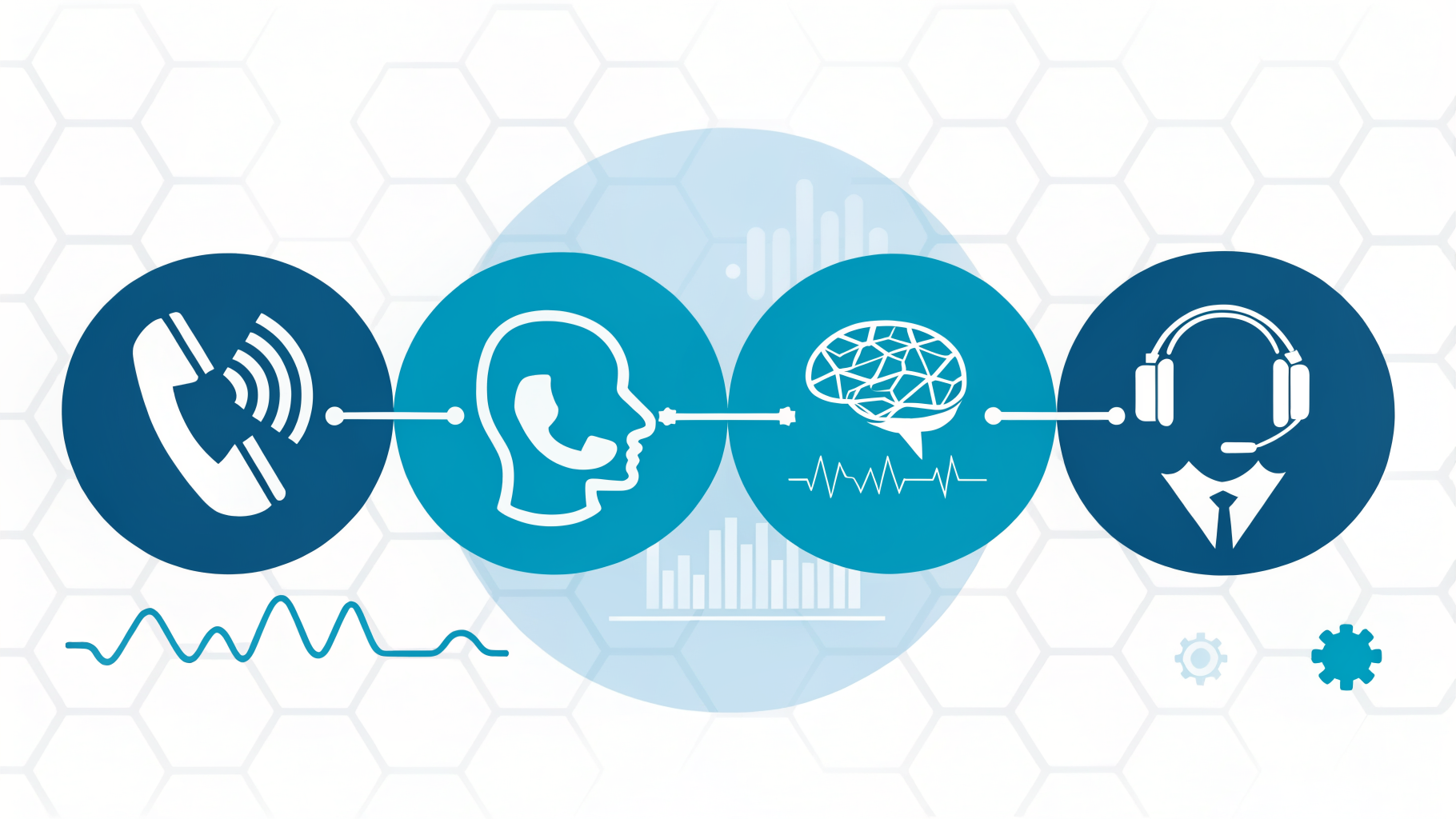
Forget the technical diagrams for a minute. An AI voice agent is really three things working together: ears, a brain, and a voice.
The ears are speech recognition (speech-to-text): the technology that turns what the caller says into text the machine can work with. The brain is a large language model — the same kind of engine behind the assistants you already know — that understands intent and decides what to do. And the voice is speech synthesis (text-to-speech) that delivers the answer with natural intonation.
What makes the experience feel seamless in 2026 isn't any one of those pieces in isolation. It's how fast they hand off to each other. The full loop — hear, understand, respond — closes in under a second and a half. That delay, more than anything, is why a caller doesn't "feel" they're talking to a machine.
Second 0 to 1: The Agent Picks Up and "Hears"
On the first ring, the agent answers on your current number — the one your customers already know. No "press 1 for..." menu. It greets the caller in your business's name, and it listens.
And listening, in 2026, means a lot more than transcribing word for word. The agent handles accents, hesitations, the background noise of a busy job site, and the caller from Calgary who mumbles half a sentence before getting to the point. Modern speech recognition no longer trips over regional accents or a speaker switching between languages mid-sentence — a real advantage in multilingual cities like Toronto, Vancouver and Montreal.
It's the step you notice least, precisely because it works. When it's bad, though, everything downstream collapses: an agent that "hears" poorly gives answers that miss the mark.
Second 1 to 2: The Brain Understands — and Reasons
This is the biggest leap of recent years. A voice agent from three years ago followed a rigid decision tree: if the caller says X, reply Y. The moment you stepped off the script, it went in circles.
A 2026 agent reasons. If a caller says "I was supposed to come Thursday but I'm working now, can we do later this week?", the agent understands this is a reschedule, that Thursday is out, and that it should offer another slot. It pulls the information together even when the caller gives it out of order — something we dig into in our analysis of reasoning and complex calls.
That's what separates a smart answering machine from a real agent. The first takes a message. The second solves the problem.
Mid-Call: The Agent Checks Your Calendar and CRM
This is where the magic gets concrete. While it's talking to the caller, the agent can query your systems in real time: your calendar for actual availability, your customer database to recognize a regular, your management software to check an order status.
In practice: a known number calls, and the agent says "Hi Sarah, I see your last visit was back in March." The caller feels recognized, not processed like an anonymous file. And when the agent confirms a booking, it lands in your calendar instantly — no double-booking, no manual re-entry the next morning. We walk through this whole connection layer in our guide to calendar, CRM and SMS integration.
This ability to act, not just talk, is part of why adoption is climbing so fast. According to a roundup of small-business AI adoption statistics, the share of small businesses using AI regularly jumped from 48% to 68% in a single year.
Second 2 to 3: The Agent Answers in a Real Voice
Once the decision is made, the agent speaks its answer. And again, this is a long way from the robotic voices of old phone systems. 2026 voices breathe, pause, and rise and fall in intonation like a person.
Better still: the agent handles interruptions. If the caller starts talking over it — "no, no, morning would be better" — the agent stops, listens, and adjusts. That one detail, more than any other, is what makes a conversation feel human rather than scripted.
The whole thing happens fast enough that the silence between question and answer feels like a normal exchange. Half a second too long, and the illusion breaks. That's why serious providers measure this lag in milliseconds.
When the Agent Can't: Smart Transfer
Here's the part most articles forget to mention. A good AI voice agent doesn't try to do everything. It knows its limits.
You set the rules in advance. An emergency — a burst pipe, a furnace failure in a Winnipeg January — triggers an immediate transfer to the on-call person, or an alert text. A request that's too nuanced or emotional? The agent doesn't stubbornly repeat the same question: it takes a callback or hands off to a human, cleanly. The 80% of routine calls get absorbed by the agent; the 20% that need human judgment come to you, better prepared.
That well-managed boundary is exactly what separates a strong deployment from a customer-service nightmare. The agent isn't there to replace your team — it's there so they stop spending their days answering the same three questions.
What Changed in 2026 (and Why It Matters)
If you tried a voice agent two years ago and walked away unimpressed, that's a reason to try again. Two things shifted.
First, reasoning. The models behind these agents can now hold a multi-turn conversation without losing the thread, handle ambiguous requests, and course-correct mid-call. Second, fine-grained control over behavior: platforms like ElevenLabs have added settings — visible in their changelog — that let providers tune tone, verbosity and behavior by channel and context.
The result? Agents that sound less "system" and more "colleague." For a Canadian business, that means phone coverage that doesn't scare anyone off — across English, French, and the many languages spoken in your market.
"So Who Actually Sets It Up?"
It's the question we get most, and the answer usually comes as a relief. You configure nothing. You touch no "platform." You connect no APIs.
The TECHMA team handles all of it: the build, training the agent on YOUR services and YOUR pricing, connecting it to your calendar and CRM, testing, and going live on your existing number. Your part is about twenty minutes of questions at the start. That's by design: most business owners have neither the time nor the desire to become technicians. The contrast with plain voicemail — which we compared in detail in our voicemail vs. AI voice agent face-off — is stark: one takes messages that 9 in 10 callers will never leave, the other resolves the call.
Frequently Asked Questions
Will my customers realize it's an AI? Most won't notice anything, especially on routine requests. And the agent can introduce itself as an assistant — transparency doesn't hurt, as long as the call gets handled efficiently.
How long before it's live? About a week. The TECHMA team does the build, you validate the script, and the agent starts taking your calls.
Does it work in more than one language? Yes. The agent switches languages based on the caller, mid-call if needed — essential in Canada's officially bilingual, multilingual markets.
What if I want certain calls to always reach a human? You set the rules. Emergencies, key accounts, specific keywords: anything you want reserved for your team gets transferred automatically.
Three Seconds, Well Orchestrated
An AI voice agent isn't science fiction or a gimmick. It's three mature technologies — ears, a brain, a voice — synchronized finely enough that a caller feels like they're talking to your best employee, at 7:12 on a Tuesday or 3 AM on a Sunday.
Want to hear what it sounds like on YOUR calls? Book a 15-minute demo — we'll play you a real call — or see our plans starting at $49/month. We build the whole thing; you just get to hear the phone stop ringing into the void.