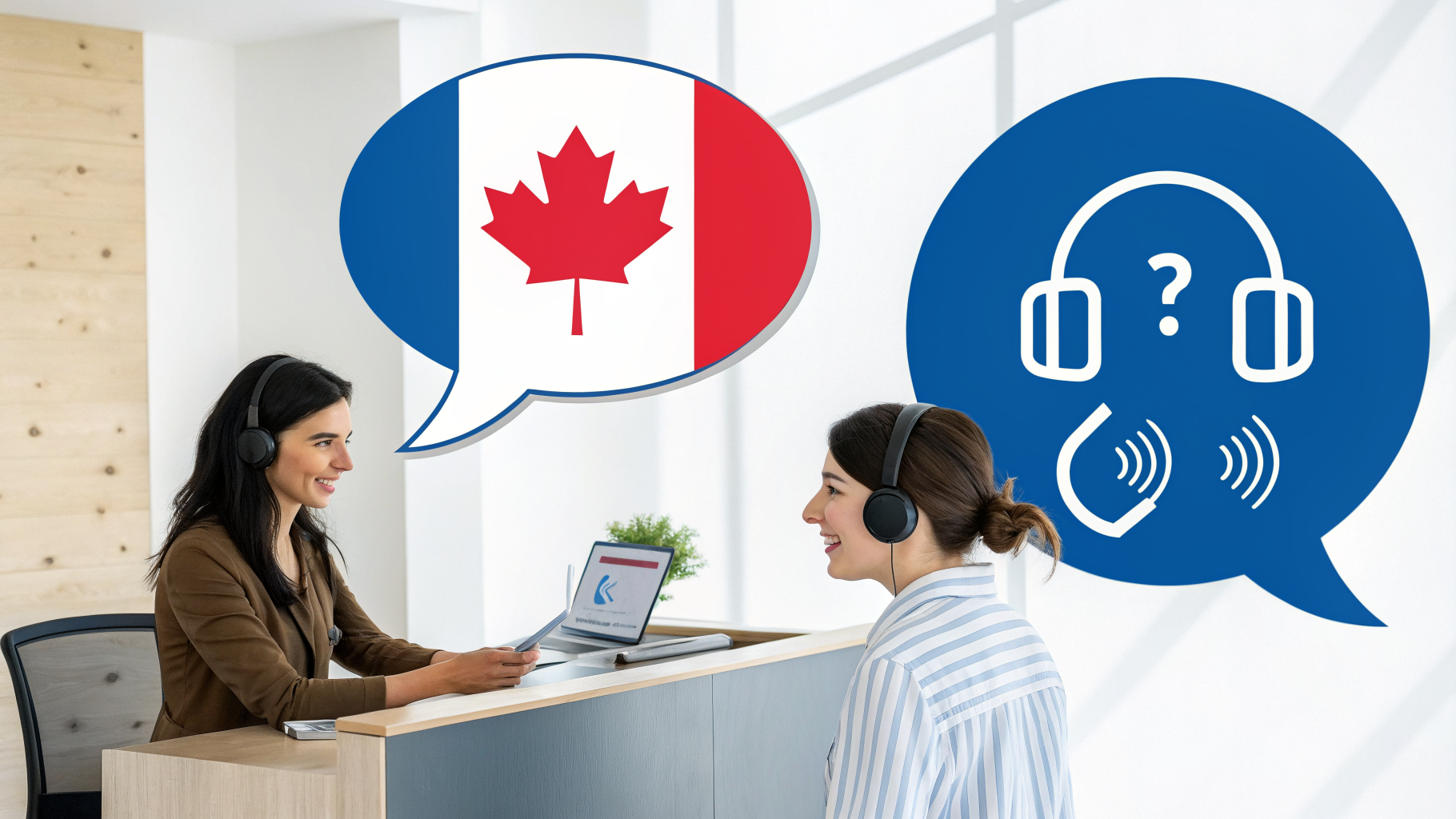
Introduction
It's 7 p.m. in Ottawa. A customer dials a clinic. She starts in English, then slips into French halfway through a sentence, the way people do every day on both sides of the river in Ottawa-Gatineau. What she gets is a recorded menu: press 1 for English, faites le 2 pour le francais. She hangs up. Three minutes later, she has booked with a competitor.
A bilingual AI voice agent solves exactly that. It detects the caller's language in the first sentence, answers in that language, and follows the caller even when they switch mid-call. But a badly configured bilingual agent is often worse than a unilingual human. This guide is a practical playbook for setting one up and, more importantly, testing it before it goes live.
By the end, you'll know how to deploy an agent that speaks natural Canadian French, switches to English without friction, and hands off to a human when it should. Budget about half a day to prepare your content, then a few hours of testing. This is not a six-month project.
Before you start: what you need
Three things before you touch any settings. First, a clear picture of your calls: what share comes in English, what share in French, and at what hours. A single week of call logs settles a lot of arguments.
Second, your up-to-date business information in both languages: hours, services, pricing, address, cancellation policy. Third, a decision about what the agent is allowed to do on its own (book an appointment, answer an FAQ) versus what it must route to a person. If you're still weighing an AI agent against a human service, our comparison of an AI voice agent versus an answering service will help you frame the decision before you configure anything.
Step 1 — Map your languages and your callers
You don't set up a bilingual agent 'just in case.' You set it up for real callers. For each service, note the dominant language and the exceptions. A home-services company in Moncton, New Brunswick, has a different profile than a law firm in Toronto or a dental office in Vancouver.
According to Statistics Canada, millions of Canadians speak French, and English and French are both official languages coast to coast. Beyond those two, major Canadian cities run on many more languages every day. Turn that into a practical target: what percentage of your calls must land in French, and where do the mixed-language cases hide? This map becomes the spec for every step that follows.
Step 2 — Choose automatic language detection (skip the menu)
The worst decision is the old reflex: press 1 for English, press 2 for French. It adds friction, it sounds bureaucratic, and it forces the caller to choose before they've even spoken.
Configure automatic detection instead: the agent analyzes the caller's first sentence and replies in the same language within a second or two. Open with a neutral greeting like 'Hello, bonjour' that commits to no language until the caller speaks. It's simple to set up, and the experience is far more natural.
Also pick a default language for the rare ambiguous case (a single 'yes' won't always reveal the language). In an English-majority market, English is the sensible default, with an instant switch to French the moment the agent hears it. In New Brunswick or the National Capital Region, you may want the opposite.
Step 3 — Write your bilingual content natively (don't translate word for word)
Here's the most common mistake: write the scripts in English, then run them through a translator. The result sounds off and gives the machine away instantly. Write each language for itself.
Prepare, in both languages: the greeting, three to five answers to your most frequent questions, your service descriptions, and transition phrases ('One moment, let me check,' 'Great, I'll confirm that for you'). Think about task-specific wording too. An agent that books appointments needs to state availability clearly; see our guide to automating appointment booking with an AI voice agent to structure that flow.
The 2026 tooling helps here. Recent platforms let you attach separate instructions or 'procedures' per task and per language, instead of cramming every rule into one prompt. One agent can run a French booking procedure and an English one without bleeding between them, while keeping sub-second response latency.
Step 4 — Configure Canadian French (not European French)
One detail changes everything: your agent's French should be Canadian, not Parisian. A caller in Winnipeg's St. Boniface or in Moncton who hears 'petit-dejeuner' instead of 'dejeuner' knows immediately the service wasn't built for them.
Check the vocabulary: Canadian French uses souper (not diner for the evening meal), magasiner (not faire des courses), stationnement, courriel. Choose a synthetic voice with a Canadian French accent and have it read a sample before you commit.
Don't forget proper nouns. Street names, neighbourhoods, postal codes, and last names are the Achilles' heel of voice agents. Test 'Rue Principale,' a city name, and a postal code like 'K1A 0B1' read out character by character, and fix the pronunciation or spelling wherever the agent stumbles. It's tedious, but it's exactly what separates a credible agent from a gimmick.
Step 5 — Set human-escalation rules, per language
A good agent knows its limits. Set a simple rule: after two failed attempts to understand a request, the agent transfers to a person instead of repeating the same question in a loop. Nothing annoys a caller more than a bot going in circles.
And this is critical in a bilingual setup: the transfer has to happen in the right language. If the caller was speaking French, they should reach someone who can serve them in French, or get a clear message about the callback to come. Plan for hours too: after closing, the agent takes the message and sets expectations ('A team member will call you back before noon tomorrow'), across all six Canadian time zones if you serve the whole country.
Step 6 — Test both paths of your bilingual AI voice agent before launch
This is the step most businesses rush, and it's the one that makes the difference. Never launch a bilingual agent without putting each language through its paces. Bring in a native speaker for each language, not just yourself.
Here's the minimum checklist: (1) call in English and complete a full task, such as booking an appointment; (2) do the exact same task in French; (3) start in English and switch to French mid-call to test code-switching; (4) test names, addresses, and a postal code; (5) test an after-hours call; (6) force a case the agent won't understand and confirm the human-escalation path works.
For each test, record three things: did the agent respond in the right language, did the task complete, and was the routing correct? Log the failures and fix them before you run it again. Our guide to measuring AI voice agent performance covers the metrics to track once the agent is live.
The most common mistakes
Three traps show up again and again. First: translating instead of writing natively, which produces stiff, obvious French. Second: ignoring Canadian French and leaving a European accent or vocabulary, which sounds foreign to a Canadian francophone ear.
The third, and costliest: launching without testing the mid-sentence language switch. In bilingual regions, code-switching is the norm, not the exception. An agent that loses the thread the moment a caller changes language reads as amateur hour instantly.
Measure success and iterate
Once live, watch the task-completion rate by language (the two should be close), the human-transfer rate, and the satisfaction score you ask for at the end of a call. If French consistently underperforms English, that's a signal: your French content or voice needs a tune-up.
A bilingual agent is never 'done.' Listen to a sample of calls each week at first, adjust the vocabulary and escalation rules, and let the data drive the fixes rather than gut feel.
Compliance: what to know across Canada
Language obligations vary in Canada by jurisdiction and activity. English and French are the country's official languages; New Brunswick is officially bilingual; and federally regulated private businesses face specific French-language expectations. The Government of Canada explains where those French-language rules for federally regulated businesses apply.
If you serve customers in Quebec, provincial language rules add further requirements for French service of equal quality. This isn't legal advice, so confirm your own situation with a professional. But from a customer-experience standpoint, a well-tuned bilingual agent that defaults gracefully and switches cleanly makes meeting those expectations far easier than a patchwork of human coverage.
Frequently asked questions
How does the agent know which language to use? It analyzes the caller's first words and replies in the same language within one to two seconds. No menu required.
Can the caller switch languages mid-call? Yes, and it's common in bilingual regions. A well-configured agent follows the switch with no transfer and no hesitation.
Does the AI's French sound robotic? The synthetic voices of 2026 are remarkably natural. The trick is choosing a Canadian-accented voice and testing real names and addresses before launch.
How long does setup take? Budget about half a day to prepare bilingual content, then a few hours of testing. At Agent IA Vocal, the technical configuration is handled by our team.
Conclusion and next steps
A well-configured bilingual AI voice agent is a front desk that never sleeps, speaks natural Canadian French, and doesn't lose a customer just because they switched languages. Configured badly, it's a frustration machine. The whole difference comes down to preparing the content and, above all, testing it.
At Agent IA Vocal, we handle the configuration, the Canadian French voice, and the escalation rules for you. Book a demo to hear it in action, or see our plans starting at $49/month.