
Introduction
It's Tuesday at 9:14 a.m. You're on the phone walking one customer through a quote when the line clicks — another call coming in. You can't take it. It rings four times, rolls to voicemail, and the caller hangs up without leaving a message. You will never know they called. Now multiply that by every busy stretch of your week.
Most Canadian businesses obsess over the calls they miss because nobody is at the desk. Far fewer measure the calls they miss because somebody already is — the second, third, or fourth caller who arrives while your one phone and your one person are both occupied. That's call overflow, and it's the quietest leak in almost every phone line in the country. This is a practical, six-step plan to plug it with an AI voice agent that answers the calls your team physically cannot.
The overflow problem nobody puts a number on
Start with the uncomfortable baseline. Across studies of small and mid-sized businesses, roughly 62% of inbound calls go unanswered during business hours, and one widely cited analysis of 85 businesses across 58 industries found only about 37.8% of calls reach a live person. Home-service companies miss around 27% of calls; dental practices closer to a third.
Here's the part owners underestimate: a large slice of those misses aren't "the office was closed" or "everyone stepped out." They're overflow. Two calls land in the same ninety seconds. One gets answered, one doesn't. You can hire another receptionist and still lose the fifth simultaneous call on a Monday morning. If you want the wider picture on where these numbers come from, we pulled the 2026 data together in our roundup of AI voice agent statistics every Canadian business owner should know.
Why voicemail and "they'll call back" quietly fail
The reassuring story is that a missed caller simply tries again later. The data says otherwise. Around 85% of people who hit a busy signal or voicemail never call back — they dial the next business on the list instead. A missed call isn't a delayed sale; it's usually a sale that went to a competitor before you knew it existed.
Even the callers who do wait have almost no patience. The average caller abandons after roughly 90 seconds on hold, abandonment spikes sharply between the 60- and 90-second marks, and very few will tolerate more than a couple of minutes. You can read the full breakdown in this 2026 call abandonment statistics report. The lesson for overflow is blunt: parking the second caller in silence is barely better than not answering at all.
What overflow really looks like across a Canadian business day
Canada makes this harder than most markets, because your calls don't arrive in a tidy nine-to-five window. A contractor in Halifax is fielding morning calls while a supplier in Vancouver is still an hour from opening — the country spans six time zones, so "peak" is a moving target that rolls east to west all day.
Then layer on the predictable pile-ups: the Monday-morning surge after a weekend of voicemails, the lunch-hour spike when people finally get a minute to call, the first cold snap that buries an HVAC line in Calgary or a plumber in Winnipeg. Overflow isn't random noise. It clusters. And the moments it clusters hardest are exactly the moments your team is least able to pick up a ringing extra line.
Multiple simultaneous calls being answered by an AI voice agent
Step 1 — Map your overflow moments before you automate anything
Don't buy technology to solve a problem you haven't located. Pull your call logs for the last 30 to 60 days and look for two patterns: the hours when call volume clears your number of available people, and the calls marked missed, abandoned, or voicemail that landed within a minute of another answered call. That second bucket is your overflow, isolated from ordinary after-hours misses.
Most owners are startled by the concentration. It's rarely spread evenly — it's a handful of windows a week doing most of the damage. Write those windows down. They become the exact hours your AI voice agent needs to be ready to catch the overflow, and later, the baseline you'll measure improvement against.
Step 2 — Decide the agent's first job: overflow catcher, not replacement
A common mistake is framing this as "AI instead of my receptionist." For overflow, the right frame is "AI behind my receptionist." Your people answer first; the agent catches whatever spills past them — the simultaneous call, the after-hours call, the storm-day flood — so nothing rings into the void.
That decision shapes everything downstream. It means the agent's job is not to sound like a corporate switchboard but to do the three things a rushed human can't do at that moment: pick up instantly, hold a real conversation, and either resolve the request or capture enough detail that your team can close the loop. Defining "answer the overflow, book or route it, never lose it" as the mandate keeps the setup focused.
Step 3 — Turn on simultaneous-call handling and smart queueing
This is the technical heart of overflow, and it's where a voice agent structurally beats a human: it answers an unlimited number of calls at the same time. Ten callers hitting your line at once are ten conversations, not nine people on hold. Confirm with your provider that concurrent-call handling has no hard cap that a busy morning could blow through.
When demand genuinely spikes past even the agent's live capacity, modern platforms now queue callers gracefully instead of dropping them. ElevenLabs, for example, added call queueing and custom hold audio for agents at their concurrency limit in September 2026, so an overflow caller hears a branded hold message and their place in line rather than a dead tone. Set your hold audio, set a maximum wait, and decide what happens when it's exceeded — voicemail-to-text, callback booking, or transfer.
Step 4 — Give it a bilingual greeting and a clear escalation path
Overflow calls are first impressions in disguise — often the caller's very first contact with you. In Canada that first line should not assume a language. A greeting that opens in both French and English, or detects and switches automatically, keeps a Montreal caller and a Toronto caller equally comfortable, and it's simply expected across much of the country.
Just as important is the exit ramp. Every overflow agent needs a clean rule for when to hand a live caller to a human — an emergency, an angry customer, a high-value account, a request outside its scope. Write those escalation triggers explicitly. The goal isn't to trap callers with a machine; it's to make sure the ones who need a person get one fast, while the routine bookings never clog the line in the first place.
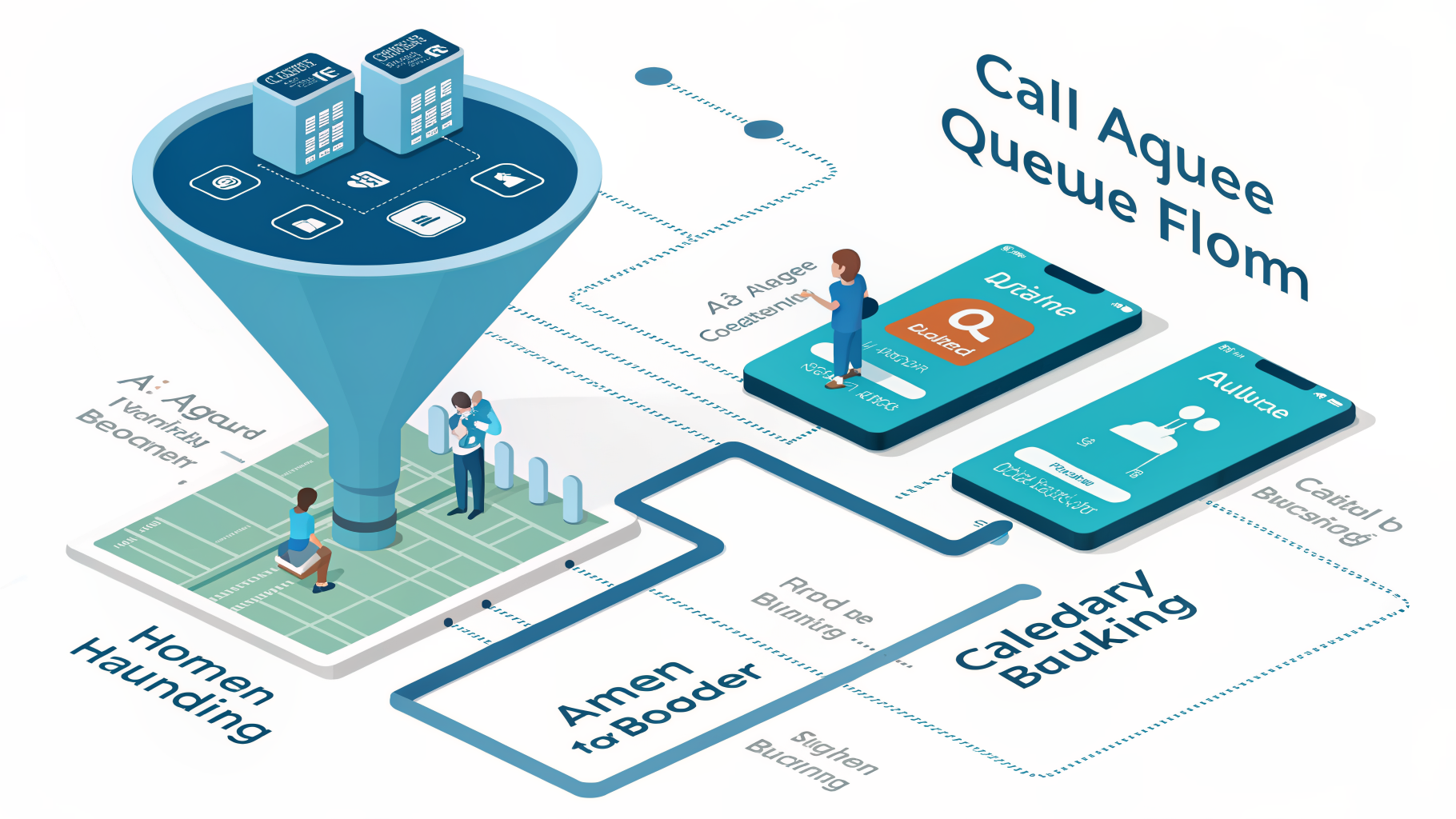
AI voice agent routing overflow calls to booking and human handoff
Step 5 — Let it book, route, and hand off — not just take a message
A voicemail is a to-do list you have to work through later. A capable overflow agent closes the loop live: it checks your calendar and books the appointment, answers the common questions ("are you open Saturday," "do you service my area"), qualifies the lead, and routes genuinely complex calls to the right person with the context already gathered.
This is the difference between a menu and an agent, and it's worth being clear-eyed about. If you're weighing this against an old-fashioned phone tree, we broke down why one loses in our comparison of AI voice agents versus IVR phone menus. Overflow is precisely where a rigid press-1-press-2 system fails hardest: the caller is already the second-choice call, and forcing them through a maze is how you lose them.
Step 6 — Measure it, or you're just guessing
Go back to the overflow windows you mapped in Step 1 and watch three numbers. Answer rate during those windows should climb toward 100%. Abandonment during peaks should fall — remember the benchmark that strong operations keep abandonment under 5%. And after-hours or storm-day capture, previously near zero, should now show real bookings and qualified leads.
Then tie it to revenue. If each recovered call is worth even $100 to $200 and you were losing a handful a day to overflow, the math moves quickly. For a fuller list of what to track and which providers make it easy, the questions to ask before choosing an AI voice agent will keep you from picking a tool that can't report on the very problem you bought it to solve.
What it costs versus what it quietly saves
The honest comparison isn't agent-versus-nothing; it's agent-versus-the-leak. A single missed call runs $100 to $200 in lost lifetime value, and busy service businesses routinely bleed $75,000 or more a year to unanswered phones — much of it overflow they never see. This breakdown of the true cost of a missed call lays out how fast it compounds.
On the other side of the ledger, hiring your way out is expensive and still capped — a receptionist costs several thousand dollars a month and can only hold one line at a time. An AI voice agent handles the fifth and fiftieth simultaneous call at the same marginal cost as the first. You're not replacing your team; you're removing the ceiling on how many callers reach you at once.
The bottom line for Canadian businesses
Overflow is the leak nobody schedules a meeting about, because it never shows up as a dramatic outage — just a slow drip of callers who quietly dialed the next name on their list. The fix isn't heroic. It's mapping your busy windows, putting an agent behind your people to catch what spills over, and measuring the answer and abandonment rates until the drip stops.
Do that, and the calls that used to vanish at 9:14 on a Tuesday turn into booked appointments and captured leads instead. If you want to see how an overflow agent would sound answering your line, in French and English, you can try a live demo and hear it handle a second caller while your first is still on the phone.