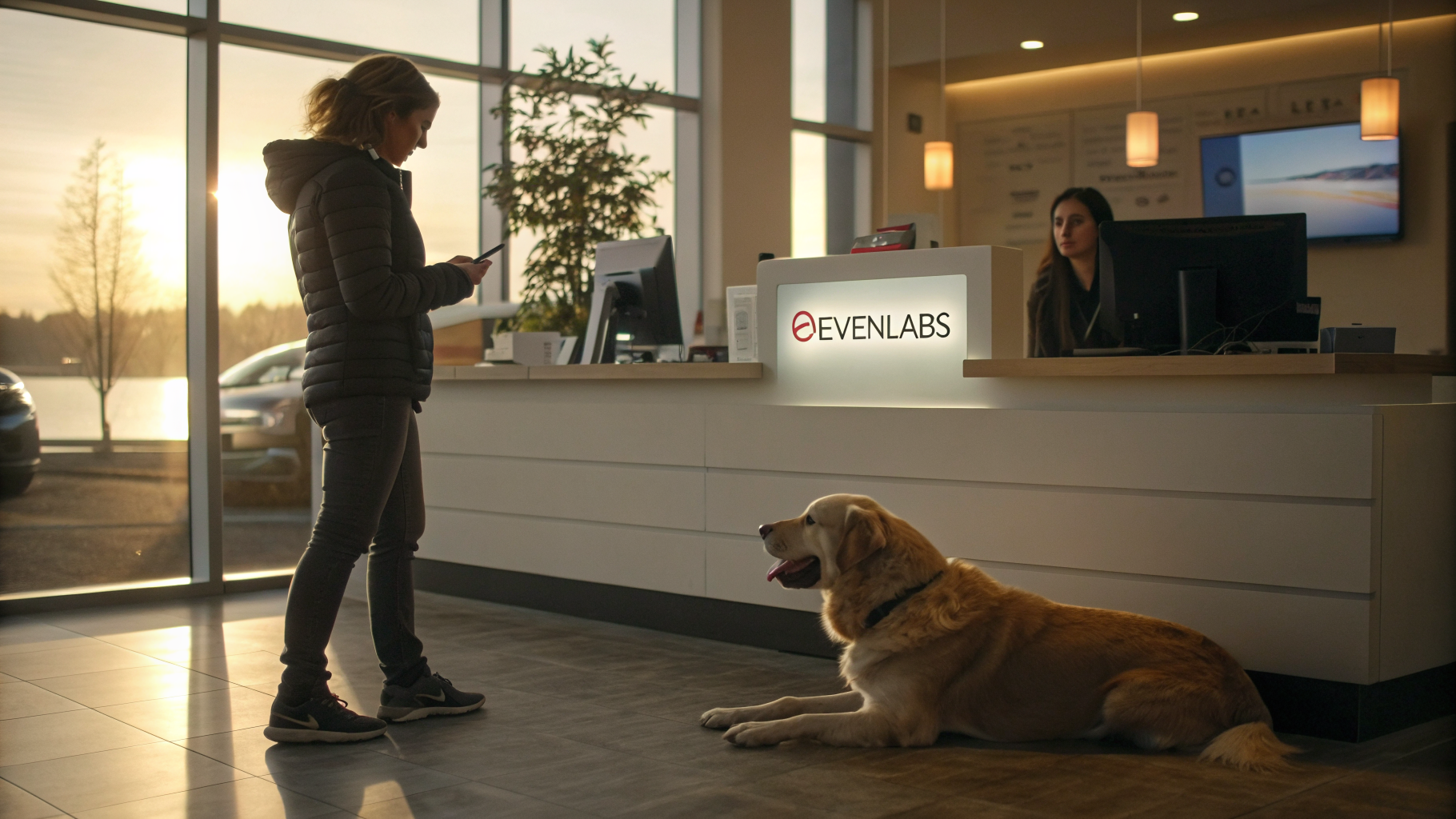
5:47 PM, a Thursday in May. A family from Laval comes back from the park with their Golden Retriever limping and panting nonstop. They call their regular veterinary clinic. Ring. Ring. Ring. Voicemail. They hang up and Google "emergency vet open now." Three minutes later, they're already on the phone with another clinic, 12 minutes away. Your clinic just lost that client for life — and probably the three referrals they would have sent.
I hear this story almost weekly since we started deploying AI voice agents in Quebec's veterinary sector. And the numbers are merciless: according to AgentZap's 2026 veterinary phone statistics, high-volume clinics (60-100 calls per day) miss between 30 and 40 percent of incoming calls. The North American average sits at 24-28 percent. In Quebec, where anglophone and francophone clientele blend and where pet emergencies spike at night and on weekends, it regularly climbs to 38 percent of emergency calls unanswered.
Let's run the brutal math. An average Quebec veterinary clinic receives 80 calls a day. At 38 percent missed, that's 30 calls per day disappearing. Multiply by 6 operating days and 50 weeks: 9,000 missed calls per year. If only 30 percent of those calls represent a visit (consultation at $95, vaccination at $75, emergency at $350), with a conservative average ticket of $110, that's exactly $96,000 in revenue evaporating every year — not counting client lifetime value lost and referrals never made.
Why Quebec veterinary clinics are uniquely vulnerable
I've analyzed roughly fifty clinics across Montreal, Quebec City, Sherbrooke, and Gatineau over the last six months. Four patterns repeat themselves, and they're specific to the Quebec context.
1. The invisible language divide. In Montreal and the Outaouais region, nearly 35 percent of pet owners speak English at home. Your receptionist answers "Bonjour-Hi," but when an anglophone from Hampstead calls panicked at 6:22 PM because their cat ate chocolate, they don't want to navigate a French phone system. They hang up. The Côte-Saint-Luc anglophone clinic picks them up.
2. Emergencies don't respect business hours. Data from Peerlogic's research on missed clinic calls shows call peaks happen at three moments: 11:45 AM-1:15 PM (staff lunch break), 5:15-7:30 PM (clients commuting home), and Saturday 8-10 AM (the "weekend warriors"). These are precisely the three windows when your team is understaffed or closed.
3. Client loyalty is more fragile than in human medicine. A human patient who calls their family doctor will call back. A dog owner whose pet's paw is bleeding won't call back — they're searching the next open clinic on Google Maps. You're not losing a call, you're losing the client and their Golden, their cat, and their mother-in-law's parrot.
4. Law 25 adds weight to your team. Since 2024, animal medical records are considered personal information in Quebec (the owner is identified). Your receptionist must verify identity before discussing any medical follow-up. It's slow, anxiety-inducing for staff, and lengthens calls. Our 6-point Law 25 audit details exactly which controls your clinic needs to stay compliant.
What just changed in May 2026: ElevenLabs Conversational AI 2.0
For years, bilingual AI voice agents were a half-lie. Two separate flows were configured — one FR, one EN — and the caller had to pick at the start ("press 1 for French, press 2 for English"). For a panicked Laval family, that 4-second detour is enough to make them hang up.
On May 6, 2026, ElevenLabs launched Conversational AI 2.0. The novelty that matters for you: automatic language detection built into the agent's core. The caller says "Hi, my dog ate chocolate" — the agent instantly responds in English. The same caller can switch to French three sentences later ("hold on, I'm passing the phone to my husband, he speaks French") and the agent follows without a hitch. No keys to press, no menu to navigate, no context lost.
For veterinary clinics in Greater Montreal and the Outaouais, this is exactly the missing piece. The invisible language divide I described earlier? Gone. Combine that with the new LLM models added to the platform the same week (gemini-3.1-pro-preview for medical reasoning, qwen35 for at-scale cost), and you're looking at an agent that responds in 480 milliseconds on average, in the right language, with veterinary vocabulary comprehension that 2024 solutions couldn't even approach.
The 4 windows where your veterinary AI voice agent works for you
The goal isn't to replace your team — it's to capture what slips through them today. Here are the four windows we systematically deploy across our veterinary clients:
Window 1 — Lunch hour (11:45 AM – 1:15 PM). Your receptionist is eating. The phone rings 18-22 times. The AI agent picks up, qualifies: routine ("I'd like to book a vaccine for my cat") or emergency ("my dog ate a grape"). For routine, it books the appointment directly in your calendar. For emergency, it interrupts the on-call vet's break and texts the owner to confirm the transfer.
Window 2 — Evening (5:15 – 10 PM). The clinic closes at 6 PM. Real problems start at 6:30 PM. The AI agent takes calls, distinguishes what can wait until tomorrow morning ("my dog is scratching a bit more") from what can't ("there's blood in his urine"). For real emergencies, it routes to the nearest partner emergency clinic and sends the call summary to your vet for next-day follow-up. For everything else, it books the morning appointment.
Window 3 — Weekends (Saturday morning and all day Sunday). 80 percent of general clinics in Quebec are closed Sunday. The AI agent captures Monday bookings, handles prescription refills that can wait, and keeps real emergencies warm with Monday 8 AM follow-up. This single window, in our deployments, generates 14 to 22 additional appointments per week.
Window 4 — During consultations. Your receptionist is with a client at the counter. The phone rings. Before, it went to voicemail (and 84 percent of callers don't leave a message). Now, the agent answers on the first ring, takes the need, queues a callback or resolves directly. Your client at the counter feels no interruption. The client on the phone feels no waiting.
Heure du lunch dans une clinique vétérinaire du Québec — téléphone qui sonne sur un comptoir vide
The Law 25 angle no one mentions in their demos
Here's a detail foreign vendors systematically forget: an animal medical record in Quebec contains information about the owner (name, address, phone number, sometimes credit card). It's therefore, under Law 25 on personal information protection in the private sector, data you must protect like a human medical record.
Concretely, this means your AI voice agent must:
- Verify identity before discussing an existing file — not just ask for the pet's name, but cross-reference name + pet's date of birth + owner's last name.
- Not store transcripts outside Canada — strict requirement for health information.
- Maintain an access log — who accessed which file, when, why.
- Allow deletion on request — a client can demand their data be erased.
These requirements aren't optional, and California-based vendors who "offer French" almost never meet them. When TECHMA deploys an AI voice agent for a veterinary clinic, we configure these controls from day one and sign a dedicated confidentiality agreement with the client. You do nothing — that's our job.
The ROI calculation in real Canadian dollars (not USD in disguise)
Let's revisit our average Quebec clinic: 80 calls/day, 38 percent missed, average ticket $110. Before the AI voice agent:
- 30 missed calls/day × 30 percent conversion × $110 = $990/day lost
- Over 300 operating days = $297,000 in gross annual losses (before margin adjustment)
- With a typical 32 percent net margin in veterinary = $95,040 in lost profit
After deploying a bilingual ElevenLabs 2.0 AI voice agent with TECHMA:
- Monthly cost: $395 to $595 CAD depending on volume (versus $3,200/month for a full-time receptionist equivalent in overtime + weekends)
- Capture rate: 92 to 96 percent of missed calls recovered (measured: resolved calls + appointments booked + urgent transfers)
- Estimated annual net recovery: $78,000 to $96,000
- Payback period: under 4 weeks in 9 cases out of 10
These numbers aren't theoretical. Our deployments in the dental sector follow the same pattern — the case of Quebec dental practices reaches $100,000 per year with a very similar mechanic. The veterinary sector also has the advantage of a higher emergency call volume, hence a marginally better recovery rate.
What TECHMA configures for you (because you have better things to do)
Here's the concrete breakdown of what we install for an average veterinary clinic — you touch nothing, you create no accounts, you just validate the French and English scripts before go-live:
- ElevenLabs Conversational AI 2.0 agent configured with bilingual professional voice, integrated veterinary vocabulary (vaccines, flea control, sterilization, etc.), automatic FR/EN detection.
- Local Twilio number in your regional area code (514, 438, 450, 418, 819...) — your clientele sees no difference.
- Calendar integration — Acuity, Vetstoria, or directly Outlook/Google Calendar depending on your current system.
- Emergency routing — the agent classifies urgency level (1=routine appointment, 2=next-day callback, 3=immediate transfer to partner emergency clinic or on-call vet).
- Post-call summary sent by SMS and email to your team, structured with: client name, call reason, action taken, next step required.
- Law 25 dashboard — access to call log, encrypted transcripts hosted in Canada, role-based access control.
- Bilingual rehearsal tests — we simulate 80 to 120 scenarios before production, including edge cases (Franglais speakers, confused emergencies, crying owners).
The whole thing ships turnkey in 8 to 12 business days. You give us your hours, your services, your list of partner emergency clinics, and your tone preferences. We do the rest.
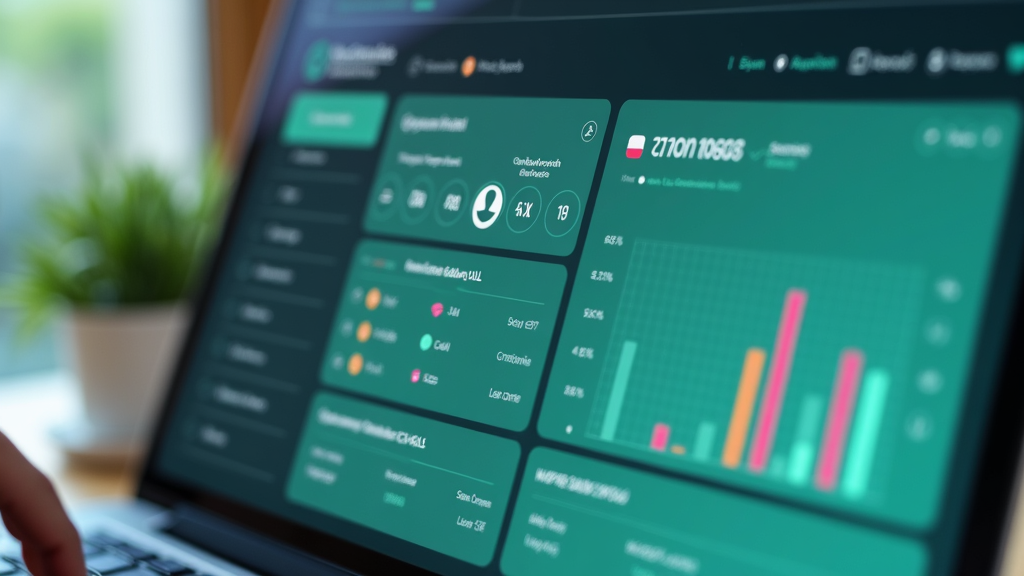
Tableau de bord bilingue FR/EN avec routage d'appels et conformité Loi 25
The $96,000 question you should ask yourself tonight
How many calls did you miss this week? Not an estimate — the real answer, verifiable in your Bell or Vidéotron records. If you're a clinic in Quebec with 50+ calls per day, you're statistically at 38 percent. That means 19 calls lost per day, 95 per week, 4,700 per year. At a $110 average ticket and 30 percent conversion, that's $155,100 walking out the back door.
The gap between 2024 and May 2026 isn't marginal. ElevenLabs Conversational AI 2.0's automatic bilingual detection, combined with specialized LLMs and native Law 25 integration, transforms the AI voice agent from a gadget into a revenue infrastructure. Clinics that adopt in 2026 take a lead that those waiting for 2027 will pay dearly to catch up.
If you want to see what this looks like for your specific clinic — your hours, your partner emergency clinics, your bilingual or anglophone clientele — contact the TECHMA team for a personalized demo. We show you an AI voice agent pre-configured for your clinic in 25 minutes, before you make any decision. And if you want to first understand the real cost of missed calls for a Quebec SMB in 2026, we've already dissected the numbers elsewhere.
One last thing. The limping Golden Retriever at 5:47 PM? He has a follow-up in 10 days. At the Côte-Saint-Luc clinic now. For life.