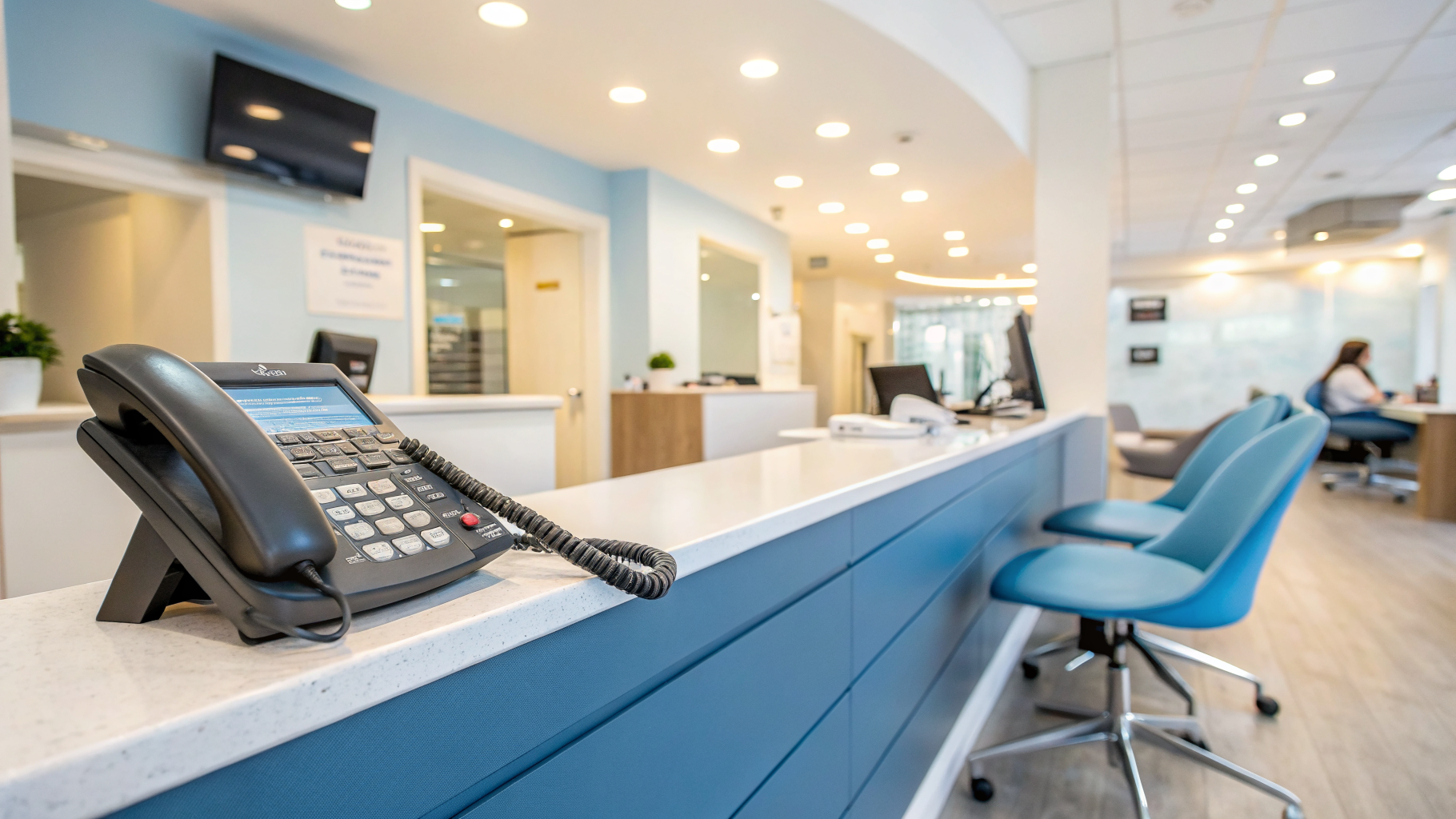
"We lost three new patients yesterday at lunch. Receptionist was on her break, and nobody called back." A clinic manager in Laval told us this in March 2026. Three patients lost translates, based on the most recent U.S. benchmarks, into roughly $2,550 in immediate production gone — and somewhere between $24,000 and $75,000 in lifetime value that just walked across the street to the competitor.
This isn't a staffing problem. It's a structural one. The 4,975 dentists registered with the Ordre des dentistes du Québec still operate in an environment where the phone is the number-one booking channel — even though patient expectations have permanently shifted. Here is the full anatomy of what happens when a patient dials your number, and how much money quietly leaves through the back door without anyone noticing.
The brutal baseline: 35% missed calls is the average, not the outlier
Before we go deeper, let's anchor the central number. According to research compiled by Resonate AI in 2026, the average dental practice misses 35% of incoming calls. Some practices climb as high as 68%. The "excellent" clinic answers 75% — meaning one call in four still slips through.
Translated into raw volume: an average practice receives around 800 calls per month and misses about 300. Not 300 secondary calls. Not 300 vague inquiries. Eighty percent of those missed calls are booking requests — so roughly 240 evaporated appointments per month.
And before you tell yourself "they'll call back" — they won't. Seventy-five percent of people who hit voicemail never call back. Only 14% leave a message. They type "dentist near me" into Google and book the next clinic on the list. That's the whole story.
Anatomy of a missed call: minute by minute
Let's dissect a real case. Tuesday, 11:47 a.m., general dental practice in Rosemont, Montreal. The phone rings.
Minute 0: Mrs. Tremblay, 47, just had a crown come loose at last night's dinner. She googles "emergency dentist Rosemont," lands on your Google profile, taps to call. She's ready to pay out of pocket. Estimated immediate value: $1,200. Lifetime value if she becomes a regular: $8,000 to $25,000.
Minute 0 to 0:18: Three rings. Your receptionist is on the other line with a patient asking whether the clinic does laser whitening or peroxide. That conversation is going to last 4 minutes.
Minute 0:19: Mrs. Tremblay's call drops to voicemail. She hears your greeting recorded back in 2022. She hangs up without leaving a message — like 86% of callers.
Minute 0:34: Mrs. Tremblay calls the dental clinic on the next street over. Someone picks up. Appointment at 2 p.m. that same day. Crown re-cemented. She's back in September for her cleaning. And January. And eventually her husband too, because it's easier to go to the same place.
You will never know she called. Your end-of-month report won't show that hole. The "could-have-been" new patients simply won't be there, and nobody on your team can name the exact cause.
The real cost: what the numbers reveal when you dig in
Calculations vary by source, but the range is surprisingly consistent. Peerlogic and Arini (Y Combinator W23) land on the same conclusions:
• Immediate value of a new patient: $850 average (first exam + X-rays + cleaning)
• Lifetime value of a new patient: $8,000 to $25,000 depending on retention
• Average annual loss per practice: $100,000 to $150,000
• High-volume practice losses: up to $960,000 per year
For a Quebec practice billing $1.2M per year, that's a hole equivalent to 8% to 13% of revenue. In many cases that's larger than the operating margin. And it's invisible — because the calls that never came in don't generate a complaint.
Why traditional fixes don't work (or no longer do)
You've probably tried something already. Here's why it didn't stick.
External answering service (call center): Typical monthly cost $800 to $2,000. The catch: most call centers in Quebec run with operators who don't know your practice management software (Dentitek, Progident, Dentrix, ABELDent), can't view your live schedule, and end up saying "we'll have someone call you back." You're paying for message-taking — not appointment-booking.
Hiring a second receptionist: $45,000 to $55,000 per year fully loaded in Quebec in 2026. Except call peaks are concentrated between 8-9 a.m. and 11:45 a.m.-1:15 p.m. — you're paying for 35 hours when you actually need 8 well-placed ones.
Automated text reminders: Excellent for retention, zero impact on the new patient calling at 7 p.m.
Evenings/nights/weekends: 40% of "dentist" Google searches happen outside business hours. Nobody picks up. Period.
How the AI voice agent changes the equation in 2026
Let's be clear: an AI voice agent isn't a glorified voicemail. It's a digital staff member who picks up on the first ring, speaks Saint-Hubert French (not Parisian), checks your live schedule via Dentitek or Progident, books the appointment, logs it, sends an SMS confirmation — and costs 1% to 3% of what a full-time receptionist costs.
The technology crossed a threshold in April 2026. The multi-agent workflows ElevenLabs shipped on April 7 let you split an "emergency" sub-agent from a "regular booking" sub-agent, each with its own knowledge base — exactly what a dental clinic needs. A cracked tooth at 9 p.m. doesn't get the same conversation as a whitening inquiry.
On the ground, this produces numbers like one U.S. clinic recently audited: 1,700 calls handled in 90 days, 184 appointments booked, 12 confirmed new patients, $230,000 in production that would otherwise have been lost. Another reports a 12% revenue lift and a 17% reduction in admin headcount.
The Quebec context: Law 25, RAMQ, and professional secrecy
This is where many foreign integrators break their teeth (pun intended). A Quebec dental clinic can't just plug Arini or Dentina.ai in and call it a day. Three specific requirements apply.
Law 25: Any system that collects personal data (name, RAMQ number, reason for consultation) needs an accessible privacy policy, a designated privacy officer, and a Privacy Impact Assessment (PIA) when the processing involves automated decision-making. Same logic as the notarial offices we analyzed in another article.
Data residency: Ideally Canada, or at minimum a jurisdiction deemed adequate under Law 25. Default U.S. solutions ship audio to American servers — which becomes a real issue when a patient mentions a sensitive health condition.
ODQ Code of Ethics: Professional secrecy applies. The AI agent can take a booking, but should never discuss a specific diagnosis or treatment over the phone — that stays the dentist's responsibility. The scope has to be clear from day one.
It's exactly the kind of guardrails we already see well-implemented in Quebec optometry practices and veterinary clinics — neighboring sectors with the same professional constraints.
What this means for your clinic, in concrete numbers
If you run a 4-dentist clinic in Quebec in 2026, here's what the realistic math looks like:
• You probably receive between 700 and 1,100 calls per month
• You miss 240 to 380 of them
• About 25% of those missed calls are new patients (60 to 95 per month)
• At $850 immediate value per new patient, that's $51,000 to $80,000 in monthly revenue going elsewhere
• Annually, a $600,000 to $960,000 hole
A properly deployed AI voice agent typically recovers 60% to 80% of that volume — not 100%, because some callers will always insist on speaking to a human and hang up. But 60% to 80% is the difference between a bad year and hiring an additional dentist.
FAQ: what dentists ask us most often
Will patients realize they're talking to an AI?
In 2026, with gpt-realtime or Claude Sonnet 4.6, roughly 70% of callers don't detect it within the first 30 seconds. The 30% who do detect it don't hang up — they keep going because the booking gets made.
Who's going to set this up? We have no internal IT.
Configurations are managed end-to-end by the TECHMA team — Dentitek/Progident integration, emergency routing, Quebec French scripts, Law 25 compliance. You provide the clinic information, we handle the rest.
What does it really cost, marketing aside?
For a typical Quebec dental clinic, initial deployment runs $3,000 to $6,000, and monthly operation $400 to $800 depending on volume. Compare that to $100,000-$150,000 in documented annual losses — the return on investment is measured in weeks, not years.
What if the agent makes a mistake?
All calls are recorded and transcribed. The dashboard shows exactly what was said, what was booked, and where the agent transferred to a human. You keep full control.
The conclusion nobody wants to hear
If your clinic loses 35% of its calls in 2026, this is no longer an operational issue. It's a decision — conscious or not. The technology to recover those patients exists, is being deployed at your competitors right now (Avoca crossed the $1B mark in service trades, and dental is the next segment up), and costs a fraction of what you're leaving on the table.
The real question is no longer "does it work." It's: "how many more months can I afford to wait?" For most clinics we work with, the honest answer is: not many.
If you want to see what this looks like for your specific clinic — with your software, your call volume, your Law 25 constraints — book a free audit. We pull your data, simulate a deployment, and give you the actual numbers before you decide anything.