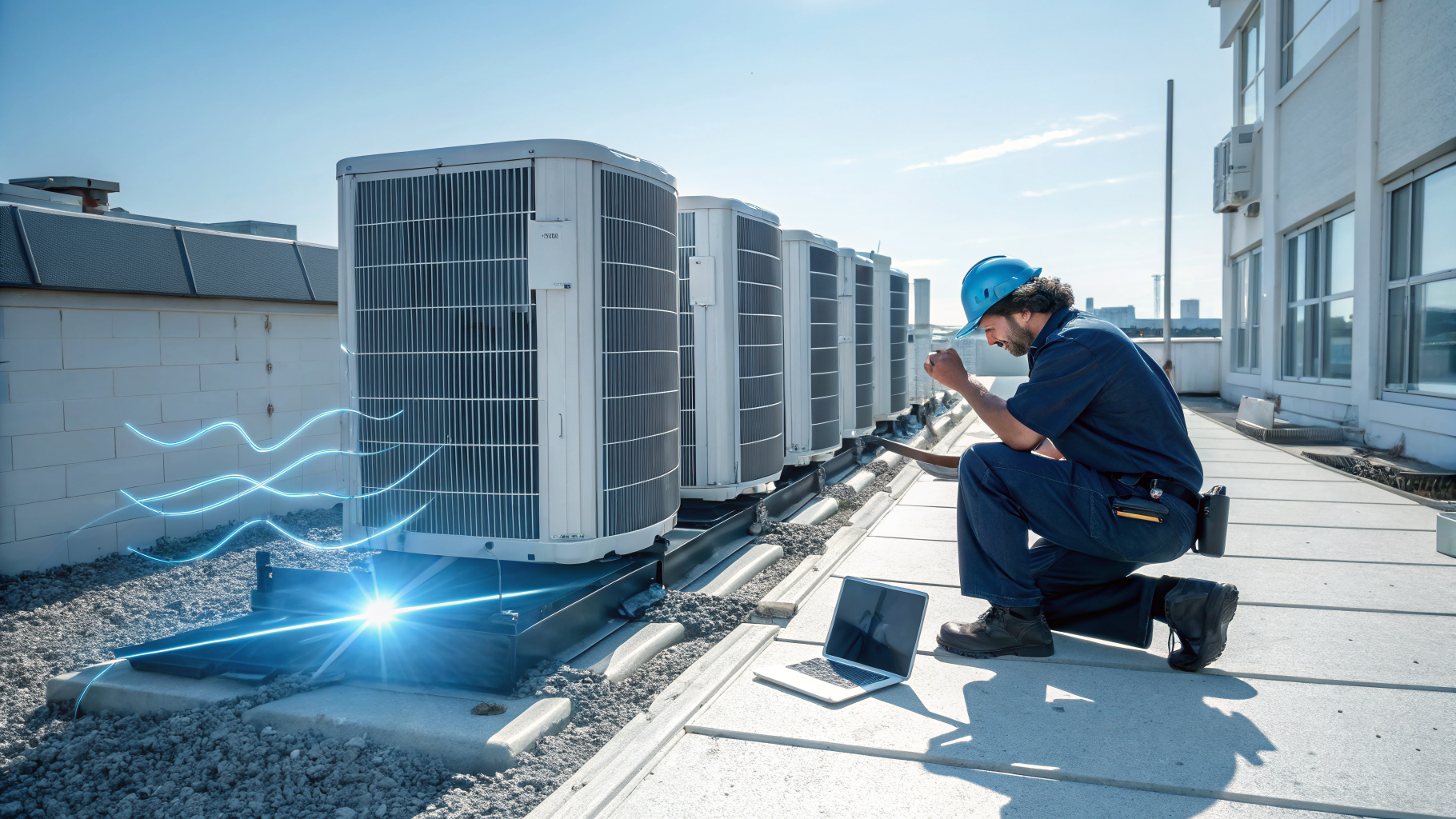
Picture a Thursday afternoon in Laval during a humid July heat wave. One installer is on a roof, another crew is stuck finishing a late change-out in Blainville, the estimator is driving back from Brossard, and the office line keeps lighting up every 20 seconds. A homeowner wants a quote for a ductless unit. A restaurant has no cooling. A landlord needs service for two tenants. Three calls hit while the admin is already on the line. That’s how installations get lost.
For Quebec contractors, the issue isn’t just high demand. It’s compressed demand. Everybody calls at once, and they call when they’re uncomfortable, stressed, and ready to buy. That’s why the keyword AI voice agent HVAC Quebec matters in real business terms: speed to answer becomes part of your sales process, not just your customer service.
The pressure is well documented. According to Noovo Info, during hot stretches, Quebec air conditioning companies are literally overwhelmed; on a hot day, a single sales employee can receive more than 30 calls per hour, and some businesses in Sherbrooke have installation wait lists stretching to the end of August. Add the climate-driven rise in cooling demand reported by Radio-Canada, and it’s easy to see why so many HVAC owners are looking for a practical way to stop losing work to missed calls.
Why Quebec HVAC businesses are especially vulnerable to missed calls
HVAC in Quebec is seasonal, field-heavy, and operationally unforgiving. Spring warms up the pipeline. June accelerates. July can turn the phone into a bottleneck. Whether you serve Montreal, Quebec City, Gatineau, Longueuil, Sherbrooke, or smaller surrounding markets, a serious heat wave compresses quote requests, service calls, replacements, and follow-ups into the same narrow window.
The biggest problem? Your most valuable people are not sitting by the phone. Techs are in attics, on rooftops, in mechanical rooms, or driving between jobs. Sales reps are in homes measuring walls, discussing rebates, or pricing replacements. Owners often answer calls themselves until volume gets out of hand — then they stop answering because they’re actually doing the work. Sound familiar?
This is similar to what other field-service sectors face in Quebec. This article about landscapers missing calls while on-site makes the same point: when your team works in the field, the phone usually rings at the worst possible moment. In HVAC, the stakes are often higher because a call may represent a $7,000 mini-split, a $12,000 heat pump replacement, or a high-value commercial service account.
And the data is blunt. According to HVAC statistics 2026, the average HVAC contractor misses about 27% of incoming calls, and that number climbs to 35% or more during peak season. On top of that, roughly 62% of HVAC customer calls happen outside standard 9-to-5 hours — evenings and weekends, when the office is closed but the need is very much alive.
The real cost of missed calls in air conditioning is bigger than most owners think
In some industries, a missed call is an annoyance. In residential and light commercial cooling, it can be lost revenue within minutes. A family with no AC during a heat wave is not building a spreadsheet of ten contractors and waiting for callbacks over three business days. They’re calling the next company. Then the next one. Whoever answers first gets the first real shot at the job.
That’s why missed calls HVAC is not just an admin metric. It’s a sales leakage metric. Per HVAC statistics 2026, each missed call costs an average of $350 or more in immediate lost revenue, and a small service company can lose between $45,000 and $120,000 per year because calls go unanswered. For contractors selling installations, those numbers can be conservative. One booked estimate can turn into a full replacement, add-on accessories, annual maintenance, and referrals.
There’s another number that should make any owner pause: about 85% of residential service customers who don’t reach someone on the first try never call back. Never. There’s no second chance to explain your financing, your lead time, your warranty, or your quality of work. The opportunity simply disappears into another contractor’s schedule.
And here’s the uncomfortable part: many of those losses remain invisible. You won’t see them in your CRM. You won’t log them as “lost quotes.” You won’t hear a complaint. The phone just rang, no one answered, and the job went elsewhere. How many installations vanished that way last July?
How an AI voice agent actually works in a Quebec HVAC workflow
An AI voice agent is not meant to magically replace your dispatchers, service managers, or sales staff. In the Agent IA Vocal model, it acts as a 24/7 bilingual front line that answers calls immediately, captures key information, qualifies the request, routes urgency properly, and supports scheduling or follow-up based on your rules. And importantly, TECHMA handles the setup and integration for you — this is not a DIY platform you try to build between service calls.
In practical terms, if someone calls at 8:47 p.m. from Terrebonne because their air conditioner stopped cooling, the AI voice agent can answer right away, identify whether it’s residential or commercial, gather the address, equipment type, symptoms, callback number, urgency level, and preferred availability, then send a structured summary to your team. If another caller wants a replacement quote in Quebec City for an aging wall-mounted unit, the agent can collect property details, home type, approximate square footage, and timing for an estimate.
The goal is not to fake a human conversation for the sake of novelty. The goal is to eliminate dead air and voicemail black holes. A well-configured AI voice agent HVAC Quebec gives callers a real response path even when your office is slammed, your team is on-site, or your phones are rolling over after hours.
And when a human absolutely needs to step in, the system can escalate, notify, or prioritize according to your process. So instead of replacing your operation, it expands your phone capacity at the exact moments your business is most likely to lose work.
Four automation opportunities that matter most during a heat wave
First: after-hours call coverage. Since around 62% of HVAC calls come in outside 9-to-5, evenings and weekends are not dead time — they’re revenue time. An AI voice agent can answer every call after hours, capture the request, sort urgency, and make sure no lead disappears just because the office closed at 5:00 p.m. For many contractors, this is the fastest ROI.
Second: quote pre-qualification. A lot of incoming calls are not emergency breakdowns. They’re high-intent quote requests: ductless installs, heat pump upgrades, replacement systems, condo units, rental properties, or cooling additions for second floors and bonus rooms. The agent can gather 8 to 12 useful details before your estimator ever gets involved. That means better-prepared callbacks, cleaner pipelines, and less wasted back-and-forth.
Third: service triage. Not all calls deserve the same priority. Complete cooling loss for a senior during a heat wave is different from a maintenance request. A convenience store with equipment-sensitive inventory is different from a general pricing inquiry. The agent can classify calls based on your criteria: no cooling, leak, strange noise, light commercial, food-related business, tenant issue, warranty concern, and more. Dispatch gets better input, faster.
Fourth: measurable reduction in missed calls. If your company handles 500 inbound calls during a peak month and your missed-call rate is anywhere near the 27% industry average — or 35% in peak season — the leakage is huge. Even recovering a portion of that demand changes the month. If you want a broader framework for tightening this up, read this guide on reducing missed calls by 90% for Quebec SMEs.
And really, what HVAC owner wouldn’t want to know what happens to every inbound lead during the busiest two months of the year? That visibility alone is valuable.
Why this is especially useful for Quebec HVAC contractors, not just generic call centers
The first advantage is response speed with local business logic. Quebec HVAC companies deal with bilingual markets, regional service areas, seasonal surges, and very specific call types. A generic answering model often captures a name and number. That’s not enough. You need a system that understands the difference between an emergency no-cool service call in Gatineau and a quote request for a wall-mounted unit in Longueuil.
The second advantage is protecting skilled labor from phone interruptions. Every time a technician has to stop troubleshooting to return an unknown number, efficiency drops. Every time an estimator gets partial, messy intake notes from a rushed office, quote quality suffers. A structured AI front line lets your people stay focused on technical and revenue-generating work.
The third is cost control. Hiring another full-time receptionist for the summer rush is expensive, and traditional answering services can become inconsistent or shallow in how they qualify calls. Agent IA Vocal is positioned as an affordable local alternative, typically from $49 to $199 CAD per month depending on the setup. If you want to compare the economics, this cost comparison between a receptionist, answering service, and AI voice agent is worth reading.
The fourth is bilingual coverage. In Montreal, Laval, the South Shore, parts of the West Island, and many mixed-language service areas, an air conditioning contractor phone line that only functions smoothly in one language can lose trust fast. A bilingual FR/EN response creates a better first impression and captures more opportunities without forcing the owner to be the translator on every call.
Finally, there’s professionalism. A caller who reaches a calm, clear, structured first response at 9:14 p.m. on a Saturday is far more likely to trust your company than one who gets voicemail. In a market where lead times stretch and demand spikes hard, that trust can win the job before your competitor even notices the missed call.
Common HVAC objections — and the straight answers
“My customers want a real person.” Fair point. But in peak season, the real comparison is often not “AI versus human.” It’s “immediate answer versus voicemail.” If your office can’t keep up, the best customer experience may be a fast, well-structured AI first response that ensures the call is captured and handled properly.
“Our calls are too technical.” Usually, the first call doesn’t require technical diagnosis at expert level. It requires identifying the issue, urgency, location, equipment type, and next step. That’s exactly where structured call handling shines. Your licensed techs still do the technical work; the AI handles intake and qualification.
“We’re a small shop — setup will be a headache.” Not with this model. Agent IA Vocal is deployed with TECHMA managing configuration and integration. That matters. Small Quebec contractors do not need another software project in July. They need missed-call protection without building a phone workflow from scratch.
“We don’t want it to sound robotic.” Completely reasonable. Tone, scripts, escalation paths, and industry vocabulary all matter. A properly configured AI voice workflow can sound clear and natural enough to do the job well. And frankly, a generic voicemail greeting is rarely warmer or more helpful.
“We already have someone in the office.” Great. Then the AI becomes overflow support, after-hours coverage, and a pressure-release valve. It doesn’t have to replace your admin. It can make that person dramatically more effective when the phones spike. Why ask one coordinator to survive 30 calls an hour alone during a heat wave if technology can back them up?
FAQ: what HVAC owners usually want to know before moving forward
“Can it book estimate requests?” Yes. It can collect intake details for installation and replacement leads, support appointment capture based on your process, and pass organized information to your team for follow-up or scheduling.
“Does it help with after-hours HVAC calls?” Absolutely. That’s one of the strongest use cases. Since so much HVAC demand happens after 5 p.m. or on weekends, immediate call handling can prevent a major amount of lead loss.
“Can it work in both French and English?” Yes. Agent IA Vocal is built for Quebec SMEs and supports bilingual FR/EN call handling, which is especially valuable in mixed-language service areas.
“Is this only for large contractors?” No. Small and mid-sized HVAC businesses often benefit the most because they don’t have deep office staffing during peak periods.
“Do we have to configure everything ourselves?” No. TECHMA handles setup, configuration, and integration. That includes adapting the call flow to your HVAC business reality rather than giving you a generic self-serve tool.
What Quebec HVAC companies should fix before the next heat wave hits
Before the next major hot spell, strong contractors do more than hope someone answers the phone faster. They define a call process. What counts as an emergency? What information is required before a quote callback? Which postal codes or cities are served? What gets transferred immediately? What gets scheduled? What gets called back within 10 or 15 minutes?
Without those rules, even good teams end up improvising under pressure. And improvisation gets expensive when calls stack up. An AI voice agent works best when it reflects the way your business already operates: residential installs, light commercial service, no-cool emergencies, maintenance, financing questions, warranty inquiries, and estimate intake.
This is not just a tech conversation. It’s an operations conversation. The best-performing Quebec HVAC SMEs increasingly treat the phone as a strategic sales and dispatch channel, not an afterthought. That shift matters when one inbound call can be worth thousands of dollars in immediate and downstream revenue.
If you’re still deciding between hiring, outsourcing, or automating part of your call handling, compare not just cost but consistency, availability, and control. For many businesses, a local, managed option backed by TECHMA offers a practical middle ground: affordable, fast to deploy, and built around real operating pressure.
Bottom line: stop letting invisible phone losses eat your summer revenue
Quebec air conditioning companies are not just losing calls during heat waves. They’re losing installs, quote opportunities, urgent service revenue, and first-time customers ready to move now. With average missed-call rates around 27%, peak-season rates of 35% or more, 85% of callers never trying again, and losses of $350+ per missed call, the status quo gets expensive fast.
An AI voice agent won’t eliminate seasonal demand spikes. What it can do is stop those spikes from turning into silence. It answers 24/7, qualifies requests, routes urgency, captures leads, and supports your team when human capacity tops out. For many HVAC businesses, that’s the difference between being busy and being profitably busy.
If you want to see how Agent IA Vocal can fit your HVAC operation, book a demo here: https://agentiavocal.ca/demo. You can also view plans starting at $49/month here: https://agentiavocal.ca/pricing. And one last point worth emphasizing: TECHMA handles the full setup and integration. You don’t have to build this yourself in the middle of peak season.