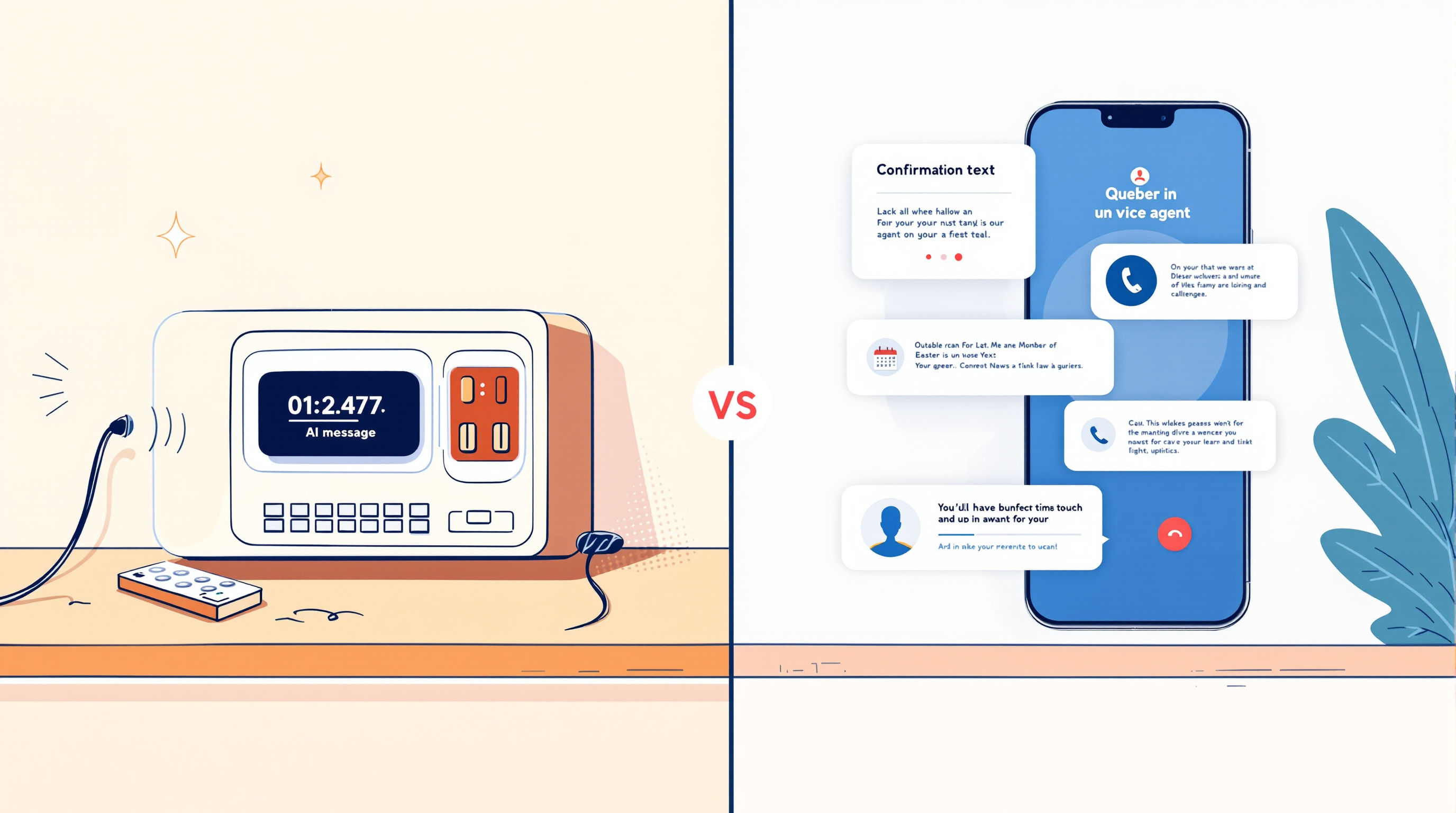
It's 5:40 p.m. on a Tuesday. Your last employee just left. The phone rings. Nobody picks up, so your voicemail kicks in: "You've reached... please leave a message." The caller hangs up without saying a word and dials the competitor next door. You'll never even know they called.
That's exactly the moment the question shows up: do you stick with good old voicemail, or move to an AI voice agent? Here's an honest comparison, no hype. Because both have a place — just not for the same reasons.
The 4 criteria that actually matter
Comparing voicemail to an AI voice agent on monthly price alone misses the point. For a Quebec SME, four things separate a phone that earns money from a phone that bleeds it: the real cost (not just the bill), availability, the experience your caller actually has, and above all what happens after the call.
We'll take these four rounds one at a time. Spoiler: there's no draw.
Round 1 — The real cost
On paper, voicemail wins in a landslide. It's usually bundled into your phone plan. Monthly cost: basically zero.
Except the real cost of voicemail isn't what you pay your carrier. It's what you lose in customers who never leave a message. The data is blunt: 93% of callers who hit voicemail never call back. They don't leave a message either. They just move on to the next name on the list.
Run the math for your business. If an average customer is worth $300 and you miss just 10 calls a month that slide into voicemail, that's $3,000 evaporating — every month. The "free" voicemail is actually the most expensive option you own. The monthly bill is the one number that doesn't matter here; the number that matters is the revenue walking out the door in silence, and it never shows up on an invoice.
Round 2 — Availability and speed
Here it's a technical tie on one point: voicemail and an AI voice agent both answer 24/7. Neither sleeps, neither takes vacation.
But "answering" and "helping" are two different things. Voicemail records. Full stop. An AI voice agent understands the request, answers common questions, checks availability and books the appointment on the spot. The 2026 technology genuinely crossed a line here: OpenAI launched voice models with GPT-5-class reasoning that can hold a real multi-minute conversation, as detailed in the gpt-realtime announcement. Meanwhile, ElevenLabs Conversational AI 2.0 handles pauses, hesitations and interruptions in an almost human way.
In plain terms: your 5:40 p.m. caller no longer hits a recorder. They speak, they're understood, their issue gets solved. Voicemail is still stuck on "leave your name and number." And the gap is only widening: each new model release makes the agent better at handling accents, background noise and half-finished sentences, while voicemail does exactly what it did twenty years ago.
Round 3 — The customer experience (and your reputation)
Ask yourself one thing: when you hit a voicemail, how does it feel? Ignored. And a customer who feels ignored is one who doubts you're serious before they've even met you.
A well-configured AI voice agent greets the caller with your business name, answers in French — and switches to English if the caller prefers, which changes everything in Quebec. It doesn't judge, doesn't sigh at 5 p.m., doesn't park anyone on hold with elevator music. That first impression is often what decides whether the caller books with you or somewhere else.
And your online reputation follows. A caller frustrated by voicemail is far more likely to leave a lukewarm review. A call caught on the fly and handled politely, on the other hand, is one more star — and sometimes a customer who refers you. In a market where a handful of Google reviews can decide who gets the call next time, that first ten seconds on the phone quietly compounds in your favour, week after week.
Round 4 — What happens AFTER the call
This is the round nobody looks at, and it's the most decisive one.
With voicemail, the work starts after the call: someone has to listen to the message, parse it, call back, play phone tag, then finally write the appointment down somewhere. How many of those messages get handled same-day? Let's be honest: not all of them.
An AI voice agent finishes the job during the call. The appointment lands in the calendar, the customer record gets updated, the confirmation text goes out — before the caller has even hung up. If the request is beyond its scope, it hands off intelligently to a human: we broke down the 6 moments an agent should pass the call to a real person. Voicemail transfers nothing. It just piles up, and every unheard message is a small decision you're postponing until it's too late to act on it. By Monday, half of those callers have already booked somewhere else.
The verdict: who wins, and when?
Let's be fair. Voicemail isn't useless. It's fine if your call volume is tiny, every call is non-urgent, and you have time to return every one same-day. For a highly specialized solo operator getting two or three calls a week, it can be enough.
In every other case — a service business, a clinic, a shop, an office with rush hours — the AI voice agent wins all four rounds. Not because it's "trendy tech," but because a call taken always beats a message never heard. The honest test is simple: count how many voicemail messages you actually returned same-day last week. If the answer makes you wince, you already have your verdict.
The real answer: the hybrid approach
Here's what most SMEs end up adopting, and it's often the smartest move: let the AI voice agent take every call, and keep humans for the 20% of cases that are complex or sensitive. The AI handles the routine — hours, prices, bookings — while your team focuses on what genuinely needs a human brain.
Voicemail, in that setup, becomes a last-resort safety net, not your front line. If you want to turn missed calls into customers, we also wrote a 7-step guide to cutting your missed calls by 90%.
A real-world scenario: Saturday morning at the shop
Picture an auto shop in Laval, Saturday at 9 a.m. Three mechanics, hands deep in an engine, and a phone that won't stop. With voicemail, here's the day: twelve missed calls, nine who hang up without a message, two messages heard at 4 p.m. once the rush is over, and exactly one customer called back in time. Net result: roughly ten appointments gone to the competitor, and the owner has no idea it happened.
Same Saturday, same volume, but with an AI voice agent. All twelve calls are answered. Eight turn into appointments booked straight into the calendar, two are pricing questions settled in thirty seconds, and the two tricky cases — a billing dispute and an insurance claim — get transferred to the owner with the context already summarized. Nobody touched the phone while the cars moved forward. The difference between those two Saturdays isn't the technology — it's the week's revenue.
Frequently asked questions
Do I have to change my phone number? No. The AI voice agent plugs in on top of your current system. You keep your number, your customers notice no difference — except that someone finally answers.
What if the AI doesn't understand a request? It transfers to a human or takes the contact info for a callback, instead of leaving the caller in limbo. That's exactly what voicemail never does.
Is it complicated to set up? Not for you. At TECHMA, we handle the entire configuration and all integrations. You don't have to play technician on a Saturday night.
Will my customers hate talking to an AI? Most don't even notice, and those who do far prefer an instant answer to a recorder. What they hate isn't the AI — it's not being served, kept waiting, or sent to a recorder that promises a callback nobody makes.
Isn't voicemail enough for emergencies? Quite the opposite: an emergency left on a recorder at 6 p.m. is a customer calling elsewhere within 30 seconds. An AI voice agent can route the emergency to the right person immediately.
Bottom line
Voicemail records messages. An AI voice agent serves customers. On real cost, useful availability, experience and follow-through, the comparison isn't even close for an SME that takes calls all day.
The right move isn't to pick one forever — it's to stop handing your first customer contact to a machine that only records. Book a 15-minute demo to hear the difference on your own calls, or explore our plans starting at $49/month.