
You're paying $1,200 a month for an answering service, and yet Monday morning at 7:45 AM, three clients hit voicemail. The service opens at 8. Your competitor, meanwhile, has an AI voice agent picking up on the first ring — at 3 AM on a Sunday or noon on a Tuesday.
The choice between an AI voice agent and a traditional telephone answering service is no longer about being tech-savvy. It's a business calculation. And the 2026 numbers settle the debate more clearly than ever.
Why This Comparison Matters in 2026
The conversational AI market reached $17.97 billion USD in 2026, growing at 23% annually. Meanwhile, traditional answering services — companies that hire human agents to answer your calls — charge between $0.75 and $1.50 per call, with monthly base fees ranging from $200 to $1,500.
For Quebec SMEs, this is a pivotal moment. Both options exist, both work, but one is evolving at breakneck speed while the other stagnates. Here are the 5 criteria that will help you decide, building on what we explored in our comparison between AI and human receptionists.
Criterion 1: The Real Cost (Not Just the Sticker Price)
A telephone answering service costs an average of $200 to $1,500 per month for an SME, depending on call volume. Add per-call fees ($0.75 to $1.50), overflow charges when volume spikes, and surcharges for nights and weekends. For a dental clinic receiving 400 calls a month, the bill easily climbs to $800 — not counting setup fees.
An AI voice agent like the one from Agent IA Vocal costs between $49 and $199 per month, all-inclusive. No per-call charges. No Sunday morning surcharges. According to 2026 industry data, the average cost of an AI-handled call is $0.40, compared to $7 to $12 for a human agent.
The math is straightforward: for 400 calls per month, a traditional service costs roughly $800. An AI voice agent? Around $160 at most. The net savings exceed $7,600 per year.
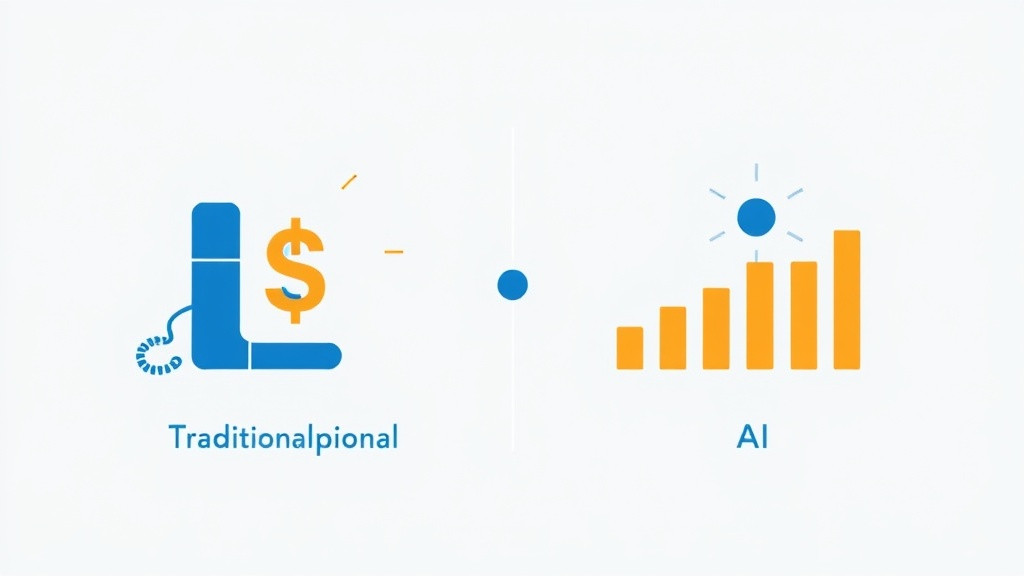
Cost comparison: AI voice agent vs answering service
Criterion 2: Actual Availability (Not Contract Promises)
Answering services often advertise 24/7 coverage. In practice, night shifts run lean, wait times climb during peak hours, and holidays — when your customers call most — are either billed extra or covered by a skeleton crew.
An AI voice agent doesn't sleep. It doesn't take coffee breaks. It doesn't call in sick the day after the Christmas party. It picks up on the first ring, 24 hours a day, 365 days a year, with exactly the same service level at 3 AM as at 10 AM on a Tuesday.
For a Quebec SME losing an average of 62% of calls outside business hours — a figure we documented in our article on AI voice after hours — this consistent availability isn't a luxury. It's the difference between capturing or losing a customer.
Criterion 3: Personalization and Business Knowledge
Here's where things get interesting. An answering service uses generic scripts. The agent who answers your calls also handles calls for a plumber in Laval, a lawyer in Gatineau, and a restaurant in Sherbrooke. They know your business name, your hours, maybe three or four standard responses. That's it.
An AI voice agent is trained exclusively on your business. It knows your services, your rates, your current promotions, your appointment calendar. It can answer specific questions like "Does Dr. Tremblay work on Fridays?" or "How much does a dental cleaning cost?" without hesitation.
In 2026, the most advanced AI voice agents use language models capable of holding natural conversations across 5 to 10 exchanges, with a no-escalation resolution rate of 70 to 90%. A traditional answering service transfers or takes a message the moment a question goes off-script.
Criterion 4: Processing Speed and Tech Integration
A call handled by an answering service follows a linear process: the agent picks up, asks questions, notes answers on paper or in basic software, then sends you an email or SMS summary. You receive the message 5 to 30 minutes later. The customer has to call back or wait for your return call.
An AI voice agent processes the call in real time. It can book an appointment directly in your calendar, send an SMS confirmation to the customer, create a record in your CRM, and notify you by email — all while the customer is still on the phone. All with less than 800 milliseconds of latency, as confirmed by AssemblyAI's benchmarks.
For businesses already using Zoho, HubSpot, or Google Calendar, this is a major advantage. At Agent IA Vocal, integration with your existing tools is included in the setup — no extra fees, no complex configuration. As we explained in our comparison with IVR systems, it's this native integration that makes all the difference.
Criterion 5: Scalability (When Your Volume Doubles Overnight)
Picture this: your ad campaign works and your call volume triples in a week. With an answering service, you need to renegotiate your contract, pay overflow fees, or accept that customers wait 5 minutes on hold. Adding capacity takes days, sometimes weeks.
An AI voice agent scales from 10 calls a day to 1,000 without flinching. There's no queue, no "all agents are currently busy." Every customer gets an immediate response, whether you have 5 calls or 500 in the same hour. In 2026, platforms like those used by Agent IA Vocal offer a 99.99% availability SLA.
For growing SMEs — or those with seasonal spikes like snow removal companies in winter or HVAC businesses in summer — this elasticity is a strategic advantage that answering services simply cannot match.

Business scalability with AI voice technology
The Verdict: When to Choose One Over the Other
Let's be clear: a telephone answering service still has its place in very specific contexts. If your calls systematically require complex human judgment — legal negotiations, emotional crisis situations, medical diagnoses — a trained human remains irreplaceable.
But for 80% of the calls a typical Quebec SME receives — appointment bookings, schedule inquiries, price requests, confirmations, reminders — an AI voice agent does the job better, faster, and for a fraction of the cost. And unlike an answering service, it improves every month thanks to AI model updates.
The market has caught on. According to Computer Weekly, 78% of organizations are already using AI in at least one function, and AI voice agents represent the fastest-growing segment with a 340% increase in implementations in a single year.
Summary Table: AI Voice Agent vs Telephone Answering Service
Here's the comparison at a glance. Monthly cost (400 calls): AI voice agent $49 to $199, answering service $600 to $1,500. Actual availability: AI voice agent 24/7/365 no exceptions, answering service variable with surcharges. Response time: AI voice agent under 1 second, answering service 10 to 45 seconds. Personalization: AI voice agent trained on your business, answering service limited to scripts. CRM/calendar integrations: AI voice agent native and real-time, answering service manual or limited. Scalability: AI voice agent instant and unlimited, answering service requires contract renegotiation.
The choice becomes obvious when you lay the numbers side by side.
FAQ: AI Voice Agent vs Telephone Answering Service
Can an AI voice agent truly replace a full answering service? For most SMEs, yes. An AI voice agent handles appointment booking, FAQs, call transfers, and real-time notifications. Only calls requiring complex human judgment (less than 20% of cases) still need to be escalated.
Does the AI voice agent understand Quebec French? The best AI voice agents in 2026 — including Agent IA Vocal's — are trained to understand and speak Quebec French, including common expressions and the local accent. This is no longer the robotic Parisian French of two years ago.
How long does it take to switch from an answering service to an AI voice agent? At Agent IA Vocal, setup typically takes 48 hours to one week. The TECHMA team handles everything: the agent, CRM integrations, calendar, call scenarios. You don't need to do anything technical.
What happens if the AI voice agent doesn't understand a question? A well-configured AI voice agent recognizes its limits. It transfers the call to a human, takes a detailed message, or offers to call the customer back — exactly like a good receptionist would, but without the delays.
My answering service provides a local number. Does the AI voice agent too? Yes. Agent IA Vocal works with your existing phone number. Your customers see no difference — except that someone finally answers every call.
Take Action
If your current answering service costs more than $300 a month and you're not 100% satisfied with the quality of responses, it's time to compare. Book a free demo with the Agent IA Vocal team to see exactly how voice AI would handle your calls — with your real scenarios, your calendar, and your CRM. Plans starting at $49/month, all-inclusive.