
The Thursday Night You Lost 12 Reservations in 90 Minutes
It's 7:15 PM on a Thursday. The dining room is full, the bar is three-deep, and your host is juggling three families waiting by the door. Meanwhile, the phone rings. Again. And again. You hear it behind you as you plate a duck breast on the pass, but nobody can grab it.
In 90 minutes, twelve calls go unanswered. Seven were reservation requests for Saturday. Two wanted a table for tonight in the next twenty minutes. One was a supplier calling back about a missed delivery. The rest? You'll never know.
That's the daily reality for restaurants bleeding revenue after-hours and especially during service rushes. It's also exactly what an AI voice agent for restaurants eliminates—without replacing anyone on your team.
Why Quebec Restaurants Miss So Many Calls
According to the 2026 Canadian Voice AI Landscape report, 63% of restaurants admit they can't answer every call during busy periods. In Quebec, where lunch service and the dinner rush often overlap with a lean front-of-house team, the number runs higher.
The problem isn't effort. It's physics. Your host cannot greet a table of eight, manage the waitlist, explain the menu in both languages, and grab a phone ringing for the fourth time in five minutes.
Zendesk data makes it worse: 93% of callers who hit voicemail never call back. And a 2026 hospitality analysis found that 83% of customers go straight to a competitor after a single missed call. That's not a lead coming back later. That's a table booked at the bistro across the street, at Joe Beef, at Toqué, or at the pizza spot on the corner that picked up.
The average cost of a missed call sits around $450 for a neighborhood restaurant. Multiply by a dozen calls a night, seven nights a week, and you're looking at a silent leak north of $150,000 a year for a single location.
How an AI Voice Agent Actually Works in a Restaurant
An AI voice agent for restaurants answers the phone 24/7, in French or English, with the voice and tone you pick. It understands natural language—no dial-pad menus, no "say reservation for reservation."
Here's what happens when Marie calls your bistro at 7:23 PM to book a Saturday 8 PM table for four:
The AI picks up on the second ring. It greets her by the restaurant's name ("Good evening, Bistro Laurier, this is Claudine"). It asks the right questions—date, time, party size, dietary notes, patio preference. It checks your reservation system in real time (Libro, OpenTable, Resy, or the Google Sheet you built yourself). If the slot is open, it confirms. If not, it offers two alternatives. The reservation lands in your system within thirty seconds, with Marie's number saved.
If Marie asks for something the AI can't handle—a complex allergy, a twenty-five-person group, a request to rent the private room—it transfers the call straight to your host or texts your cell with a summary. You call back when the pressure drops.
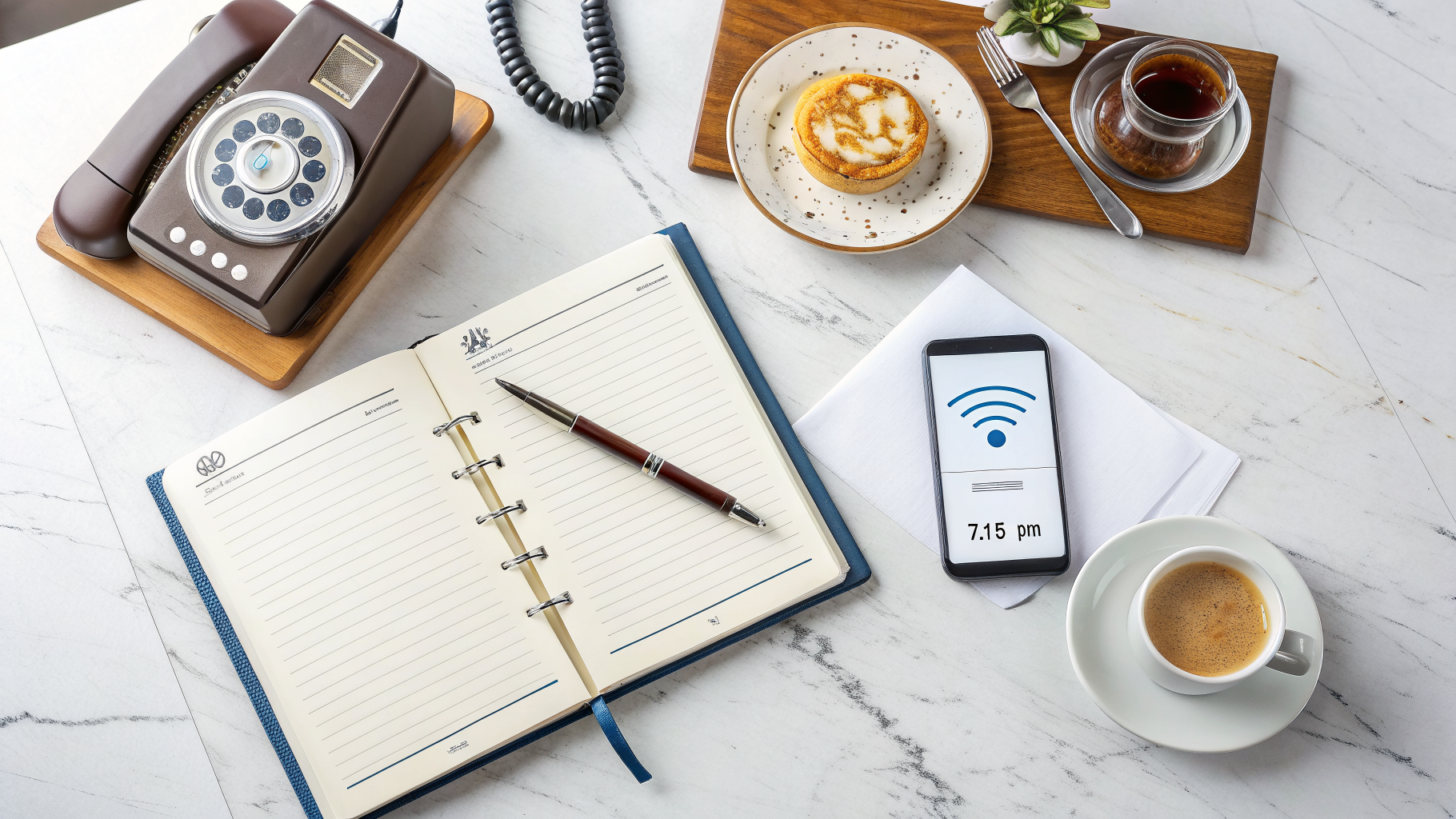
Restaurant host station with AI voice agent handling reservations during dinner rush
4 Automations That Actually Move the Needle
Most operators think "take reservations" when they hear AI voice agent. That's just the start. These are the four automations that make the biggest operational difference in our deployments.
**1. Real-time reservations with two-way sync.** The AI doesn't just read your calendar—it writes to it. No more double-bookings. No more "we were expecting you yesterday." In our deployments, the double-booking rate drops under 0.5% versus 4-6% with an overwhelmed host, and the average handle time for a new reservation falls from 3 minutes (human) to 45 seconds (AI), which matters when your phone is ringing every ninety seconds between 6 PM and 9 PM.
**2. Automated confirmation callbacks to kill no-shows.** The day before, the AI calls or texts: "Hi Marie, confirming your reservation tomorrow at 8 PM for four. Press 1 to confirm, 2 to cancel." Restaurants using this flow see no-show rates drop from 18% to under 5%. That's exactly the kind of gain we walk through in our guide on eliminating no-shows with AI voice.
**3. Takeout and catering order capture.** The AI can take a full order (appetizer, main, side, allergies, payment method) and push it straight to your kitchen via Square, Clover, or your POS. Per 2026 Sadie data on the Canadian market, restaurants using this feature process an average of 166 orders per month per location, with an average ticket of $31.92.
**4. Smart filtering of sales calls.** Suppliers, cold calls, wrong numbers—the AI identifies them and reroutes to voicemail or email, freeing your team for the calls that actually matter.
The Revenue an AI Voice Agent Really Brings In
Let's talk numbers. It's what our clients want to know first, and that's fair.
A 2026 Forbes analysis of AI voice adoption in restaurants reports that locations deploying a well-configured voice agent see between $3,000 and $18,000 in additional monthly revenue, depending on volume. The median lands around $7,000 per location per month.
Where does that revenue come from? Three main sources. First, the 25% of calls that used to ring into the void after-hours become reservations or orders. Second, the drop in no-shows frees 2 to 4 covers per night that were booked but ended up empty. Third, integrated upsell—the AI suggesting a wine pairing, mentioning the house dessert, flagging Sunday brunch—lifts average ticket by 8-12%.
For a restaurant paying $49 to $199 a month with Agent IA Vocal, ROI is usually visible within the first 30 days. Our 4-step method for calculating AI voice agent ROI walks through the math for your own location.
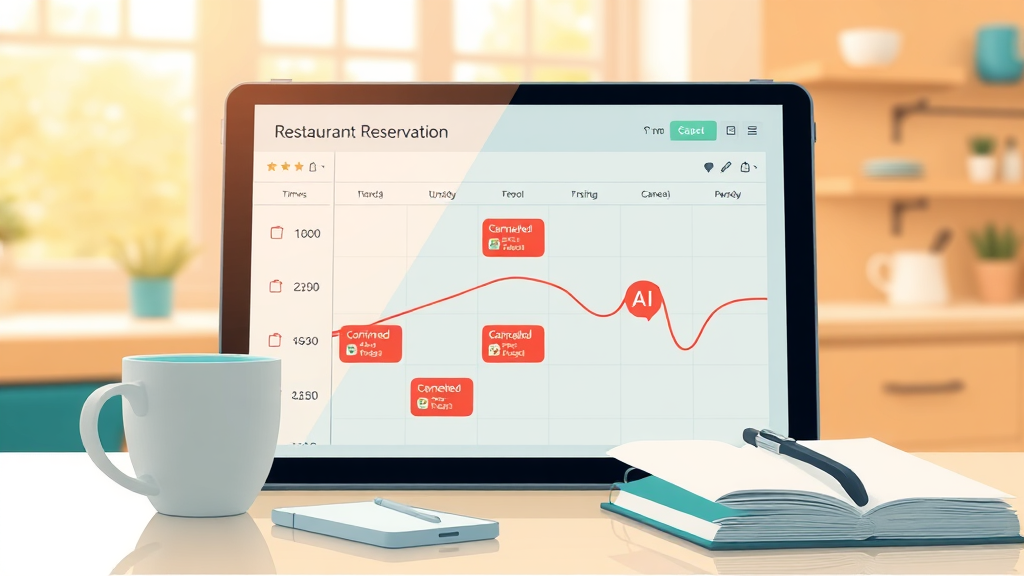
Restaurant reservation calendar synchronized in real time by an AI voice agent
"But My Guests Want to Talk to a Human"—What We Actually See
We hear this objection on every first call with a restaurateur. It's a fair worry. Here's what plays out in the field.
The vast majority of your calls—75 to 85% in our measurements—are simple requests: book, confirm, cancel, ask about hours, inquire about a group menu. For those calls, guests actually prefer an immediate, accurate response to a four-minute hold followed by a breathless host. After three months of deployment, 94% of surveyed guests either didn't realize they spoke to an AI or didn't care.
For the 15-25% of calls that genuinely need a human (large groups, private events, complaints, VIP relationships), the AI transfers instantly to the right person. Your team focuses on those high-value conversations instead of repeating the hours of operation for the 40th time that day. That alone frees up an average of 90 minutes of front-of-house time per shift in a busy Plateau-Mont-Royal bistro we work with.
One important detail: the voice agent is calibrated to your brand. A neighborhood bistro on Wellington Street doesn't sound like an upscale steakhouse downtown. You pick the voice, the tone, the vocabulary, the Quebec expressions, even which language the AI leads with based on the caller's phone area code. Some clients even name their AI (Claudine, Mathieu, Jean-Paul), print it on the menu as 'our tireless teammate,' and bake it into the house culture so regulars ask for her by name.
FAQ: What Restaurateurs Ask Before They Sign On
**Can the AI actually handle the Quebec accent and franglais?** Yes. The 2026 models are trained on Canadian francophone data. It handles "je veux réserver pour deux pour le five à sept de jeudi" without blinking. It switches to English if the guest switches.
**How long does it take to roll out?** For a typical restaurant, full deployment runs 5 to 10 business days. TECHMA handles the reservation-system integration, voice configuration, scripts, and testing. You write zero code.
**What happens if a guest asks for the chef or manager?** Instant transfer to the designated mobile. If nobody answers, an automatic SMS with the caller's name, number, and the reason for the call.
**What if we change hours or the menu?** You send an email or a note in your Agent IA Vocal dashboard, and the TECHMA team updates the AI within the hour. Zero maintenance on your end.
Next Steps For Your Restaurant
An AI voice agent isn't a tech gimmick. It's a maître d' who never takes a break, never gets impatient at 8:45 PM on a Saturday, and never loses a reservation because the line rang through a twelve-top service. For a Quebec restaurant running on tight margins, it's often the single operational change with the fastest visible payback in the first month.
At Agent IA Vocal, the TECHMA team takes care of everything: integration with your reservation system, Quebec-French and English scripts, voice calibration, team testing, and ongoing support. You get an agent configured for YOUR restaurant—not a generic chatbot forced into a phone line. If you already use Libro, OpenTable, Resy, Tock, or a custom Google Sheet workflow, we wire it up. If you don't, we help you pick what fits.
Book a 20-minute demo to hear the agent live with a scenario tailored to your restaurant, or check our plans starting at $49 per month to see which fits your call volume.