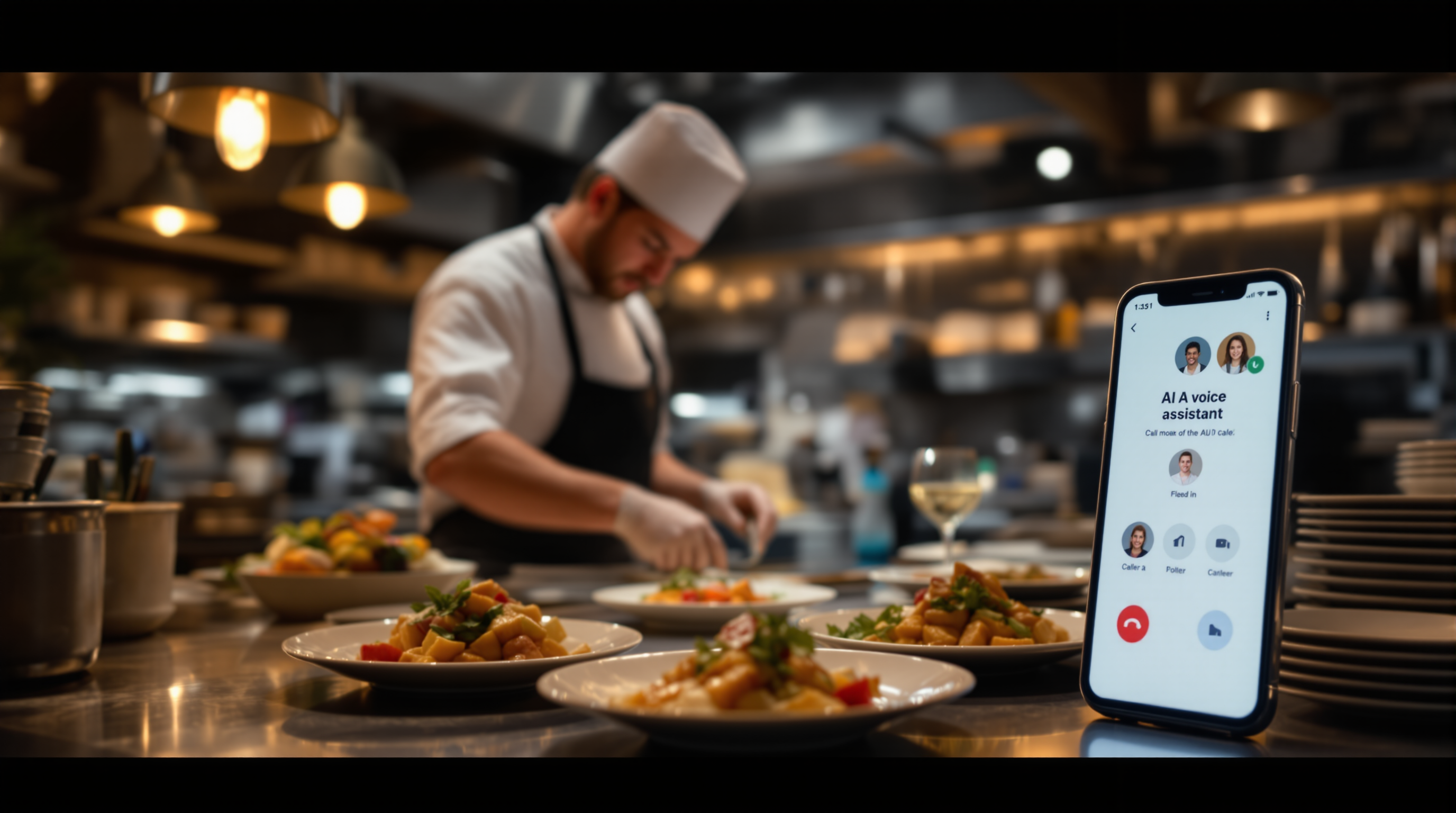
Friday night, 7:12 PM. Your phone is ringing into the void.
The kitchen is firing on all cylinders, the dining room is packed, two servers are calling out orders at the same time, and the phone rings. Again. For the sixth time in twenty minutes. Nobody picks up — because nobody can pick up. The person on the other end wanted to book a table for eight on Saturday night. They hang up, Google "restaurant [your neighborhood]," and call your competitor two blocks over.
You'll never know it happened. No notification, no missed call in your system — just an empty table Saturday night and a customer lost for good.
Let's be real: this scenario plays out dozens of times every week in Quebec restaurants. And the cost is far steeper than most owners realize.
The problem nobody tracks (but everyone suffers from)
According to restaurant industry data, 43% of phone calls to restaurants go unanswered. Not 10%, not 20% — nearly half. And here's the number that really stings: 83% of customers order somewhere else after just one unanswered call. They don't call back. They move on.
For a typical Quebec restaurant — say 30 seats, about fifteen calls a day — that works out to roughly 6 to 7 missed calls daily. At an average table value of $85, we're talking about $500 to $600 in lost revenue every single day. Monthly, the shortfall easily climbs above $15,000.
And we haven't even mentioned Google reviews. A customer who can't reach your restaurant rarely adds a star — it's usually the opposite.
The AI voice agent: your receptionist who never takes a break
An AI voice agent is an intelligent system that answers the phone on your behalf, 24 hours a day. We're not talking about a robotic automated menu ("Press 1 for reservations, press 2 for…"). We're talking about a natural conversation, in French or English, that understands what the customer is asking and acts accordingly.
In practice, when a customer calls your restaurant, the AI voice agent can:
- Take a reservation by checking availability in real time from your calendar
- Handle takeout and delivery orders, including customizations ("gluten-free, extra cheese, half pepperoni half veggie")
- Answer common questions: hours, daily specials, allergy options, parking, accessibility
- Cancel or modify an existing reservation without any human intervention
- Transfer the call to a team member when the situation requires a human touch
All of this happens while your team focuses on what they do best: cooking, serving, and creating a memorable dining experience.
5 real-world scenarios where voice AI transforms restaurants
1. Automatic reservations with calendar sync
The customer calls, says "I'd like to book a table for four on Friday at 7 PM," and the agent instantly checks your availability. If the slot is open, the reservation is confirmed and added to your system. If it's full, the agent offers alternatives: "Friday at 7 PM is fully booked, but I have an opening at 8:30 PM or Saturday at 7 PM. Which works better for you?"
Restaurants using this type of solution report up to 50% more phone reservations captured, simply because every call gets answered.
2. Takeout and delivery orders
You know the scenario: a customer calls to order while your cook is managing three dishes at once and the server is writing down a table order. The AI voice agent takes the phone order with surgical precision, handles modifications ("no onions on the pizza, dressing on the side for the salad"), and confirms the total before hanging up. The order goes straight into your POS system.
3. Confirmations and anti-no-show reminders
No-shows are the bane of the restaurant industry. A table of six that doesn't show up on a Friday night is a $500 hole in your revenue. The AI voice agent can automatically call your guests 24 hours before their reservation to confirm. Those who cancel free up the table in time to give it to someone else. We've covered in detail how no-shows bleed SMBs dry and how voice AI eliminates them — the problem is the same in restaurants, only worse.
4. Overflow management during rush hours
This is arguably the most powerful use case for restaurants. Between 11:30 AM and 1:30 PM, then 5:30 PM to 9 PM, your team is underwater. The AI voice agent doesn't replace your host — it backs them up. When they're busy seating guests or managing the waitlist, the AI handles the phones. Zero missed calls, even at the peak of the dinner rush.
5. After-hours service
It's 10:30 PM, your restaurant is closed, and someone calls to book a Sunday brunch. Without a voice agent, that call goes nowhere. With AI, the reservation is taken, the customer gets a confirmation, and your Sunday starts with one more table booked. As we explain in our article on the AI voice agent that works while you sleep, after-hours calls often make up 30 to 40% of total volume — that's revenue most restaurants are leaving on the table.
The bilingual advantage: a decisive edge in Quebec
Quebec has a unique linguistic reality. Your customers call in French, in English, sometimes switching between both in the same sentence. A human receptionist handles this with varying degrees of success. A modern AI voice agent does it without hesitation — seamless switching between French and English, no artificial accent, same quality of service in both languages.
For restaurants in tourist hotspots — Old Montreal, Quartier Petit Champlain, Mont-Tremblant — this bilingual capability is a direct competitive advantage. The American tourist calling to book gets served in English; the local family, in French. All without hiring additional staff.
The ROI breakdown: what does this actually bring to your restaurant?
Let's run the numbers for a typical Quebec restaurant:
- Daily calls received: 15 on average
- Missed calls (43%): ~6 per day
- Average value per converted reservation: $85
- Estimated lost revenue: $510/day → ~$15,300/month
Even recovering just half of those missed calls means $7,500 in additional monthly revenue. Forbes data confirms that restaurants equipped with voice AI generate between $3,000 and $18,000 in additional monthly revenue, depending on their size and call volume.
Against an investment of $49 to $199 per month for a solution like Agent IA Vocal, the return is hard to argue with. We're talking about a 30-to-1 ratio in the most conservative scenarios.
And this calculation doesn't even account for no-shows prevented through automated reminders, or takeout orders captured after hours.
"But my customers want to talk to a real person…"
This is the objection we hear most often. And it's half-valid. Your customers want to talk to someone, not necessarily a human. What they really want is an answer. Fast, clear, effective.
The latest data shows a 96% satisfaction rate among customers who interact with a well-configured AI voice agent. Why? Because the agent answers on the first ring, never puts anyone on hold, and handles the request in under two minutes.
Compare that to the current reality: the phone rings eight times, nobody picks up, the customer hangs up frustrated. Between an AI that answers immediately and a human who never answers at all, the choice is obvious.
"It must be too expensive for my small restaurant…"
At $49/month for the base plan with Agent IA Vocal, it costs less than a single four-hour shift at minimum wage. And the agent works 24/7, doesn't take vacation, and won't call in sick on a Friday night.
"It must be complicated to set up…"
With Agent IA Vocal, the TECHMA team handles everything. System configuration, integration with your reservation calendar, customization of responses based on your menu and hours — it's all done for you. Nothing to install, nothing to program on your end. To compare this turnkey approach with other options, check out our comparison of AI voice agents versus traditional answering services.
The industry is accelerating — and restaurants are following
The conversational AI market reached $17.97 billion in 2026, on track for $82 billion by 2034. Major fast-food chains already use voice AI for drive-through orders. But the technology is no longer reserved for giants — it's now accessible to independent Quebec restaurants at a fraction of the cost.
Specialized restaurant platforms are multiplying (Slang AI, Loman, Hostie), and general AI providers like ElevenLabs keep adding new features, including WhatsApp support and on-premise deployment. The trend is clear: within two years, not having an AI voice agent in a restaurant will be as unusual as not having a social media presence.
Frequently asked questions
Can the AI voice agent handle special requests and food allergies?
Yes. The agent is configured with your complete menu, including allergens, vegetarian, vegan, and gluten-free options. When a customer mentions an allergy, the agent can indicate which dishes are safe and which aren't — exactly like a well-trained server would.
What happens if the agent can't answer a question?
The agent transfers the call to an available team member or takes a message with the customer's contact information for a callback. It never leaves a customer without a solution.
How long does setup take?
With Agent IA Vocal, the TECHMA team configures everything in a few days. You provide your menu, hours, and reservation preferences — the rest is taken care of. No technical skills required on your end.
Can the agent handle multiple calls at the same time?
Absolutely. Unlike a human receptionist who can only take one call at a time, the AI voice agent handles multiple simultaneous conversations. During Friday night rush, it can process five calls in parallel without keeping anyone waiting.
Your empty tables have a cost — voice AI fills them
Every missed call is a reservation that will never arrive, an order that goes to the competition, a Google review that won't be another star. Quebec restaurant owners don't need more staff — they need a system that answers when their team can't.
Agent IA Vocal gives your restaurant a bilingual receptionist, available 24/7, that takes reservations, orders, and answers questions — while your team does what they do best: delivering a memorable dining experience.
Book a free demo and find out how many calls your restaurant is missing every week. The result might surprise you.