
Three Floors Up, the Phone Rings Into the Void
Your crew is finishing a move-out clean in a Calgary walk-up. You're on the third floor, gloves soaked in degreaser, when your phone buzzes in your pocket. No chance of answering. By the time you're back at the van, the caller has hung up — no voicemail, like almost everyone. What you'll never know is that it was a property manager shopping for a new company to handle weekly common-area cleaning across three buildings.
If you run a cleaning company anywhere in Canada, that's not a bad day. That's every day. Calls arrive precisely while you're working, and every unanswered ring is a quote request walking down the Google list to the next competitor.
What a Missed Call Actually Costs a Cleaning Business
In most businesses, a missed call costs a sale. In cleaning, it costs a contract. A biweekly residential client at $160 a visit is worth over $4,000 a year. A commercial office contract typically runs $1,500 to $5,000 a month — and renews. That 40-second call nobody picked up wasn't worth $160. It was potentially worth tens of thousands of dollars in recurring revenue.
The window is brutally short, too. Research published in the Harvard Business Review found that companies responding to a lead within minutes dramatically out-qualify those that call back an hour later. Someone shopping for a cleaning service in Toronto or Halifax rarely calls one company. They work down the list until somebody answers.
Run the math on your own operation. How many calls do you miss a week — five, ten, fifteen? If just one in ten was a recurring contract, how much are you leaving on the table every year?
Why Cleaning Calls Always Come at the Worst Time
A cleaning company's phone keeps cruel hours. Facility and property managers call in the late afternoon, when they're back at their desks — and your crews are still driving between buildings. Homeowners in Vancouver, Ottawa or Winnipeg call in the evening and on weekends, once their own workday is over. And urgent jobs — a flood cleanup, a post-construction clean that has to pass inspection Monday morning — arrive whenever they please.
Then come the seasonal spikes: spring deep cleans, end-of-lease turnovers at month's end, post-construction booms in fast-growing markets like Calgary and the GTA. The exact weeks your schedule is fullest are the weeks your phone rings most — and nobody's free to answer. For franchises operating across provinces, six time zones make 'office hours' even blurrier.
Hiring a full-time receptionist to fix it? With the labour shortage BDC has been documenting, most cleaning businesses already struggle to staff their crews. A $40,000-plus admin position that only covers business hours isn't in the budget for the average operator.
What an AI Voice Agent Actually Does for a Cleaning Company
An AI voice agent is a natural-sounding voice — not a 'press 2' menu — that answers on the first ring, around the clock, in English, French, and the languages your city actually speaks. For a cleaning business, it does four specific things.
One: it captures the full quote request. Service type (recurring house cleaning, deep clean, move-out, post-construction, commercial janitorial), square footage or room count, frequency, neighbourhood, start date. Next morning, you have a structured lead in your system instead of a missed number in your call log. Two: it answers the questions that eat your day — eco-friendly products, insurance coverage, service areas, price ranges. Three: it books walkthrough appointments straight into your calendar. Four: it recognizes urgency — a flood, a complaint from a major commercial client — and transfers the call or alerts you immediately.
Meanwhile, your crews keep cleaning. Nobody takes their gloves off.
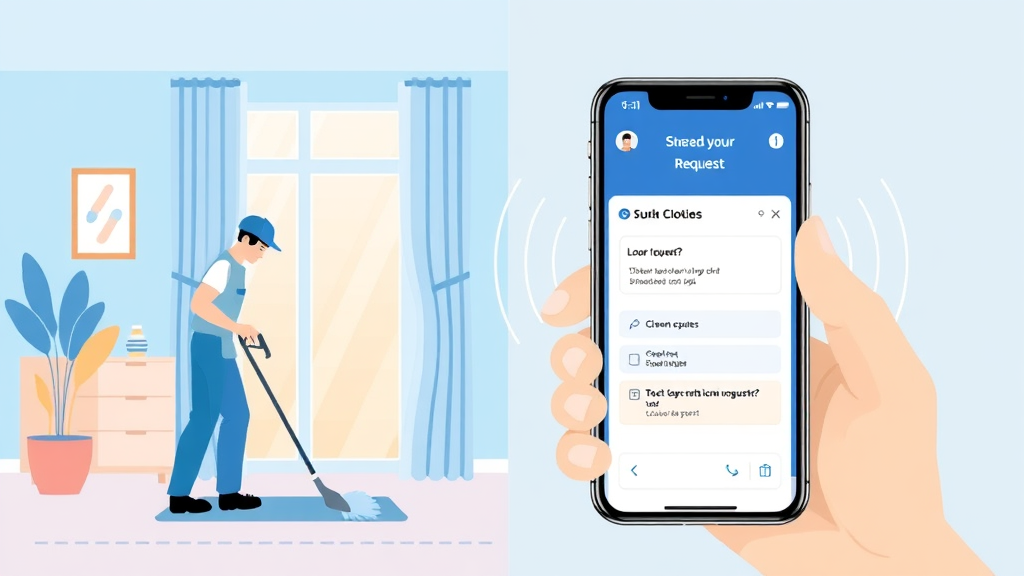
AI voice agent capturing a cleaning quote request while the crew works
The Four Leaks Automation Actually Plugs
Leak one: calls during working hours, when the line is busy or the crew is unreachable. The agent answers only when you can't, if that's how you want it — your routine doesn't change, but lost calls become leads.
Leak two: evenings and weekends. It's a one-time setup that covers every off hour, as we walk through in our guide to handling after-hours calls. For cleaning companies, that's usually where the best residential contracts are hiding.
Leak three: recurring clients who need to move a visit. That's a two-minute call the agent handles alone — instead of a voicemail, a callback, and a text-message tennis match. Leak four: follow-up. Some operators think an automatic text-back after a missed call is enough. We compared both approaches in our missed-call text-back versus AI voice agent breakdown — and for services where the caller wants to talk to someone now, the conversation wins almost every time.
A Typical Day Once the Agent Is On the Line
At 7:12 a.m., a condo owner in Ottawa calls about a deep clean before the in-laws visit. The agent logs the square footage, the three bedrooms, the fragrance allergy, and offers a Thursday slot. At 12:40 p.m., while both your crews are at lunch, an office administrator asks whether you service commercial buildings in Burnaby: the agent confirms the coverage area, captures the building details, and books a walkthrough for Tuesday. At 9:05 p.m., a panicked tenant needs a move-out clean by Saturday — the agent checks the calendar, books it, sends the confirmation.
Three calls, three moments when nobody was available, three pieces of revenue that would have vanished without a trace. Your only task: call the administrator back with a price. That's the difference between being run by your phone and putting it to work.
And on Monday morning, instead of guessing what you missed over the weekend, you open a report: every call, every request, every booking. In black and white.

After-hours calls answered automatically and booked into the calendar
What It Costs, What It Returns
Let's talk numbers, because that's how business decisions get made. An AI voice agent runs $49 to $199 a month depending on volume. A full-time receptionist costs over $3,300 a month; a traditional answering service bills by the minute with agents who don't know a move-out clean from a deep clean — we broke that comparison down in our answering service versus AI voice agent analysis.
The break-even is almost embarrassingly simple: one recovered residential contract pays for the agent for a year. One commercial contract pays for it several times over. Everything else it captures across the year is margin.
Innovation, Science and Economic Development Canada's small business statistics tell the structural story: nearly all building-services firms in Canada are small businesses with fewer than 20 employees. Nobody has a reception department. Which is exactly why the advantage goes to whoever picks up.
'My Clients Will Hate Talking to a Robot' — and Other Objections
We hear this one every week, and it deserves a straight answer. What your clients hate isn't a polite synthetic voice that solves their problem in two minutes. It's voicemail. It's the endless ring. Between 'talk to a human tomorrow' and 'get my request handled now,' callers have already voted.
Second objection: 'my quotes are too complicated for a machine.' True — and the agent doesn't quote for you. It collects the details (square footage, frequency, condition, pets, timeline) and hands you a qualified lead. You still set the price. The difference is you're calling back someone whose needs you already know, instead of chasing an unknown number.
Third concern, very real in Canadian cities: language. A caller in Mississauga who starts in English and switches mid-sentence? A francophone client in Moncton? The agent follows the conversation across languages without a transfer or a hiccup. Try getting that from an outsourced call centre.
And here's the part nobody puts in the marketing brochures: the agent doesn't have bad days. It doesn't sigh at the fifteenth 'how much for a two-bedroom?' of the week. Every caller, from the first to the fiftieth, gets the same patient, professional intake. For a business where reputation travels through Google reviews and neighbourhood Facebook groups, that consistency is worth as much as the captured leads.
Frequently Asked Questions
Can the agent give out my prices? If you want it to. You decide: indicative ranges on the phone, or information-gathering for a custom quote. Most cleaning operators we work with share a range and save the exact number for the walkthrough.
What about my existing recurring clients? The agent recognizes them by number. It can move a visit, log a special instruction ('key's with the neighbour this week'), and record everything — without interrupting your crews.
How long does setup take? A few days. The TECHMA team configures everything — services, coverage areas, calendar, emergency transfers. There's nothing for you to program.
What if a call is too complex? The agent transfers to whoever's on call or takes a structured message with a callback promise. It never improvises an estimate.
Does it work with the scheduling software I already use? In most cases, yes. Whether you run Jobber, a shared Google Calendar, or a spreadsheet and a whiteboard, the TECHMA team wires the agent into your existing workflow during setup. Bookings and lead details land where you already look for them — no new app to learn, no double entry.
Where to Start
Move-out season and spring-cleaning rushes won't slow down so you can answer the phone. Every week the line rings into the void, recurring contracts are signing somewhere else.
The good news: putting a voice agent on your missed calls requires no hiring, no new phone number, no technology migration. Book a demo to hear it answer as if it were your company, or see our plans starting at $49 a month. Your crews make floors shine — let the agent do the same for your customer service.