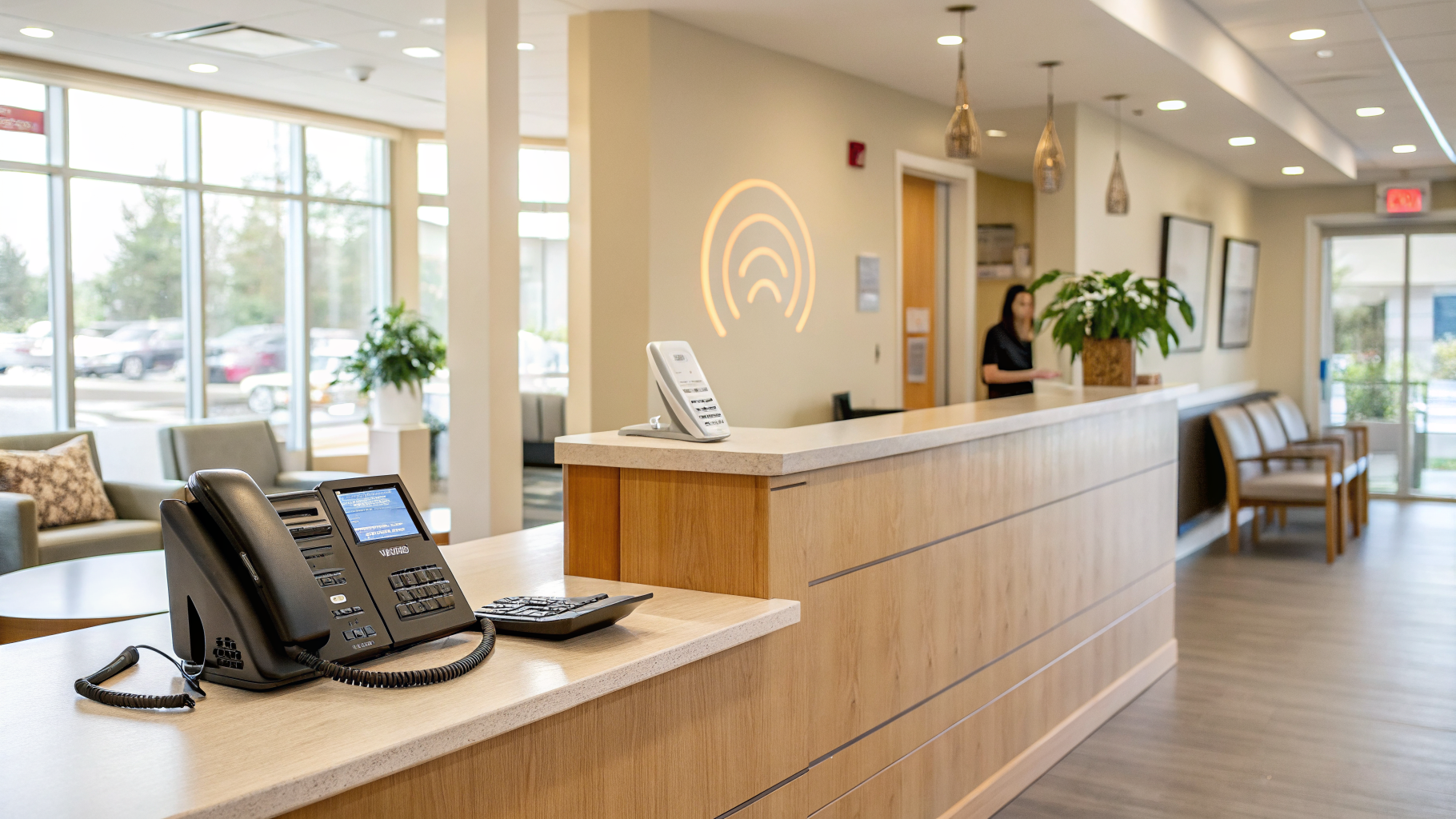
It's 2 p.m., your hygienist's hands are in a patient's mouth, and the phone rings
Tuesday, 2:10 p.m., at a dental clinic in Calgary. The receptionist is taking a payment at the counter, the hygienist is finishing a cleaning, and the dentist is in operatory two. The phone rings. Nobody can pick it up. On the other end, a new patient with a toothache hangs up after four rings, searches « emergency dentist near me », and books with the competitor two blocks away.
This isn't negligence. It's the plain math of a dental front desk: when the whole team is caring for the patients in the room, no one is free for the patients on the phone. And a missed call at a dental clinic is almost never a trivial question. It's an appointment slipping away, often a new patient who will never call back.
That's exactly the gap an AI voice agent for dental clinics is built to fill. Not to replace your team, but to catch the calls they physically cannot take, over the lunch hour, in the evening, and during the Monday-morning rush that hits clinics from Halifax to Vancouver at the same time.
One call in three unanswered, and 86% of patients who never leave a message
The industry numbers are blunt. In a busy dental clinic, roughly a third of calls go unanswered during peak hours. Nearly 80% of those missed calls are about booking or changing an appointment. And according to an analysis of missed business calls, only 14% of new patients leave a voicemail when no one picks up. Put differently, 86% simply hang up and move to the next clinic on the list.
The problem isn't volume, it's value. A new dental patient isn't worth one appointment; they're worth years of hygiene recalls, treatment, and often a whole family. Losing three or four of those calls a week isn't a small administrative annoyance. Over a year, it's a measurable slice of your growth ringing out into an empty room.
We've already broken down the scale of that waste in our guide to missed calls and what an AI voice agent actually recovers. For a dental clinic, the equation cuts even sharper than for an ordinary business.
Why a dental front desk can't win the phone battle
This isn't about hiring better people. It's structural. The patient in the chair comes before the one on the phone, and that's exactly what your patients expect. Between chairside assistance, check-ins, insurance claims and payments, your front-desk team is already two hands short.
Add the real-world time shift: people call their dentist when they're not at work, meaning over lunch and in the evening, precisely when your clinic is closed or thinly staffed. Monday morning after a long weekend, calls arrive in a cluster, all at once, and there's one receptionist to take them, whether the clinic is in Toronto, Winnipeg or Moncton.
No amount of hiring truly fixes this, because the problem isn't headcount: it's that call peaks don't line up with the moments someone is free. An AI voice agent has no break and no queue. It answers the first call the same way it answers the tenth, at 1 p.m. the same as 9 p.m., across all six of Canada's time zones.
What an AI voice agent actually does for a dental clinic
In practice, it answers on the first ring, 24/7. It identifies why the patient is calling (new patient, emergency, reschedule, billing question), offers real openings pulled from your calendar, confirms the appointment and avoids double-booking, all in a few minutes, without a single team member picking up the handset.
After the call, it sends an SMS confirmation and handles the automated reminders that drive no-shows down. It plugs into the scheduling tools you already run: a building block like Cal.com manages real-time availability well, and the agent connects to it so it never offers a slot that no longer exists.
If you're starting from scratch, our step-by-step guide to automating appointment booking shows exactly how to go from a phone ringing into the void to a calendar that fills itself. For a clinic, typical setup runs one to two weeks.

Equipe dentaire occupee pendant que le telephone sonne sans reponse a l'accueil
Hygiene recall: the gold mine your schedule forgets
Where a dental clinic differs from an ordinary business is the hygiene recall. Hundreds of patients are due for a six-month cleaning and never rebooked. Each one is an appointment you've already earned, sitting dormant in your system. An AI voice agent can handle those patients' inbound calls instantly and rebook them without a wait.
The measured results speak for themselves. One study of automated reminders cut no-shows by nearly 23%. In one reported case, a practice booked 244 additional appointments, with a stated value of more than $204,000, simply by no longer letting calls go unanswered. These aren't theoretical gains. It's the same phone, answered better.
Health information on the phone: PIPEDA and PHIPA are not optional
A dental call is never neutral where data is concerned. It touches treatments, insurance numbers, sometimes medical conditions. Across Canada, that information is protected under PIPEDA and, in provinces like Ontario, health-privacy laws such as PHIPA. A voice agent that handles it must be built to protect it, not just to book appointments.
The good news is that the technology matured on exactly this point. Serious voice platforms added concrete safeguards in 2026: conversation guardrails, background-voice detection, and above all keypad-input (DTMF) redaction, which masks the digits a patient types (insurance, card numbers) in transcripts and logs. That's the difference between a novelty and a tool you can safely put in front of a clinic.
Two non-negotiables: data hosted on Canadian servers, and a clear policy on what's retained. We covered all of this in our breakdown of AI voice agent data privacy, and the Office of the Privacy Commissioner of Canada remains the reference to consult before deploying anything.
Your patients don't all speak the same language
A clinic in Mississauga, Ottawa or Surrey sees English-speaking, French-speaking and newcomer patients in the same day. A good voice agent greets in the caller's language and switches mid-call, English to French to another language, without a transfer, without friction, and without losing track of the appointment in progress.
That flexibility isn't a luxury in a country as multilingual as Canada. It's the difference between a patient who books and a patient who gives up because they weren't understood. The ability to switch languages mid-call has become a standard, and we explain how it works in a dedicated article.

Agent vocal IA securise traitant un appel, motif d'ondes sonores et de bouclier de confidentialite
What an AI voice agent should never do in a dental clinic
Let's be honest about the limits, because that's where trust is won or lost. A voice agent doesn't diagnose, doesn't give clinical advice, and doesn't manage a true emergency. A patient with trauma, bleeding or acute pain must be recognized as such and routed immediately to a human or an emergency line.
A good agent knows its lane: booking, moving and confirming appointments, screening, sharing hours and services, and intelligently transferring everything else. An agent that claims to do everything is a liability; an agent that knows how to say « let me transfer you to someone » is an asset. That framing, more than raw technology, is what lets a clinic sleep at night.
"Can you tell it's an AI?" The question your patients actually have
It's the number-one fear among clinic owners: that a patient will hang up the moment they realize they're talking to a machine. In practice, the opposite usually happens. A patient far prefers an agent that answers in two seconds, polite and clear, over a voicemail box that sends them to leave a message no one will hear until tomorrow. The voice is natural, it pauses, it rephrases, and it never gets impatient, even on the tenth identical call of the day.
What matters isn't fooling the patient into thinking they're speaking with a human, it's solving their problem fast: find a slot, confirm it, send the text. Transparency actually builds trust: an agent that announces itself and then performs cleanly reassures people more than a vague grey area. And for anything outside its scope, it transfers, exactly the way a good, overwhelmed receptionist would hand you to the right person.
The real risk to your reputation isn't the voice agent. It's silence. Every call that rings into the void tells the patient one thing: "we didn't have time for you." On that score, an agent that always answers beats a human team that, for all its goodwill, simply can't be in two places at once. We've quantified that cost of silence in our missed-calls breakdown.
Where to start, and what it really costs
Setup is simpler than most owners expect: you connect your calendar, define your appointment types and rules (duration, provider, buffer between patients), write the greeting script, and test. Budget one to two weeks, with no code on your side. Plans start at just $49/month, a fraction of the cost of an extra front-desk seat.
The best place to start isn't a contract, it's a demo. Book a 15-minute demo to hear the agent handle a real clinic scenario, or explore our plans if you want the numbers first. Your clinic's phone is already ringing; the only question is who answers when your team can't.