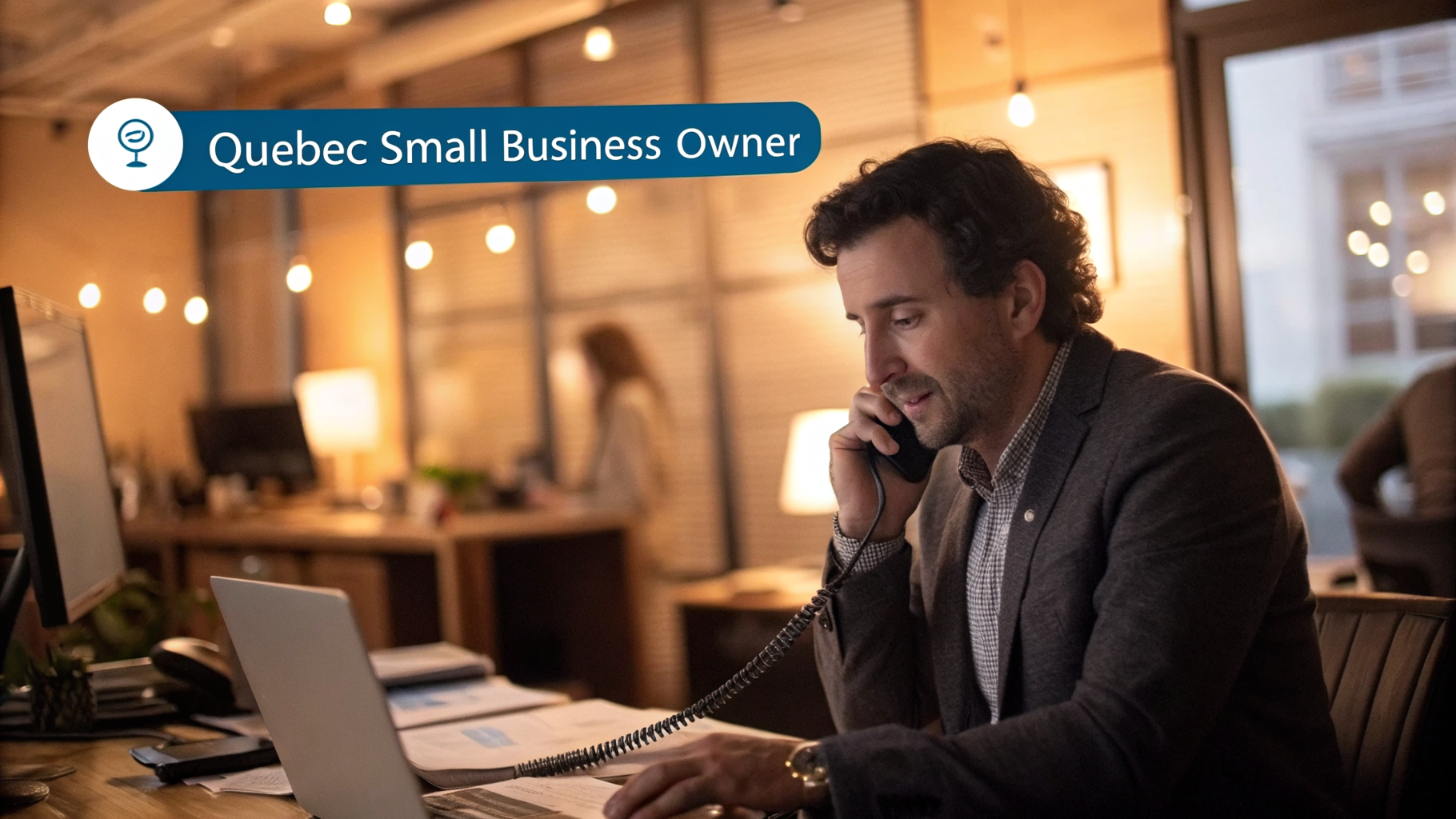
A customer calls your Brossard car dealership on a Tuesday morning. She starts in French: "Bonjour, j'appelle pour le lease de mon Civic, est-ce que je peux extend un mois de plus?"
Three seconds. That's how long it took your "bilingual" AI voice agent to go off the rails. It caught the word lease, switched to English, and stayed locked in English even when she came back in French. Result: she hung up, called again only to hit voicemail, then drove over to your competitor on Taschereau.
Welcome to the reality of bilingual Quebec. "Frenglish," that very local way of mixing French and English in the same sentence, crashes more than 8 out of 10 AI voice agents in production. And almost every vendor selling you a "bilingual agent" has never seriously tested this case.
Here's why it breaks, how to test it before signing, and what a truly bilingual agent looks like.
"Frenglish" isn't a bug — it's the Quebec default
Listen to how people actually talk in a Quebec small business:
- "Je veux book un rendez-vous pour mon chat"
- "My timing belt is making a weird noise"
- "Est-ce que vous faites le follow-up par courriel ou par texto?"
- "C'est quoi le price pour un nettoyage complet?"
For a human, zero friction. For an AI voice agent built on a standard stack (English ASR or French, not both at once), it's chaos. The speech recognition engine tries to force the sentence into one language. It hears "book" and decides English. Or it hears "rendez-vous" and forces French. Either way, half the sentence becomes noise.
Worse: when the agent replies, its speech synthesis (TTS) has already locked a language. It answers you half-wrong. The call falls apart in 4-5 turns.
The 3 failure modes your competitor sells as "bilingual"
1. Rigid pre-selection (aka "old IVR in disguise")
"For French, press 1. For English, press 2." Ring a bell? That's exactly what 60% of so-called "bilingual" voice agents do: they ask for the language once at the start, then lock it for the rest of the call. If your customer slips one English word in the middle, the agent can't adapt. That's façade-multilingual, not living bilingual.
2. One-way switching
Some agents detect a language change… but only one way. They jump from French to English the second they hear an English word, but never come back. That's worse than pre-selection: your customer ends up in English without asking for it, just because she said "lease." It sends the message "your French isn't good enough for us" — the exact opposite of what a Quebec SMB wants to project.
3. Accent drift (Paris vs. Montreal)
Even when the agent stays in French, accent can derail it. A model trained mostly on European French will stumble on "char," "magasiner," "courriel," or "dépanneur." Your customer hears a voice that doesn't sound "from here" — and buying intent drops. We've already covered the latency killing engagement, but the wrong-sounding accent is the second silent killer.
Why it actually breaks (in plain English)
An AI voice agent is 3 layers that all need to understand both languages at the same time:
Layer 1 — ASR (speech recognition). This turns voice into text. Older models are mono-lingual: you pick French or English at setup. Newer models (Whisper v3, gpt-realtime, ElevenLabs Scribe) handle code-switching natively, but only if your vendor actually uses them and has tuned them for the Quebec context.
Layer 2 — LLM (understanding). The model that "understands" must process a mixed sentence without flinching. GPT-4o and Claude Sonnet handle it well; a smaller model or a rule engine (rigid scripts) will choke.
Layer 3 — TTS (synthesis). And here's the real trick: the voice that answers must be able to say "No problem, I can extend your lease" while keeping one coherent accent. That's where low-grade synthetic voices collapse — they "switch" voices mid-sentence, or pronounce an English word as if it were French ("leeze" instead of "lease").
If your vendor can't explain what each of the 3 layers does in their agent, that's a red flag. We made a list of 10 questions to ask before signing, and the code-switching one is number 4.
5 tests to run before you sign (20 minutes)
Here's the protocol we apply to every new agent before it answers a single customer call. Budget 20 minutes and a phone. Record every call.
Test 1 — The FR → EN → FR slide. Start in pure French. After 2 sentences, drop one English word ("meeting," "deadline," "booking"). Keep going in French. The agent must understand the English word without flipping the whole conversation. Fail if the next reply is in English.
Test 2 — Intra-sentence code-switching. Say a sentence that mixes both languages: "Je veux reschedule mon rendez-vous pour next week." The agent must extract the intent (reschedule an appointment to next week) even with the mix. Fail if the extracted date is wrong or the answer is incoherent.
Test 3 — Full language switch at turn 3. French for 2 turns, then switch entirely to English at turn 3. The agent must follow and switch. Reverse it at turn 5. Fail if the agent gets stuck in the first language or replies half-and-half.
Test 4 — Pure Quebec-ism. "J'ai besoin de faire checker mon char, il fait un bruit dans le muffler." That sentence is 100% understandable to any Quebec human. The agent must extract: (a) inspection request, (b) vehicle, (c) problem area. Fail if it replies "I didn't understand."
Test 5 — Imperfect accent. Have someone with a non-Quebec accent (France, Belgium, Haiti, North Africa) place the call. Your SMB serves a diverse population. Fail if comprehension drops below 85% with those accents.
If your agent passes the 5 tests at 85% or better, you have a real bilingual agent. If it misses 2 or more, you're buying a gadget, not an employee. Our full 5-scenario test protocol is laid out here.
What a properly-built bilingual agent looks like in 2026
The bar moved in April 2026. OpenAI shipped gpt-realtime with native code-switching, and ElevenLabs added multi-agent tracking with continuous language detection. A modern well-built agent should have:
- Continuous language detection (not just at the start), updated every turn
- Bilingual context memory — if the customer slips an English word then returns to French, the agent remembers both
- Quebec-trained TTS voice, not France, with proper pronunciation of common anglicisms
- Sub-800 ms latency even during the switch (otherwise the customer hears the hesitation and hangs up)
- Bilingual call logs — your transcript must preserve the original language of each segment for audit
According to Hamming AI's multilingual testing framework, an agent that clears 80% of code-switching scenarios is considered "production-ready." Below that, it's a prototype billed at product prices.
What this means for your SMB
If you serve a Quebec clientele, you will get Frenglish. It's not an edge case, it's the rule. An AI voice agent that can't handle it costs more than it earns: every failed call is a customer who calls the competitor and never comes back. The math we ran on the 800 ms latency piece applies here: moving from 5% to 15% abandonment is roughly $30,000 per year in lost revenue for a mid-size SMB.
The good news: you don't have to build this yourself. The TECHMA team handles all the setup — choosing ASR/TTS models tuned to Quebec, running the test scenarios, integrating with your existing line. You give us your number, we ship an agent that won't crash when your customer says "extend my lease."
Want to see a bilingual agent pass the 5 tests live? Book a 15-minute demo, we'll call you and you can throw every Frenglish phrase you've got at us. We'll take the breaks as they come.