A Scene You'll Recognize
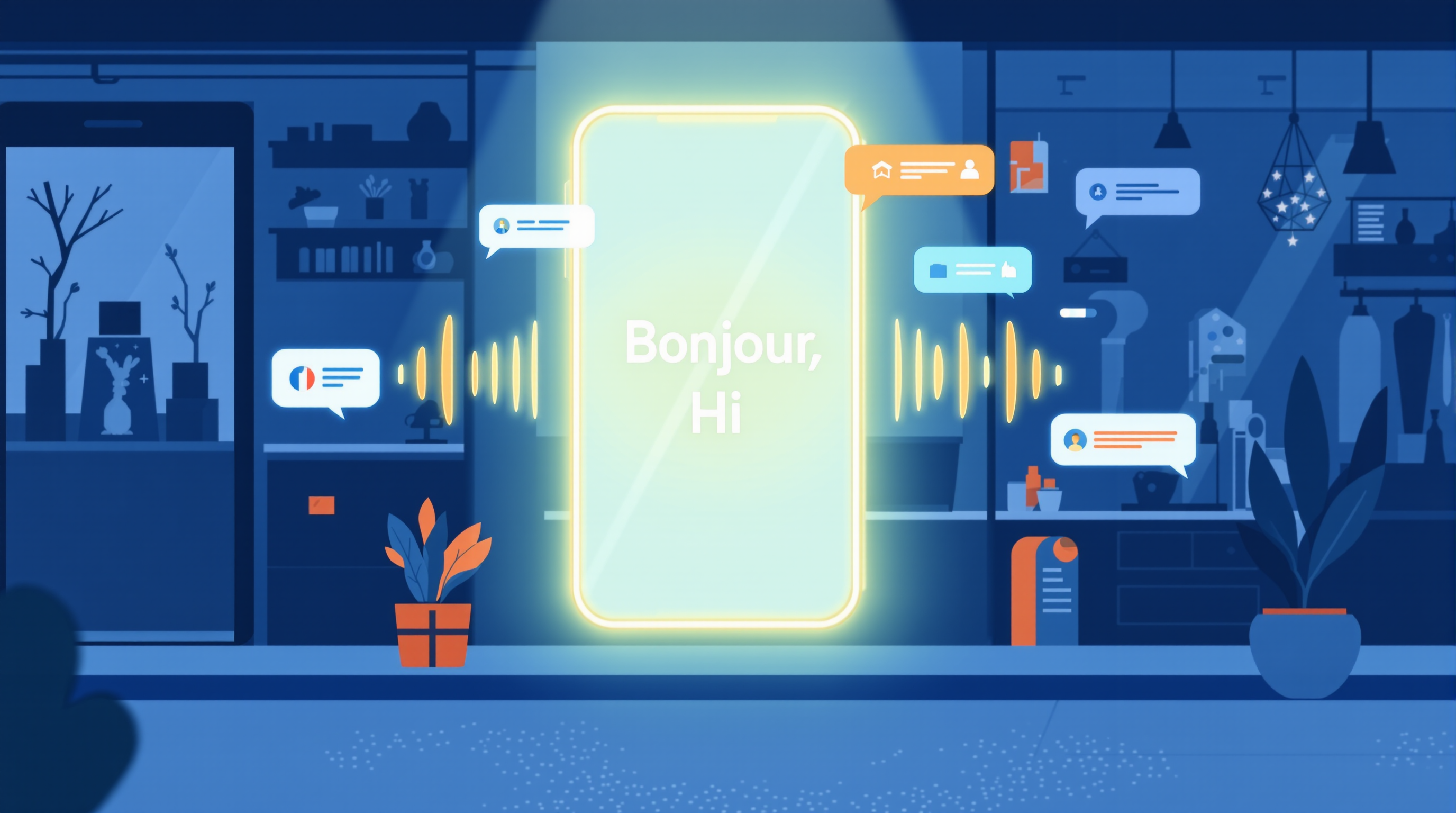
It's a Tuesday at 2 PM at a dental clinic in Montreal's Plateau. The phone rings. The receptionist picks up: "Bonjour, Hi." The caller starts in French: "Salut, j'aurais besoin d'un rendez-vous pour mon fils, but actually he needs to come in this week, his tooth is killing him." The receptionist switches mid-sentence without flinching. Nobody finds it weird.
That's how Quebec talks in 2026. We slide between languages the way most people breathe. To a bilingual human, it's invisible. To an AI voice agent, it's been a wall of concrete for years.
And that wall just came down.
The Thesis: Single-Language Voice AI Is Already Obsolete in Quebec
Here's my prediction, and it won't make every vendor happy: any AI voice agent deployed in Quebec that can't handle real-time code-switching will be obsolete before the end of 2026. Not improved. Not patched. Obsolete.
We're not talking about having one agent in French and another in English. That was the old model. We're talking about a single agent that follows the customer when they start a sentence in French and finish it in English — no voice change, no conversation reset, no forcing the caller to pick a side.
This isn't science fiction anymore. It's what the best 2026 platforms do today. And it completely changes what we can promise a Quebec SMB.
Why It Stayed Hard for So Long
Code-switching — alternating two languages within a single sentence — has crashed most voice agents for years. The reason is technical but simple.
A voice agent is four layers chained together in under a second: speech-to-text, language model, text-to-speech, and orchestration. Each layer has long been configured for one language at a time. When the customer switches mid-sentence, the transcription model keeps interpreting English words as if they were broken French. The result sounds like gibberish, and the agent answers something irrelevant.
Teams that take voice agent testing seriously know it: if you're not testing code-switching explicitly, your multilingual agent is not production-ready. A phrase like "Quiero pagar my bill" is enough to derail most setups.
In Quebec, this problem isn't an edge case. It's the default conversation in roughly half the calls a Montreal SMB receives every day.
Argument #1: Sub-Second Latency Changes Everything
For a conversation to feel natural, the agent has to respond in under a second after you stop speaking. Beyond that, the caller feels the delay and the whole exchange gets awkward.
The challenge with multilingual is that language detection adds processing time. Some languages transcribe slower than others. Internal translation, when it exists, stacks more lag.
What changed in 2026 is that providers stopped duct-taping separate layers and started fusing recognition, reasoning, and synthesis into unified, low-latency pipelines. ElevenLabs notably added support in April 2026 for new model providers like Gemini 3.1 Pro and the Qwen 3.5 family, and announced on-device and on-premise deployment that brings compute even closer to the user (see ElevenLabs' official changelog).
In plain terms: less latency plus better multilingual understanding equals an agent that no longer freezes when you switch languages mid-sentence. That's the invisible engineering behind every "wow" demo of 2026.
Argument #2: The Quebec Market Is Now a Core Use Case, Not an Option
For years, voice agent solutions were built for the U.S. market. Quebec French, when it existed, was a checkbox option. Today, it's flipped: serious vendors now explicitly support Quebec French, Acadian, Franco-Ontarian, and international French variants — because they figured out the bilingual Canadian market is the perfect testing ground to validate their models.
For a Quebec SMB, that means three concrete things. One, your francophone customer no longer has to tolerate a tinny European accent. Two, your anglophone customer no longer has to hang up because the agent can't catch their name. Three, the customer who blends both in the same conversation stays with your business instead of going to your competitor.
We see this already with restaurants deploying voice agents during the dinner rush: a caller from Montreal and another from the West Island get the same service, in the language they pick — sometimes alternating in the same sentence.
Argument #3: Language Compliance Stops Being a Headache
In Quebec, the Charter of the French Language sets clear rules on customer-facing communication. Service must be available in French, period.
With a properly configured bilingual AI voice agent, this stops being a constraint and becomes an advantage. The greeting starts in French by default. If the caller answers in English, the agent follows. If they mix both, the agent still follows. French stays the primary service language, and English becomes the natural option it's supposed to be in practice.
It's also a file you handle in parallel with Law 25 on personal data protection. Our guide on Law 25 compliance for AI voice agents explains why both frameworks — language and personal data — should be designed in from day one, not bolted on later.
The Counterargument: "My Customers Will Prefer a Human"
This is the objection we hear most. And honestly: before 2026, it was often valid. A voice agent that couldn't code-switch, that asked the caller to repeat three times, that forced a language choice at the start of the call — yes, that was worse than a human.
But the ground is shifting fast. New-generation bilingual agents pick up frustration in the voice, soften their tone, and transfer to a human when needed — what's called vocal emotional intelligence, which has been shown to cut escalations by up to 25% in real 2026 deployments.
And for 80% of calls — booking appointments, schedule questions, routing, confirmations — an agent that answers in under a second, at any hour, in the customer's language, is no longer a compromise. It's often better than the overworked receptionist who picks up on the fourth ring.
Why Quebec SMBs Are Ahead of the Rest of Canada
Here's what most people outside Quebec don't realize: we're the most advanced bilingual market in North America. Not because we speak two languages — other cities do too — but because we mix them daily, at work, in commerce, at home.
That means a Quebec SMB that masters AI code-switching in 2026 gains an edge on two fronts. First, against Quebec competitors still running a unilingual agent. Second, against Canadian and American competitors whose agents stall the moment a bilingual customer opens their mouth.
We see this dynamic in every sector: vet clinics recovering missed calls, insurance brokers, accounting firms during tax season. The common denominator is the same: a missed or mishandled call is a customer walking out. A call answered in the right language (or in both) is a customer who stays.
What This Means for You, Concretely
If you run a Quebec SMB and you tested an AI voice agent a year or two ago, this might be the right time to revisit. Plenty of business owners walked away disappointed in 2024 because the demo froze on the first "Hi" dropped into a French sentence. Those memories are out of date.
The real test isn't "does it speak French" anymore. The real test is: does it follow a conversation where I start in French, drop in an English word, slip in a Montreal-Nord expression, and end with a question? If yes, you're looking at 2026. If no, you're watching a 2024 demo with a fresh paint job.
This shift is what we deploy at TECHMA for Quebec SMB clients — integration, multilingual configuration, code-switching tests, Charter and Law 25 compliance — handled by our team, not in self-service mode.
One Final Thought
"Bonjour, Hi" has long been a quiet identity marker in Quebec — a way of saying here, we adapt. For years, voice technology forced people to pick a language up front, to press 1 or press 2.
In 2026, for the first time, the technology starts to talk like we do. Not in one language, not in two. But in the exact, fluid, natural blend we use every single day.
It's rare for technology to catch up to a culture. Take advantage of it.
Got an opinion on this? Share your perspective with us, or come see a bilingual voice agent in action and judge for yourself.
FAQ
My current voice agent doesn't handle code-switching. Do I have to start over? Not necessarily. Depending on the platform, it's often a matter of transcription model and configuration. Our TECHMA team can audit your deployment and tell you whether it's an upgrade or a platform change you need.
Is a bilingual agent more expensive than a unilingual one? In 2026, the cost gap is thin. Most platforms bill per minute, not per language. The real cost isn't in the bill — it's in the configuration and testing, and that's exactly what we manage for you.
What if my customer speaks heavy joual? 2026 models explicitly support Quebec French. They understand "tantôt," "pantoute," "icitte." The tinny European accent is ancient history when the agent is properly tuned.
How long until this is everywhere? Faster than people think. The barrier isn't technical anymore. It's the decision to move. SMBs that act this year will have a 12 to 18-month head start on their competitors.