
A grandmother picks up the phone. It's her grandson's voice, panicked, saying he's been in an accident and needs money right now. Except it isn't him — it's a clone built from a few seconds of video pulled off social media. CBC Marketplace documented exactly this kind of case earlier this year, and it's not a one-off anymore. So a real question is starting to come up with business owners across Canada who are considering an AI voice agent to answer their phones: if my customers just heard a story like that on the news, are they going to trust the voice that answers when they call my business?
It's a fair question, and it deserves better than "don't worry about it." Here's what actually separates a legitimate AI voice agent from a voice scam — and why, set up properly, it becomes the opposite of a trust problem.
The summer AI voice scams became front-page news
This isn't a vibe. Reported fraud losses in Canada climbed from $107 million in 2020 to $704 million in 2025, and a meaningful chunk of that recent spike carries the fingerprints of generative AI. Canadian Anti-Fraud Centre data shows family-emergency voice-cloning scams alone cost Canadian victims close to $3 million in 2024 — and the curve has kept climbing into 2026.
The practical effect: your callers now arrive with a reflex they didn't have two years ago. A half-second hesitation. A quiet "is this actually [business name]?" running in the background. For a clinic in Halifax or an accounting firm in Winnipeg that just rolled out an AI voice agent, ignoring that reflex is a mistake. Addressing it directly, in the first few seconds of the call, turns it into an advantage.
The real risk isn't getting scammed — it's getting mistaken for one
Here's the nuance most providers miss. The danger for a Canadian small business is almost never that its own AI voice agent gets hijacked to defraud a customer. The quieter, more commercially real risk is a hesitant caller hanging up before leaving a message, because the voice "sounded a little too smooth" and nobody told them who — or what — they were talking to. That's not a theoretical concern. We covered this when we wrote about what Canadian law requires an AI voice agent to disclose: the law says you have to say it, but in the 2026 climate, saying it upfront has also become the best commercial defence against doubt. A customer who finds out later that they were talking to an AI remembers that discovery. A customer who's told upfront moves on within a second. Think about the two calls side by side. In one, the agent opens with the business name, says plainly that it's an AI assistant, and offers a human if needed — the whole thing takes four seconds and the caller barely registers it. In the other, the agent tries to sound as human as possible, dodges the question if asked directly, and the caller spends the rest of the call listening for tells instead of answering questions about their appointment. The first business captured a lead. The second one gave a nervous caller a reason to call the next name on their list instead.
SynthID watermarking: what changed with OpenAI and ElevenLabs this summer
There's a recent technical development that points in exactly this direction. In late July 2026, OpenAI confirmed that audio generated through GPT-Live and its voice API now carries Google DeepMind's SynthID watermark — a marker that's inaudible but detectable with a verification tool. ElevenLabs announced the same for its own voices. More than 100 billion pieces of audio and visual content now carry this signature. In practice, the watermark changes nothing about what your callers hear. It doesn't replace spoken disclosure either — a detection tool is useless to a caller mid-conversation with no way to run it. But it sets an industry-wide standard: serious voice platforms now document the provenance of the audio they generate. It's one more signal, in an industry that's been short on them, that the legitimacy of an AI voice agent provider comes down to details like this — not just the price per minute.
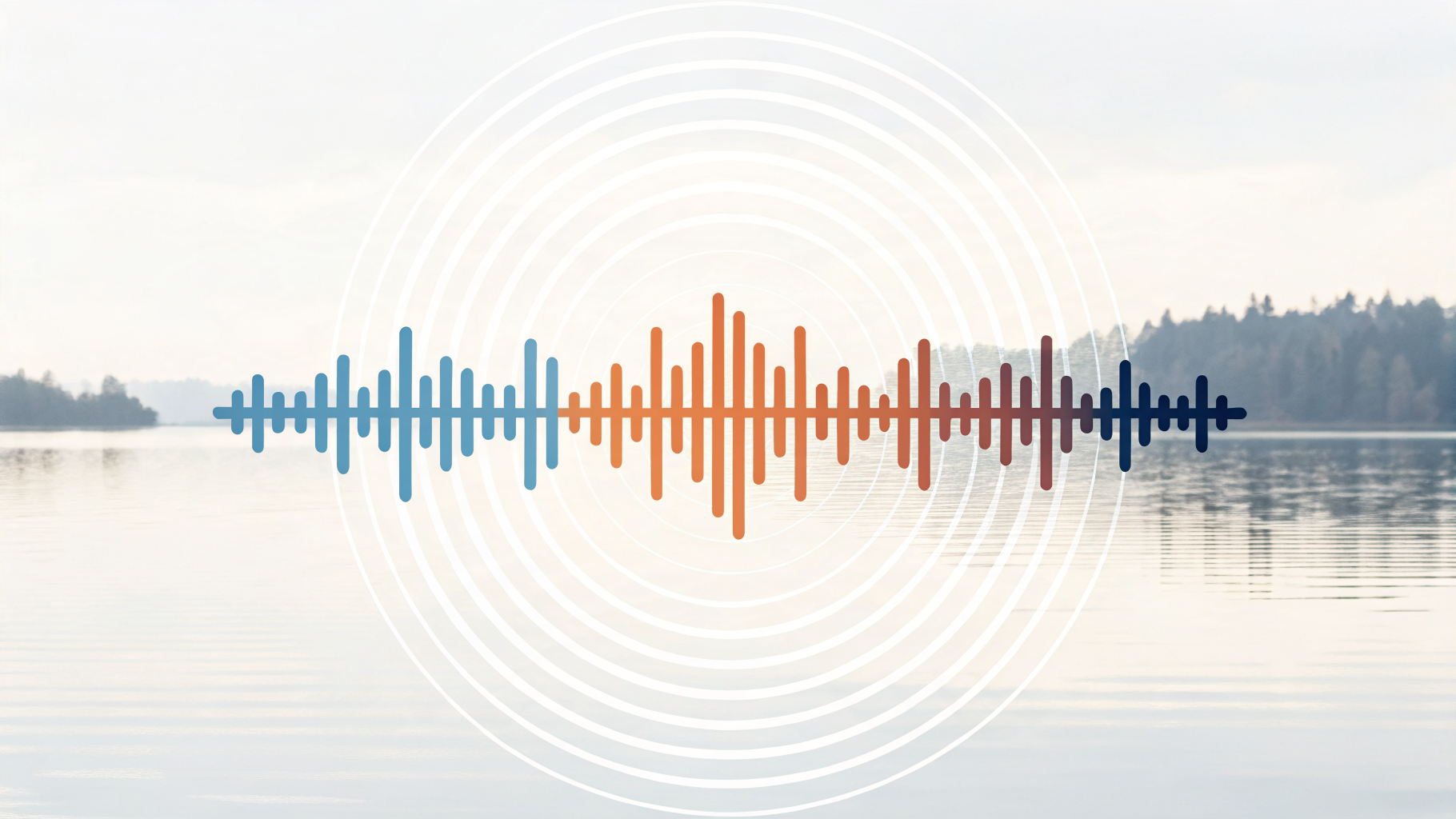
Filigrane audio SynthID integre dans une onde sonore generee par IA
The 4 signals that say "this is legitimate" in under ten seconds
No caller is going to check an audio watermark while they're waiting to book an appointment. What actually reassures them happens inside the conversation itself, and it happens early.
- The business name, said first. A scam never opens with a verifiable business name and a callback number. A legitimate AI voice agent always leads with that.
- The explicit words "AI" or "artificial intelligence." Not a euphemism, not just a first name. This is exactly what we break down in our guide on AI voice agent disclosure requirements — and it's precisely the kind of transparency a scam will never offer.
- No urgency, no request for money or banking details in the first few lines. Voice scams run on panic. A professional AI voice agent books an appointment or takes a message — it never asks for a wire transfer.
- A clear path to a human. We mapped out exactly when an agent should escalate a call in our guide to the 6 moments an AI voice agent should hand off to a human. A caller who can say "I want to talk to someone" and get that immediately has no reason left to be suspicious.
The mistakes that feed distrust
Most businesses that get a complaint along the lines of "your system felt off" made one of these mistakes — not a technical failure.
Giving the agent a human first name and never mentioning it's AI is still the most common error, and the easiest to fix. Putting the disclosure only on the website, when the caller is on the phone and never sees it, is another. And the worst one: staying vague about what happens to the call data. A customer who asks "is this call recorded, and why" deserves a straight answer, not an awkward silence. We laid out the exact questions a customer — or you, as a buyer — should be able to ask a provider in our guide to data privacy questions for Canadian businesses.
What this means across Canada, sector by sector
For a dental clinic in Toronto or a law firm in Ottawa, the trust stakes are even higher — patients and clients are sharing personal information within the first few seconds of a call. For a contractor in Calgary or a moving company in Vancouver, the concern is more straightforward: not losing an inbound call because a hesitant customer hung up. For a retailer in Winnipeg fielding calls from customers in a different time zone than head office, the after-hours slot is exactly when a caller is most likely to be unsure who — or what — picked up, since there's no easy way to call back during business hours and check. Either way, the fix is the same across all six time zones: say what it is in the first sentence, and give callers a way out to a human. That's not a compliance checkbox. It's what turns hesitation into a booked appointment, whether the call comes in from Halifax at 8 a.m. Atlantic or from Vancouver at 8 a.m. Pacific.

Les 4 signaux qui rassurent un client au telephone en moins de 10 secondes
Frequently Asked Questions
Can an AI voice agent be used to scam my own customers?
The documented risk so far involves cloning real human voices — a family member's or an executive's — not commercial AI voice agent platforms like the ones businesses use to answer their phones. Those platforms run on standardized synthetic voices, not individual voice clones, and have no commercial incentive to be associated with fraud.
Does SynthID watermarking make my AI voice agent more "legal"?
No, it isn't a legal requirement in Canada in 2026. It's a voluntary industry practice that strengthens traceability of AI-generated audio. Your legal obligation remains spoken disclosure, which exists independently of any technical watermark.
Will my customers actually notice if I don't say anything?
Increasingly, yes. With voice scams getting this much media coverage, callers are paying closer attention to the signals of an automated call. Staying silent on this now stands out more than it did two years ago.
Is it still worth deploying an AI voice agent given all this?
Yes, as long as it's configured properly. The technology was never the problem — transparency about how it's used is. A business that's upfront about what it uses and why ends up building more trust than one that says nothing at all.
Conclusion
AI voice scams are going to keep making headlines through 2026 — this isn't a trend that's fading. But for a Canadian business rolling out a legitimate AI voice agent, that climate isn't a reason to hold back. It's a reason to do it right from the start: name the business, say it's AI, offer a clear path to a human, and be straightforward about the data. Done that way, your AI voice agent becomes exactly what reassures a skeptical caller — not what worries them.
At Agent IA Vocal, disclosure, data transparency, and human handoff are part of the standard setup on every deployment. Book 15 minutes to hear what a properly configured call sounds like, or see our plans starting at $49/month.