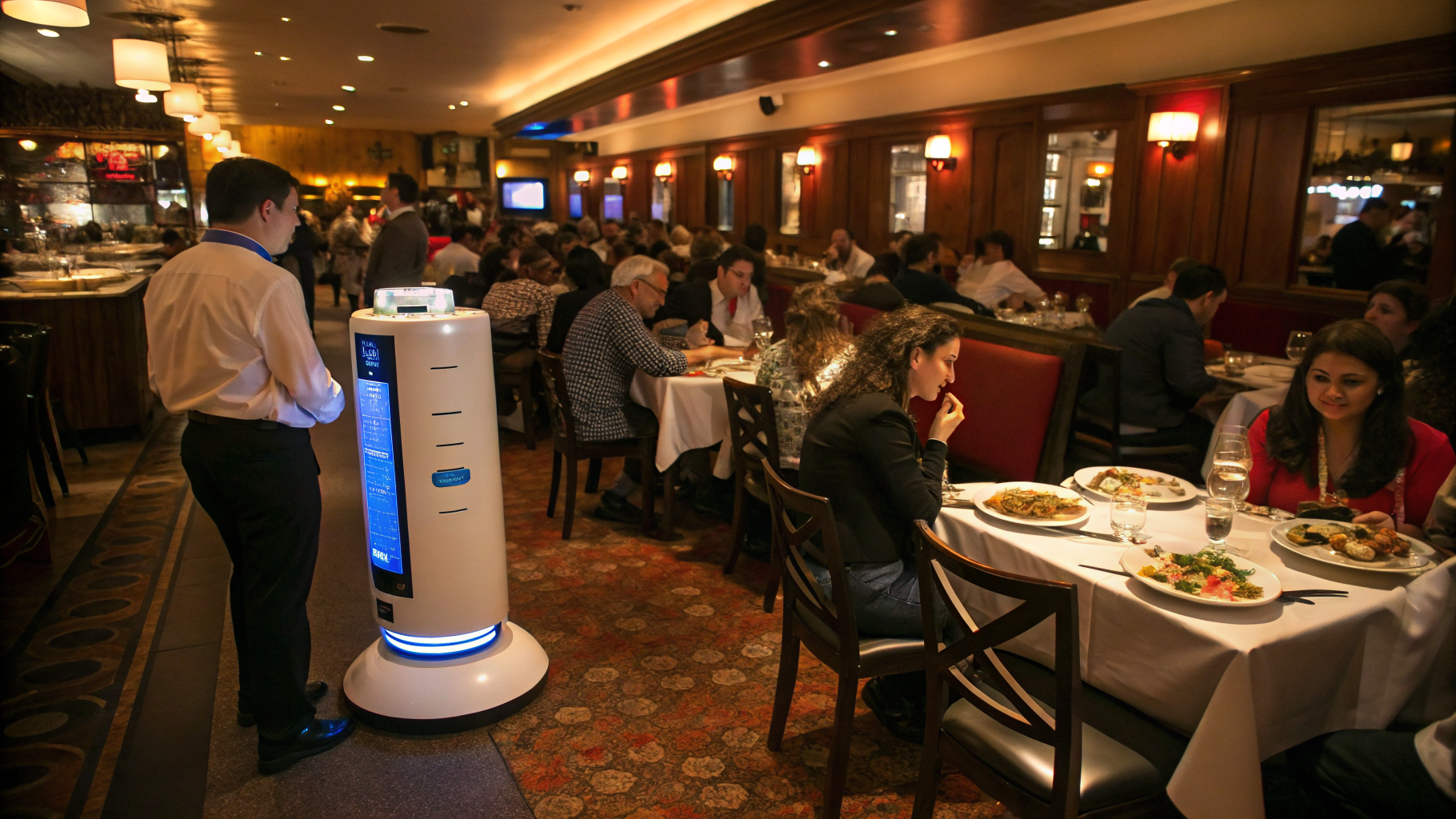
Friday night, 7:15 PM. The restaurant is full. Servers are running. The kitchen is firing on all cylinders. Your host is juggling three tables arriving at once. The phone rings at the stand. Once. Twice. Nobody can answer. A third ring. Then silence.
What you'll never know: that was a group of four looking to book for Saturday night. They hung up and called the place down the street.
According to industry data, this happens with roughly 1 in 4 calls during peak service hours at restaurants. For Quebec's 18,500 food service establishments — 58.2% of which are independent operators according to Association Restauration Québec — each missed call is a reservation lost. And with average profit margins at just 3.5%, there's no room for this kind of invisible revenue leak.
The Restaurant Owner's Paradox
Here's the structural problem: the hours when your phone rings most are exactly when your team has the least capacity to answer. Friday dinner rush. Saturday lunch. The pre-theatre wave. These are precisely the moments when your staff is at maximum capacity — and minimum availability to pick up a phone.
And it doesn't get easier with the seasons. Summer brings patio season, graduation dinners, birthday parties, office outings — call volumes climb. Then comes the holiday booking rush from November through December, Valentine's Day, Mother's Day. Reservation peaks never align with quiet periods.
A 2026 restaurant industry ROI analysis found that restaurants miss 20–30% of inbound calls during peak hours — and 83% of callers who reach no one don't call back. They move to the next option: a competitor, a reservation app, or a night in.
Quebec's Bilingual Reality: A Challenge Most Solutions Ignore
Running a restaurant in Quebec comes with a language dimension that's genuinely unique in North America. On a Friday night in Montreal, your calls might be in French, in English, or somewhere in between depending on the neighbourhood and clientele. Expecting your host to switch fluently between both languages during a full house — while managing incoming guests at the door — is asking a lot.
An AI voice agent handles both languages natively. It detects the caller's language automatically and continues the conversation accordingly — no extra configuration, no language training, no second hire. For a Quebec restaurant, this turns a daily operational friction into a competitive edge.
How an AI Voice Agent Handles Calls During Peak Service
Agent IA Vocal is fully set up and managed by the TECHMA team — you don't program anything, you don't configure a single setting yourself. Here's what it actually does in a restaurant context:
When a customer calls, the agent picks up in under a second. No hold music. No "your call is important to us." It takes the reservation — date, time, party size, any dietary preferences — confirms it back to the caller, and logs it. It also handles routine questions: hours, address, parking, common allergens, today's specials. For anything more complex — private event logistics, large group requests, detailed dietary consultations — the agent transfers to a human or leaves a detailed callback note.
What changes the math entirely is 24/7 availability. Your restaurant closes at 10 PM, but people think about weekend dinner plans on Sunday night at 11. The agent takes those late-night reservations without you doing anything.
4 Moments Where the Difference Is Real and Measurable
Friday at 7 PM (the classic case). During the rush, every staff member is in the dining room or the kitchen. The AI agent handles all incoming calls simultaneously — multiple lines at once, nobody waiting on hold. Every reservation confirmed and logged automatically.
Sunday at 11 PM (the impulse booking). A couple decides they want to celebrate an anniversary at your restaurant. The impulse hits late. The agent takes the reservation. Monday morning, you find three new bookings made after closing.
Repetitive questions that pull staff off the floor. "Are you open Sunday for brunch?" "Do you allow dogs on the patio?" "What's the pasta special tonight?" These calls don't directly generate revenue, but they take a server or host off the floor for 2 minutes each. The agent handles them without effort, freeing your team for the in-person service that actually builds customer loyalty.
Peak seasons (summer patio + holiday rush). From June through September, then November through December, call volumes can double. Without an AI agent, you either hire extra staff or miss reservations. With the agent, a volume spike has zero impact on your answer rate — it handles as many simultaneous calls as needed.
The ROI Calculation: What Your Restaurant Is Leaving on the Table
Let's run the numbers plainly. As our Quebec SMB AI voice adoption analysis showed, the ROI often surprises restaurant owners who assumed the technology was sized for larger operations.
Take a restaurant receiving 30 incoming calls per weekend evening, missing 8 (roughly 27%) during peak hours. Of those 8 missed calls, 5 were reservation requests — groups of 3, average spend of $55 per person. That's 3 × $55 × 5 = $825 in missed revenue per evening. Two weekend evenings = $1,650 per week. Per month: $6,600 in revenue that went to the competitor down the street.
The monthly cost of Agent IA Vocal: starting at $99/month on the Pro plan, with full setup and configuration by TECHMA included at no extra charge. The math is stark — you're 66 times covered by the first month's recovered revenue alone.
Smaller restaurant? Say 15 calls per evening, missing 4. The ROI still lands clearly in positive territory. You break even by recovering fewer than two reservations per month.
3 Objections Restaurant Owners Raise — and Honest Answers
"My restaurant is upscale — guests expect to speak with a person." That's entirely valid for complex calls: a 12-course tasting menu with wine pairing, a private event requiring custom logistics, a serious allergy consultation. For these, the agent transfers to a human or takes a full callback note. But the 80% of routine calls — "I'd like to book for two on Friday at 8" — don't require a white-glove conversation. As we break down in our comparison of receptionists, answering services, and AI voice agents, automation doesn't replace the human — it frees them for the interactions that actually matter.
"My team doesn't have time to set this up." Agent IA Vocal isn't a tool your team uses — it's a system that the TECHMA team sets up and manages for you. Your staff doesn't touch a thing. The agent integrates with your existing phone number via call forwarding, and you receive a daily summary of logged reservations and messages in your inbox every morning.
"My restaurant is too small to justify this." Often it's the opposite. An independent 35-seat restaurant missing 3 reservation requests per evening is proportionally more impacted than a large chain missing 30. The base plan at $49/month is built specifically for smaller independent operators. And to avoid the common mistakes that eat into early ROI, our guide on the 7 most expensive AI voice deployment mistakes is worth a read before you start.
FAQ: What Quebec Restaurant Owners Ask Most
Can the agent integrate with my reservation system (OpenTable, Resy, etc.)? The TECHMA team configures the integration based on your current tools. For the most common reservation systems, direct integration is available. For others, the agent logs reservations in a centralized report that you or your host confirms at the start of each service.
What happens with group bookings or private event inquiries? For any request beyond a standard reservation — groups of 10 or more, private event inquiries, custom menu discussions — the agent identifies the complexity and either transfers to a human or takes a detailed callback message. These calls exit automatic mode entirely.
Does the agent sound natural in French, or robotic and European? The AI uses ElevenLabs' most recent voice models, which TECHMA calibrates to a natural Quebec French accent. Voice, tone, and phrasing are adjusted during setup to match your restaurant's positioning — relaxed bistro versus fine dining.
How long before it's live and taking calls? The TECHMA team handles the full setup — typically 3 to 7 business days depending on menu complexity and integration requirements. Your only action: fill out a short intake questionnaire to brief the team.
Making the Decision
The math is clear. The question isn't whether an AI voice agent can recover missed reservations for your restaurant — it can. The real question is how many more Friday nights you'll let the phone ring unanswered before acting on it.
When Amazon Ring evaluated over 40 AI voice vendors before routing 100% of their customer calls to an AI platform, they saw immediate improvements in customer satisfaction. Your restaurant's Friday rush isn't a billion-dollar enterprise challenge — but the principle holds: every unanswered call is a conversation that never happened, and a table that stayed empty.
To see exactly how Agent IA Vocal would work in your restaurant, book a free demo with the TECHMA team — or explore plans starting at $49/month. Setup is fully handled by TECHMA.