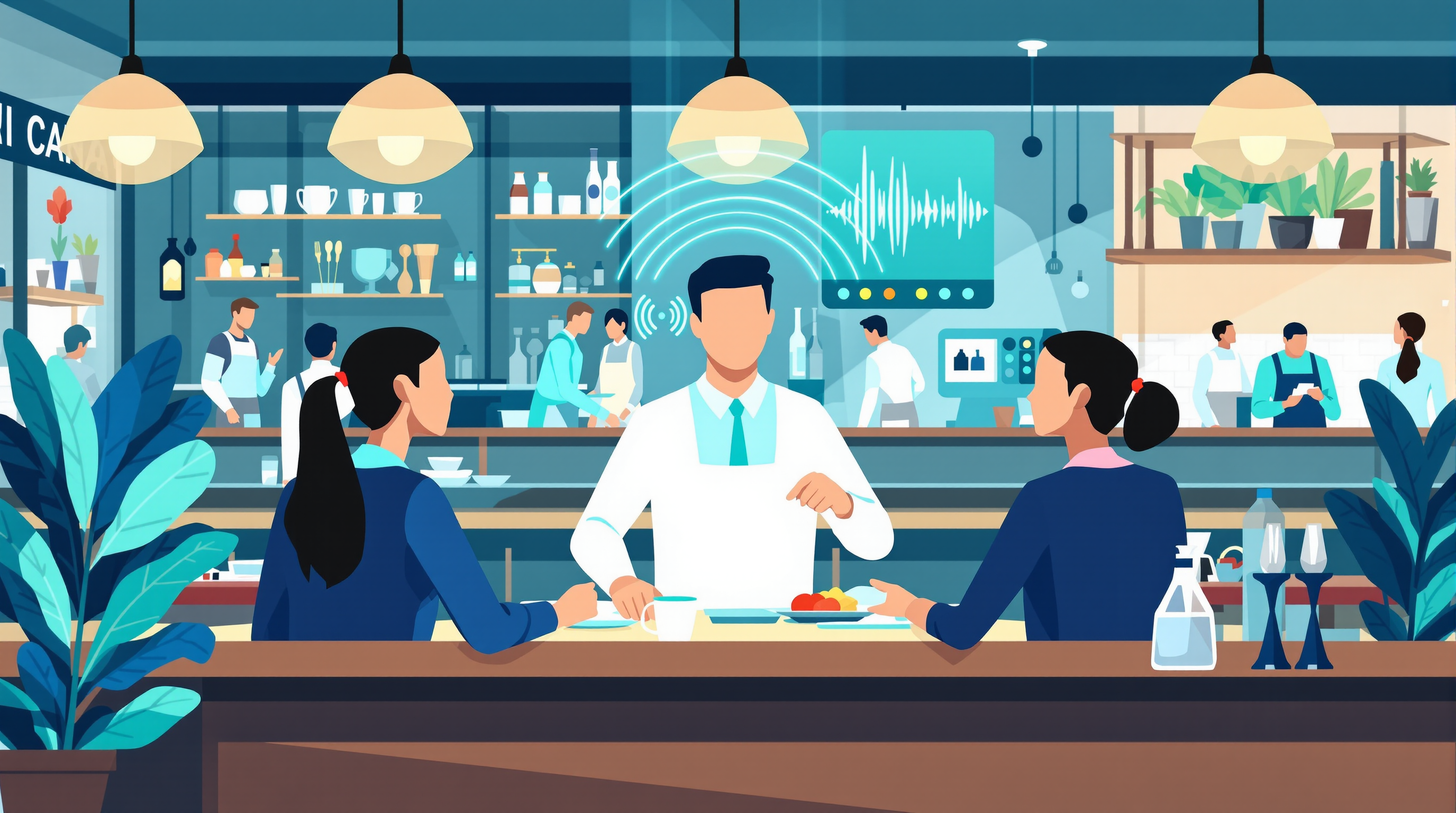
Picture a Saturday at 6:18 p.m. on Ossington in Toronto, Commercial Drive in Vancouver, or 17th Avenue in Calgary. The host is seating a walk-in four-top, the kitchen manager is chasing a timing issue on mains, Uber pickups are stacking at the front, and the phone rings three times in under two minutes. Nobody gets to it. One of those calls was probably not a “quick question.” It may have been a same-night reservation, a takeout order for a family of five, or a 22-person birthday inquiry that would have turned into a pre-set menu and bar tab.
That is why an AI voice agent for restaurants Canada is not just about convenience. It is about revenue recovery. According to QSR Magazine, across roughly 700,000 restaurants, missed calls cost about US$20.1 billion per year, and the average restaurant loses around US$28,728 annually to missed calls. The same source notes that roughly 60–70% of missed restaurant calls are revenue-related: takeout orders, dine-in bookings, large-party reservations, and catering.
For Canadian operators, this lands close to home. In a business where margins are tight and labour is stretched, a ringing phone is often a live sales channel competing with in-person service. If it goes unanswered, the guest does not wait around forever. They call the next place.
Why this hits Canadian restaurants harder than many owners realize
Restaurants do not miss calls because they do not care. They miss calls because phones ring when the operation is busiest. Lunch prep. The Friday dinner push. The 20 minutes after doors close. The exact moment the host is dealing with coats, a late reservation, and a walk-in line. In independent restaurants, especially owner-operated ones, every person already has a full-time job before the phone starts demanding attention.
And the calls themselves are all over the map. One guest wants to book a table for six. Another needs to ask about shellfish allergens. Another wants to place a pickup order before leaving the office in Edmonton. Another is calling from Halifax about a rehearsal dinner for 16. Another wants to know whether there is parking near the restaurant in downtown Ottawa. These are not all “admin” calls. Many are direct buying signals.
The Canadian market is big enough that this operational friction compounds quickly. According to IBISWorld, Canada’s restaurant industry is about $135.2 billion in 2025, and full-service restaurants make up an approximately $47.2 billion segment with about 78,287 businesses. A problem repeated across tens of thousands of restaurants stops being minor pretty fast.
Consumer behaviour is also moving in two directions at once. Dine-in still matters enormously, but off-premise demand keeps growing. Mordor Intelligence reports that takeaway is the fastest-growing service type in Canada, at roughly 18.75% CAGR through 2031, while dine-in still held about 55.8% share in 2025. So now the phone is supporting both the dining room and the takeout stream. Miss calls before opening, after closing, or during service, and you lose opportunities on both sides of the business.
There is also the Canadian reality of multiple languages and multiple time zones. A restaurant group with locations in Toronto and Vancouver may receive calls across three hours of difference; a downtown Montreal concept may need French-first handling with English available; a Winnipeg operator may serve a highly diverse local customer base. Phone coverage is no longer just a front-desk task. It is part of service design.
How an AI voice agent for restaurants Canada works in practice
An AI voice agent for restaurants Canada answers calls 24/7 using rules, scripts, and workflows tailored to the restaurant. It can greet callers, answer common questions, collect reservation details, capture takeout intent, qualify large-group and catering leads, and route information to the team in a structured way. The goal is not to “fake a person.” The goal is to make sure valuable calls do not disappear into voicemail or ring unanswered.
With Agent IA Vocal, restaurants are not expected to build this alone. Setup is handled by the TECHMA team, not left as a self-serve project. That matters because restaurant call flows are specific: hours, holiday closures, reservation rules, patio policies, allergen disclaimers, group thresholds, and preferred escalation steps all need to reflect how the business actually operates.
In practical terms, if someone calls to reserve a table for four on Friday at 7:30 p.m., the agent can gather the key details and move the request through your defined process. If a caller wants takeout after close, the agent can still capture the request, explain availability, and prevent the customer from bouncing to a competitor. If the inquiry is for a 30-person holiday dinner or office catering drop for next Tuesday, the agent can collect the date, headcount, dietary needs, approximate budget, and contact information for the decision-maker.
That consistency is the real win. The host may be slammed. The owner-operator may be on the floor. The dining room may be in full motion. The agent still answers. No panic, no hold music loop, no “please leave a message and maybe we will call back.” It is one reason restaurants belong among the sectors that benefit most from voice automation.
Opportunity 1: capture phone reservations during the busiest dinner windows
The highest-intent reservation calls often come in when the team is least able to answer them. Friday and Saturday from roughly 5 p.m. to 8:30 p.m. are obvious examples. The host is working the door, servers are turning tables, and management is solving live problems. Meanwhile, the guest calling is ready to spend now or very soon.
An AI voice agent can answer every one of those calls, collect reservation details, and prevent leads from vanishing. Even if your restaurant still wants a human to approve certain time slots or large parties, you have still saved the opportunity. That is a major difference from a missed call that turns into nothing.
Given that 60–70% of missed calls are revenue-related according to QSR Magazine, reservation coverage is not a small efficiency gain. It is a direct revenue protection move. And once operators start adding up the annual impact, they usually see the real ROI of an AI voice agent much more clearly.
There is also a no-show angle. Restaurants that rely heavily on phone bookings often need a better way to support confirmations and reservation follow-through. Voice workflows can help reinforce that process, alongside the ideas covered in this article on reducing no-shows. Because an empty four-top at 7 p.m. on a Saturday is not just annoying; it is expensive.
Opportunity 2: recover takeout orders before opening, after closing, and between service peaks
Many restaurants still think of the phone as an “open hours only” channel. Customers do not. They call on the way home from work in Vancouver. They call before the lunch rush starts in downtown Toronto. They call from a hotel in Ottawa after the dining room has closed to ask whether pickup is possible tomorrow. They call early from Halifax for a later family order. If nobody answers, the order often goes elsewhere.
This matters more now because takeout demand is growing quickly in Canada. When takeaway is the fastest-growing service type, every unanswered call outside the perfect service window becomes more costly. An AI voice agent can capture those orders or at least the purchase intent, explain timing, and keep the customer in your orbit rather than sending them to the next listing in search results.
Will every after-hours caller convert? Of course not. But if your current conversion rate on those calls is effectively zero because they are missed, even partial recovery changes the economics. A handful of additional takeout orders per week can make a visible difference, especially for neighbourhood restaurants where phone orders are still common.
And there is an operational upside that owners often appreciate immediately: the front-of-house team stops getting pulled away from guests every time the phone rings with a pickup question. That alone can improve service quality in the dining room.
Opportunity 3: never let large-group and catering inquiries fall into voicemail
Not all calls carry the same revenue potential. A two-person reservation matters. A 14-person birthday dinner, private room inquiry, office lunch catering request, or holiday party lead matters even more. These are the calls that can turn into high-ticket bookings, deposits, repeat corporate business, and strong midweek revenue. They are also the calls that require a few minutes of back-and-forth — exactly what busy restaurant staff do not have during service.
An AI voice agent can qualify these leads properly: event date, headcount, budget range, service style, dietary restrictions, seating preferences, contact details, and any timing constraints. So when the manager or owner follows up, they are not starting cold. They are responding with context, which usually means faster turnaround and a better chance of closing the business.
This is where missed calls become especially expensive. Losing a $50 takeout order hurts. Losing a $1,200 private dinner or a recurring office catering client hurts a lot more. Yet from the restaurant’s perspective, both opportunities begin with the same ringing phone.
For many Canadian restaurants, especially those in business districts, event-heavy neighbourhoods, or suburban family markets, protecting this category alone can justify the monthly investment. High-value inquiries should not depend on whether the host happened to have a free hand at that exact second.
Opportunity 4: offload repetitive questions so staff can focus on guests
A surprising share of restaurant calls are repetitive: What time do you close? Do you have gluten-free options? Is there parking nearby? Are kids allowed on the patio? Can we bring a cake? Are reservations required? Do you have vegan dishes? What is the nearest intersection? Each question is reasonable. The problem is volume and timing.
An AI voice agent can answer those FAQs instantly and consistently, using approved information. That reduces interruptions for the host, manager, bartender, or server who would otherwise stop what they are doing to handle the call. The result is not just labour savings. It is better guest focus in the room.
This matters in multilingual Canadian cities too. In Montreal, Ottawa, Toronto, Vancouver, and parts of Calgary or Edmonton, callers may expect service in different languages or accents. A well-configured voice setup helps maintain clarity and consistency while respecting local expectations. In Quebec specifically, French-first handling is part of good service design, not an afterthought.
The broader point is simple: your staff should spend their energy on hospitality and sales moments that truly need humans. The phone should support that, not sabotage it.
What restaurants gain: revenue recovery, smoother service, and better brand consistency
First, restaurants recover opportunities that would otherwise be lost. That includes reservations, takeout orders, large-party requests, and catering leads. When the average restaurant may be losing around US$28,728 annually to missed calls, as cited by QSR Magazine, even modest recovery can matter.
Second, operations become calmer. Hosts stay present at the door. Managers stop chasing voicemail tags. Kitchen leaders are not pulled into front-desk interruptions. The dining room gets more attention from the people who actually shape the guest experience.
Third, the brand sounds more consistent. A well-designed voice agent uses the restaurant’s approved tone, policies, and information. That is often better than rushed, inconsistent answers given by whichever staff member happened to grab the phone between tables. And yes, guests notice consistency.
Fourth, coverage extends beyond business hours and beyond a single shift’s staffing limits. Canada spans six time zones, and many restaurants serve customers whose planning habits do not match the restaurant’s schedule. A 24/7 voice layer means the business remains reachable even when the floor is busy or the doors are closed.
Finally, the economics are accessible. Agent IA Vocal offers straightforward plans at $49, $99, or $199 CAD per month, with setup handled by the TECHMA team. No DIY build, no complicated implementation maze. Just a practical way to stop restaurant missed calls from turning into silent revenue leakage.
Common objections, answered honestly
“Diners want a human. They will hate AI.” Some guests do prefer a person for complex situations, absolutely. But the real comparison is not “human versus AI.” It is “answered call versus missed call.” Most callers mainly want fast help: book a table, ask a question, place an order, or leave details for follow-up. A responsive system usually beats endless ringing.
“We already use an online reservation app, so we do not need phone coverage.” Online booking tools are useful, but they do not eliminate phone demand. Guests still call to modify reservations, ask about large parties, discuss allergies, check patio availability, confirm special requests, or request catering. A reservation app handles one lane. The phone still carries several others.
“It will sound robotic and hurt our brand.” Poorly configured systems can, sure. But that is a setup problem, not a category problem. When call flows, language, tone, and escalation rules are tailored to the restaurant, the experience feels far more polished than voicemail or unanswered calls. That is one reason setup is handled by TECHMA rather than pushed onto busy operators.
“We are a small family place. It is too expensive.” For many restaurants, one recovered large-party booking or a few saved takeout orders can cover the monthly cost. When owners compare $49, $99, or $199 CAD per month against the value of missed opportunities, the conversation changes quickly. That is the logic behind the real ROI of an AI voice agent.
FAQ
Can an AI voice agent really handle phone reservations?
Yes. It can answer calls, collect the essential reservation details, and route or process them according to your restaurant’s rules. Some operators use it mainly for capture and qualification; others use it more deeply depending on workflow.
Is this useful if we already have online ordering and online booking?
Yes. Online tools do not replace all phone demand. Guests still call for changes, special requests, group bookings, catering, accessibility questions, and after-hours inquiries. Voice coverage fills the gaps those tools leave behind.
Can it help reduce no-shows?
Yes, especially when it supports confirmations, reminders, or reservation verification workflows. That is why many operators pair phone coverage with processes like the ones discussed in this no-show reduction article.
How hard is setup for a restaurant team?
It is not a DIY project. With Agent IA Vocal, the TECHMA team handles setup so the voice agent reflects your hours, policies, brand tone, and call scenarios without adding another implementation burden to your staff.
Conclusion: if the phone is a sales channel, it needs coverage
For Canadian restaurants, missed calls are rarely just a front-desk nuisance. They are lost reservations, abandoned takeout orders, missed private dining leads, uncaptured catering inquiries, and preventable service interruptions. In a market this competitive, that kind of leakage adds up quietly — then shows up loudly in revenue.
An AI voice agent for restaurants Canada gives operators a practical way to answer every call, protect the guest experience, and recover demand that would otherwise disappear. It works for busy independents, family-run neighbourhood spots, and multi-location groups alike, whether they serve diners in Toronto, Vancouver, Calgary, Ottawa, Winnipeg, Halifax, Edmonton, or beyond.
If you want to see how Agent IA Vocal can cover reservations, takeout, large-group bookings, and catering calls for your restaurant, book a demo or view pricing here: agentiavocal.ca/demo or agentiavocal.ca/pricing.