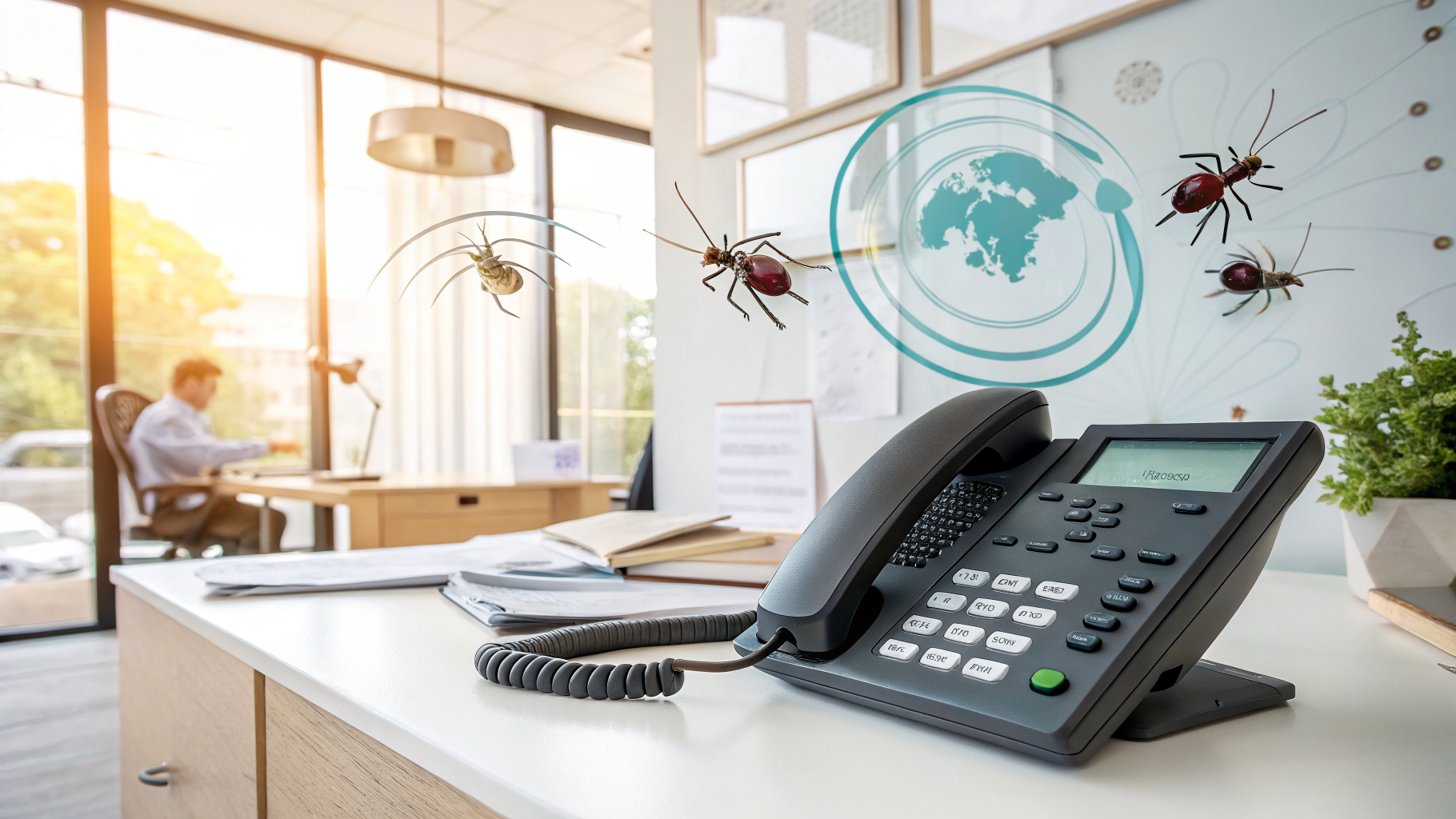
It’s late afternoon in June, the heat is sitting heavy, and the phone will not stop
Picture a pest control owner in Toronto on a humid Tuesday. Two technicians are already out on jobs. One is removing a wasp nest from the eaves of a family home. The other is dealing with carpenter ants discovered during a renovation. Back at the office, nobody is free. The main line rings, then rings again. A caller in Ottawa has bed bug concerns before weekend guests arrive. Another in Calgary wants urgent help after spotting mice activity in a garage. Someone in Vancouver is calling about hornets near a daycare entrance. By the time voicemail picks up, they’ve already started dialing the next exterminator.
That is the real operating environment behind the phrase AI voice agent for pest control companies Canada. Not theory. Not trend-chasing. Just a practical response to what bug season actually looks like for Canadian pest control companies when demand spikes and nobody on the team can safely stop a treatment to answer every inbound call.
In June 2026, this matters even more because the summer rush is already underway across the country, just in different patterns. In Southern Ontario, wasps and carpenter ants drive urgent residential calls. In Vancouver, seasonal insect activity mixes with dense urban service demand. In Calgary and Winnipeg, timing shifts a bit with weather, but the surge still comes. In Halifax, weekend calls can bunch up fast when homeowners are finally outside and noticing nests, entry points, or recurring pest issues they ignored all spring.
The common thread is simple. Pest problems feel urgent. Customers do not want a callback “sometime tomorrow.” They want an answer now, a few useful questions, and ideally a confirmed next step. If your line goes unanswered, they rarely wait politely. They move on.
That’s where a managed AI voice agent fits. It answers every call, around the clock, can switch between English and French, qualifies the issue, captures customer details, books straightforward appointments, and hands off complicated quote requests or technical edge cases to your team. If you’ve seen the model working in adjacent trades, our article on AI voice agents for HVAC and plumbing contractors in Canada shows the same operational logic. Pest control just has even less tolerance for missed calls.
Why a missed call is unusually expensive in pest control
Some industries can survive a slower callback. Pest control usually cannot. If someone finds a wasp nest beside the front door, discovers carpenter ants in a structural area, or suspects bed bugs before relatives arrive for the weekend, they are not browsing casually. They are trying to solve a problem that feels immediate, embarrassing, unsafe, or all three at once.
That urgency changes the economics of the phone. Across service businesses, many contractors lose roughly $800 to $1,500 per month to unanswered calls. In pest control, peak-season losses can land at the higher end quickly because intent is so high. The caller is not collecting ideas for later. They are ready to book.
There is also the lifetime value issue, and this is where many owners undercount the cost of a missed lead. In well-run operations, recurring contracts often account for 60 to 70 percent of revenue. So the person calling today about ants, wasps, bed bugs, or mice is not just a one-time $250 ticket. That caller may become a recurring prevention customer worth $1,000 to $1,600 per year.
And some jobs are simply more valuable from day one. Carpenter ant work, for example, is often among the pricier removals, around $1,000. Miss that call because everyone is on the road and you are not losing a minor booking. You may be losing a high-value residential customer who was ready to buy immediately.
This is one reason answering speed matters so much in this vertical. Industry resources keep pointing to the same problem. This pest control answering service guide frames it clearly: when urgency is high, voicemail is not a customer experience strategy. It is often a handoff to your competitor.
That’s the central business case for an AI voice agent. It does not create demand. The demand already exists. It protects the demand you are currently leaking every time the phone rings out.
Summer volume jumps 2 to 3 times, but you cannot hire for the peak all year
Most pest control operators know the rhythm. Winter is one thing. Summer is another universe entirely. In many companies, call volume in summer runs 2 to 3 times higher than in winter. The spike is not only bigger. It is messier. More urgency, more after-hours calls, more reschedules due to weather, more follow-up coordination, more customers who want service before guests arrive, before the weekend, before a sale closes, before a tenant issue escalates.
The obvious fix sounds simple: hire more office coverage. The math is not so simple. A dedicated receptionist typically costs about $35,000 to $45,000 per year, and that is before onboarding, supervision, vacation coverage, sick days, and the fact that one person can still only answer one call at a time. If six calls hit at once during a heat wave, five people are still waiting.
An AI voice agent changes that bottleneck because it can handle unlimited concurrent calls during peak rush. That matters more than people first realize. In pest control, spikes are rarely neat or evenly spaced. They come in bunches. A warm Friday afternoon can flood your line with wasp nest calls from multiple neighbourhoods at once. A Monday morning can combine weekend voicemail follow-ups with fresh ant and bed bug inquiries. Human staffing alone struggles with those surges unless you overbuild for the busiest weeks of the year.
Most Canadian pest control companies do not want to carry that fixed cost twelve months a year. They want responsiveness in summer without paying for idle capacity in slower periods. That is why managed voice automation is so attractive operationally. It flexes with the season.
The same seasonal staffing problem shows up across service businesses, especially in vacation months. Even though one of our related articles is written from a Quebec summer coverage angle, the principle still applies broadly: AI voice agents help close summer coverage gaps for small businesses when regular staff are stretched thin or off the schedule.
For pest control owners, the goal is not replacing the field team. It is protecting the field team from being dragged into reception work at the exact moment service demand is peaking.
After-hours and weekends are not fringe cases in this industry
Pests do not care about office hours. Customers discover problems when they discover them. That often means after work, at dinner time, on a Saturday morning, or late Sunday when they are finally home and paying attention to the property.
A wasp nest by the back door gets noticed when the kids go outside. Bed bug anxiety spikes at night, not at 10:15 a.m. on a tidy office schedule. Mouse sounds in a wall are often heard when the house is quiet. For commercial accounts, after-hours calls may be the only practical time a manager can report an issue without staff or customers around.
Yet many pest control companies still treat after-hours coverage as optional. They rely on voicemail, maybe a basic answering service, maybe a cell phone that the owner checks when possible. During bug season, that approach leaves money on the table every week.
A properly configured AI voice agent acts as a 24/7 front line. It can answer immediately, reassure the caller, explain next steps, collect the right details, and route the issue according to your rules. If a call looks urgent based on pest type and location, it can be flagged for priority follow-up. If the situation is standard and your booking logic allows it, the agent can offer an appointment directly.
There is an important honesty point here. The agent is not a technician. It should not pretend to diagnose with certainty over the phone. It should not invent treatment plans or quote complex commercial work without guardrails. Its role is to capture, qualify, schedule what is schedulable, and escalate what needs expertise. That boundary is not a weakness. It is what makes the system trustworthy.
For Canadian companies serving mixed-language markets, the bilingual layer helps too. A caller in Ottawa may start in English, another in Montreal may expect French first, and a national or regional operator may need both without friction. That flexibility matters when every missed call is a warm lead.
Lead qualification by pest type is where the operational value really shows up
Not every inbound call deserves the same workflow. A customer reporting visible wasps near a front entrance is different from a landlord asking about possible bed bugs in several units. A homeowner with carpenter ants may need a different scheduling window than someone asking for a routine preventive service. If every call lands in the same generic bucket, dispatch gets messy fast.
A well-built AI voice agent asks short, useful questions. What pest are you seeing? Wasps, hornets, carpenter ants, bed bugs, mice, something else? Is the activity indoors or outdoors? When did you first notice it? Is there an immediate safety concern? Are you the homeowner, tenant, property manager, or business owner? What city are you in? What is the best callback number? What availability works?
Those details are not just administrative. They shape routing, urgency, and technician prep. They help your team decide whether the job is straightforward, whether it needs a specialist, whether follow-up documentation matters, and whether the case belongs in a standard residential slot or needs human review before booking.
When the voice agent is connected to your scheduling software or CRM, all of that can sync automatically. Appointment details, notes, contact data, service type, callback requests, language preference, even flags for urgency can be passed into the system without someone manually re-entering everything later. That reduces friction, but it also reduces mistakes.
Customers feel the difference. They are not repeating the same story to three people. Your team feels it too. Instead of starting every callback from zero, they open the record and see what the caller already reported.
There are still situations that belong with a human from the start. Complex quotes. Multi-site commercial accounts. Ambiguous infestations. Sensitive customer situations. The right model is not “AI handles everything.” The right model is “AI handles the repetitive front-end work consistently, then hands off where judgment matters.”
Trust remains a major factor in this industry. Homeowners want to feel they are dealing with a legitimate, professional company. Consumer guidance like CAA-Québec’s advice on choosing an exterminator underlines that professionalism and process matter. A clean intake experience supports that trust, even outside Quebec.
Reminders and easy rescheduling protect your route from no-shows
Pest control revenue does not stop at the first visit. There are follow-up treatments, inspections, recurring seasonal work, annual prevention plans, and revisit windows that matter for treatment effectiveness. When customers miss those appointments, the damage is bigger than one empty slot.
A no-show can waste drive time, break route efficiency, create technician downtime, and push other appointments around. During peak summer demand, that disruption hurts. You may not be able to refill the slot on short notice even though other customers are waiting somewhere else in the queue.
An AI voice agent helps in two practical ways. First, it can send or trigger reminders so customers confirm upcoming appointments. Second, it can make rescheduling easy when plans change. That matters because many no-shows are not hostile. They are preventable. People forget, get stuck at work, leave for the cottage, or realize too late that they cannot be home.
If rescheduling is simple, more customers will actually do it instead of disappearing. If reminders are timely, attendance improves. That route protection adds up over a season.
We covered the broader economics of this in our article on reducing no-shows with an AI voice agent in Canada. For pest control companies, the impact is especially tangible because follow-ups often have timing logic. Missed bed bug treatment steps, delayed inspections, or poorly coordinated revisit windows can affect both outcomes and customer satisfaction.
The best systems also tailor the reminder flow. A first-time urgent wasp appointment is not the same as a recurring preventive inspection. Bed bug follow-up may need more detailed instructions than a standard outdoor treatment. Good configuration makes those communications feel specific rather than generic.
Why this finally sounds natural in 2026, and what “good” actually looks like
For a long time, business owners had a fair objection: if the voice sounds robotic, customers will hate it. In a high-stress category like pest control, that concern was valid. Nobody calling about bed bugs wants to wrestle with a clunky phone tree disguised as intelligence.
By mid-2026, the voice quality issue has improved dramatically. Recent advances in conversational voice technology have made interactions sound much more natural, with better pacing, better turn-taking, and fewer obviously synthetic rough edges. The June 2026 updates documented by ElevenLabs are part of that story. You can review the ongoing improvements in the ElevenLabs changelog.
Still, natural sound alone is not enough. A successful deployment depends on scripting, escalation rules, booking logic, language handling, and integration quality. This is where managed implementation matters. AgentiaVocal, as a TECHMA service, configures the full workflow end to end rather than dropping software on your team and hoping for the best.
For Canadian pest control companies, “good” usually means a few things at once. The agent answers immediately. It sounds calm and competent. It can work in English and French when needed. It knows the difference between a simple intake and a case that needs a real person. It captures customer information reliably. It respects your scheduling rules. It does not overpromise.
That last point matters. The agent should never present itself as a licensed technician or pretend to provide definitive technical advice. It is there to improve responsiveness and operational flow, not to replace expertise in the field. Customers generally accept that, especially when the interaction is smooth and gets them to a clear next step quickly.
Where the AI agent stops and your team should take over
Let’s be blunt. An AI voice agent is not a field expert. It cannot inspect a property through the phone. It cannot verify a species from a vague description with certainty. It should not build a detailed treatment strategy for a multi-unit infestation or negotiate a complicated commercial service package on its own.
So where does it shine? In consistency and scale. It answers on the first ring. It captures the basics every single time. It handles overflow without frustration. It keeps after-hours leads from disappearing. It books simple appointments. It sends reminders. It logs notes. It creates a cleaner handoff to your staff.
The handoff model is where the real value sits. Your human team focuses on technical judgment, complex quoting, high-value account management, and field execution. The AI handles the repetitive front-end communication layer that too often gets neglected when everyone is busy. That division of labour is practical, not futuristic.
For smaller operators, especially teams with two to five technicians, this can be transformative because they are the most vulnerable to missed calls during peak season. For larger regional companies, it becomes a way to standardize intake quality across locations and time zones while keeping staff focused on revenue-producing work.
Either way, the point is not to sound innovative. The point is to stop losing ready-to-buy customers simply because nobody was free to answer.
Quick FAQ for Canadian pest control companies
Can an AI voice agent book pest control appointments directly? Yes, if it is connected to your scheduling system and configured with your booking rules. Straightforward jobs can be booked automatically, while complex cases can be flagged for human review.
Will customers accept talking to an AI voice agent? In many cases, yes, especially when the voice sounds natural, the questions are relevant, and the caller gets a fast next step. In urgent service categories, speed often matters more than whether the first responder is human.
Can it handle both English and French? Yes. That is especially useful for Canadian pest control companies serving bilingual markets or operating across multiple regions.
Does it replace my office staff completely? Usually not. It is best used to cover missed calls, after-hours demand, overflow, reminders, and repetitive intake work, while your team handles technical decisions and complex customer situations.
If bug season is already flooding your line, now is the time to fix the intake problem
June 2026 is not the moment for wishful thinking. If your team is already hearing the same pattern every summer, you know what comes next. More wasp calls. More carpenter ant jobs. More bed bug anxiety. More evening and weekend urgency. More leads arriving at the exact moment no one can answer.
A managed AI voice agent for pest control companies Canada helps you capture every call, qualify the lead, book what can be booked, reduce no-shows, and route complex work to the right human on your team. It gives Canadian pest control companies a way to handle summer demand without staffing year-round for a seasonal peak and without letting voicemail send customers to the next exterminator.
If you want to hear how it works in practice, you can book an AgentiaVocal demo.
If you want to review costs first, see AgentiaVocal pricing and plans, with plans starting at $49 per month.
If you want to talk through your call volume, workflows, or scheduling and CRM integrations, contact the AgentiaVocal team.