
On April 7, 2026, ElevenLabs pushed a single line into its changelog that almost no Quebec SMB owner ever read: "v2.42.0 — DTMF input support added." Three words that quietly unblock six months of operational dead-ends. If your AI voice agent is only used for inbound — clients calling into your business — you might not feel it right away. But if you're using it (or want to use it) to call out — chasing a supplier, confirming a client appointment, checking a balance with the SAAQ — this update changes the very nature of what your agent can finish without a human in the loop.
Let's look at what actually shipped, why DTMF is still the great blind spot of voice AI agents deployed in Quebec, and three concrete cases where moving to an agent that can navigate a phone menu drops straight to your bottom line.
What ElevenLabs delivered on April 7 (and why it's bigger than it looks)
In version 2.42.0 of their agent API, ElevenLabs added three things that matter to a small business's phone operations: DTMF input support, organized test folders, and scoped analysis. We're going to focus on the first, which is by far the most operational. On April 13, a follow-up release added knowledge base content search, conversation topics, and flexible branch merging — useful for conversational quality, but it's the DTMF that transforms outbound workflows.
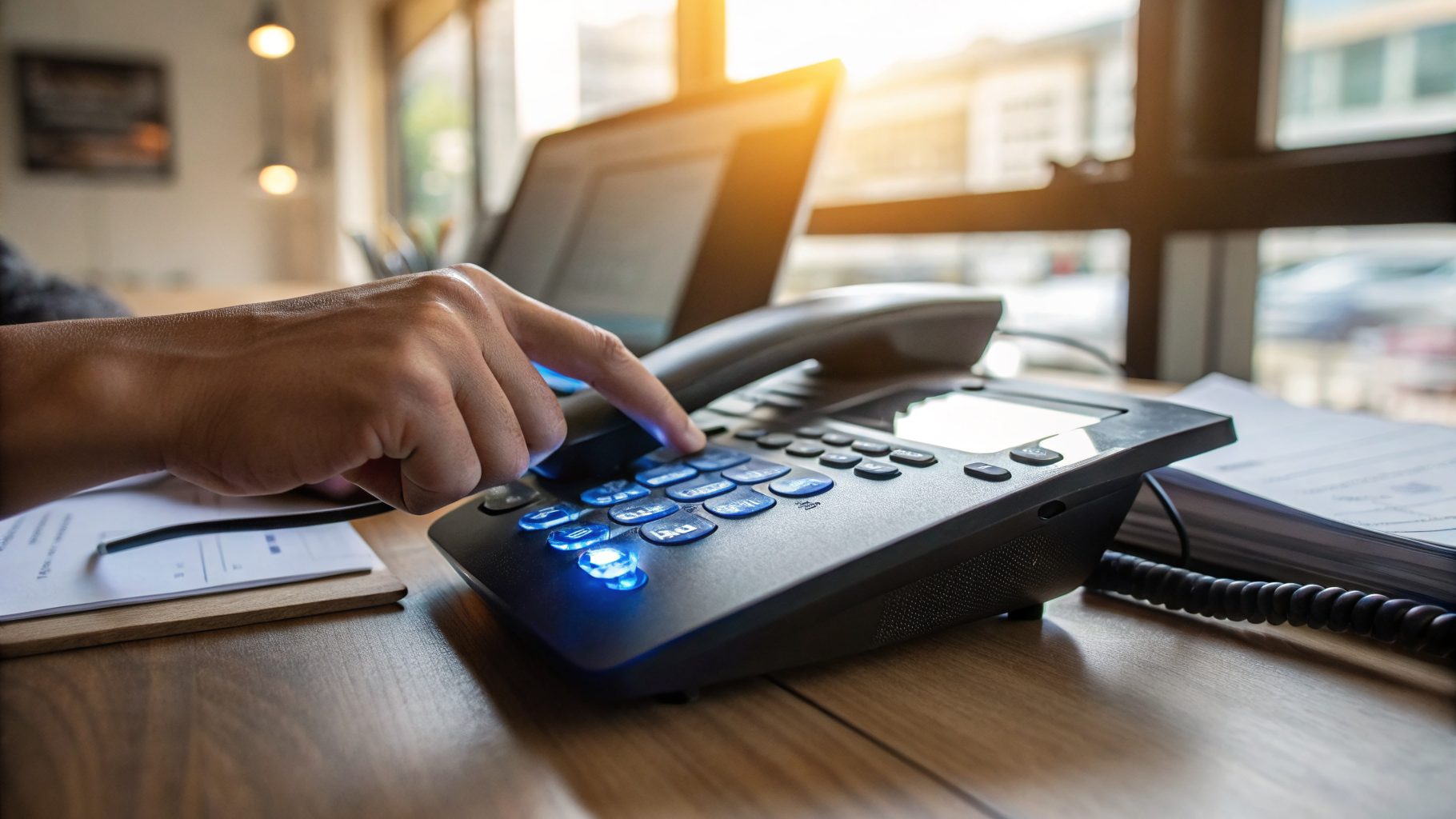
DTMF, short for Dual-Tone Multi-Frequency, is the technology behind the tones your phone emits when you press a key during a call. "For customer service, press 1. For billing, press 2." The keys you grumble through every Monday morning at 9 a.m. — those are DTMF codes. Until April 7, 2026, ElevenLabs' AI voice agent could not generate them. In practice: if your agent called your Bell supplier to validate an invoice, it got stuck at the IVR (Interactive Voice Response) tree, unable to move forward.
That bottleneck forced every Quebec SMB to choose between two bad options: keep a human in the loop to open every outbound call, or restrict the agent to calls where no menu showed up — which is to say, almost nothing in the real world. Retell AI has documented its press-digit equivalent for several months, and VAPI has supported it via Twilio. ElevenLabs, the platform of choice in Quebec because of its French voice quality, was lagging. That gap is now closed.
Why DTMF stays the blind spot for AI voice agents in Quebec
When you mention an AI voice agent to a Quebec SMB owner, the picture that comes to mind is almost always the same: an inbound call. A client dials, the agent picks up, books an appointment, qualifies a request, transfers if needed. That's the market everyone watches — and it's also the one where the capabilities are most mature.
The trouble is that on a small business's books, outbound calls often eat more administrative time than inbound. A veterinary clinic in Brossard calls the lab daily, two pharmacies, three insurers, and two clients for post-op reminders. A Sherbrooke accounting firm spends 90 minutes a day on the phone with Revenu Québec, the CRA, and software vendors. A property manager in Laval calls subcontractors and city services up to 40 times a week.
In every one of those cases, almost every outbound call lands on a phone menu. Without DTMF, the AI voice agent stops cold. With DTMF, it moves forward. It's that simple — and that structural. If you want a quick refresher on the technical vocabulary before going further, we published a 20-term glossary that covers DTMF, ASR, latency, and the rest.
Three concrete cases that drop straight to your margin

1. Appointment confirmations with clients who themselves have a menu
A dental clinic in Trois-Rivières runs 180 appointment confirmations a week. Before April 7, its AI voice agent could call patients directly, but systematically missed patients in long-term care or in seniors' residences — because the building's switchboard answers before the resident does. "To reach a resident, press 3, then the room number." The agent froze.
With DTMF support, the agent navigates the menu, dials the room number, waits, talks to the patient. On 180 weekly confirmations, roughly 22% of patients in a geriatric clinic live in residences with switchboards. Before: 40 patients to call back manually by a receptionist, at about 4 minutes per call — 2.7 hours a week. After: zero. At a $28/hour loaded cost, that's $3,900 in annual savings on a single workflow.
2. Calls to suppliers and government services
This is where Quebec accounting firms, notary offices, and insurance brokers benefit the most. All those trades spend significant time waiting in queues after navigating an IVR. Revenu Québec, the Canada Revenue Agency, CNESST funds, commercial insurers — each has its own tree, and each starts with a sequence of keys to press before you even reach the queue.
With DTMF enabled, the AI voice agent can hold the line for you. It navigates the menu, waits in the queue, and transfers you the moment a human picks up. A South Shore notary firm timed its team: 4 hours 15 minutes a week, per employee, lost waiting in government queues. Across a team of 6, that's 25 weekly hours — the equivalent of half a full-time position. DTMF was the missing piece to automate that wait.
3. Accounts receivable follow-ups with payment menus
Several Quebec SMBs (gyms, private schools, mechanic shops with subscription plans) bill via pre-authorized payments through platforms that expose a DTMF menu to validate, edit, or cancel a declined transaction. When a payment fails, the phone follow-up with the client often involves navigating one of those menus to confirm the new debit date. Without DTMF, the agent calls, reaches the client — then drops the round when a code needs to be keyed into the system. With DTMF, the round closes, the payment reschedules, the revenue lands.
What it doesn't do (yet)
Before you ask your provider to flip the switch next week, three nuances to keep in mind.
First, ElevenLabs' DTMF support is send-side. Your agent can now emit tones. But if it's calling a system that expects open-ended voice input ("Describe the nature of your call"), DTMF is useless — your agent has to recognize when to speak in natural language rather than press keys. That's prompt engineering, not DTMF.
Second, timing remains finicky. Poorly designed IVRs (often the older carriers') don't respond to a too-quick keypress. Your AI voice agent provider must be able to inject delays between tones, with timings adjustable per workflow. If your provider can't show you the configuration window, ask before you sign anything.
Third, and this is the critical point: calling out is outbound. In Quebec, the CRTC strictly governs unsolicited telephone communications via the Unsolicited Telecommunications Rules. If you're calling your own clients for reminders or confirmations, you're generally covered by the existing relationship — but if you're prospecting cold with an AI agent, you fall under particular rules. We wrote a complete guide on the 7 CRTC rules for AI outbound; read it before you turn anything on that calls numbers your customers haven't explicitly opted into.
What does it mean for the broader AI voice agent ecosystem?
The timing here isn't coincidental. April 2026 has been a rare concentration of structural announcements in voice AI: ElevenLabs ships DTMF and knowledge base search, OpenAI moves gpt-realtime into general availability with SIP support and EU data residency, and the multimodal window widens. We covered it in detail in our analysis on the multimodal turning point of April 2026.
For a Quebec SMB, the net result: the wall between "agent that answers well" and "agent that completes full operations" is dropping fast. DTMF isn't the most glamorous feature on the list — it's likely the most operational.
How to actually turn this on in your business (and who handles it)
If you're already a customer of an AI voice agent provider in Quebec, the good news is you have nothing to update on your side. DTMF support flows through agent configuration, not your infrastructure. Three questions to ask your provider this week:
- Are your agents running on ElevenLabs v2.42 or newer? If not, ask when the migration is planned — version 2.41 doesn't support DTMF.
- Which outbound workflows can we prioritize? Identify two or three outbound flows where menu navigation is the only blocker. That's where you start.
- What's the default DTMF send latency, and is it adjustable per workflow? If the answer is fuzzy, dig deeper.
At Agent IA Vocal, we handle end-to-end integration for our Quebec SMB clients — agent configuration, testing on the most common IVRs (Bell, Vidéotron, Revenu Québec, CRA, major insurers), and post-deployment monitoring. You never touch the platform code. If you want to see what this looks like on your own outbound workflows, reach out via our contact page — we'll review your case in 30 minutes.
What to take away
ElevenLabs' DTMF update in April 2026 didn't make headlines, and that's a shame: it's probably the feature that unlocks the most concrete use cases for Quebec SMBs since gpt-realtime arrived. If your operations run on outbound calls where your team bumps into phone menus daily, you now have the option to automate the wait, the navigation, and the wrap-up. Annual savings on a single workflow regularly clear $4,000 for a 10–30 person SMB — and several workflows can run in parallel.
The competitive window is narrow: in 6 to 9 months, every serious provider in the Quebec market will have shipped the feature. SMBs that grab it now will pull a small lead on their administrative margins. The ones who wait will just be catching up.