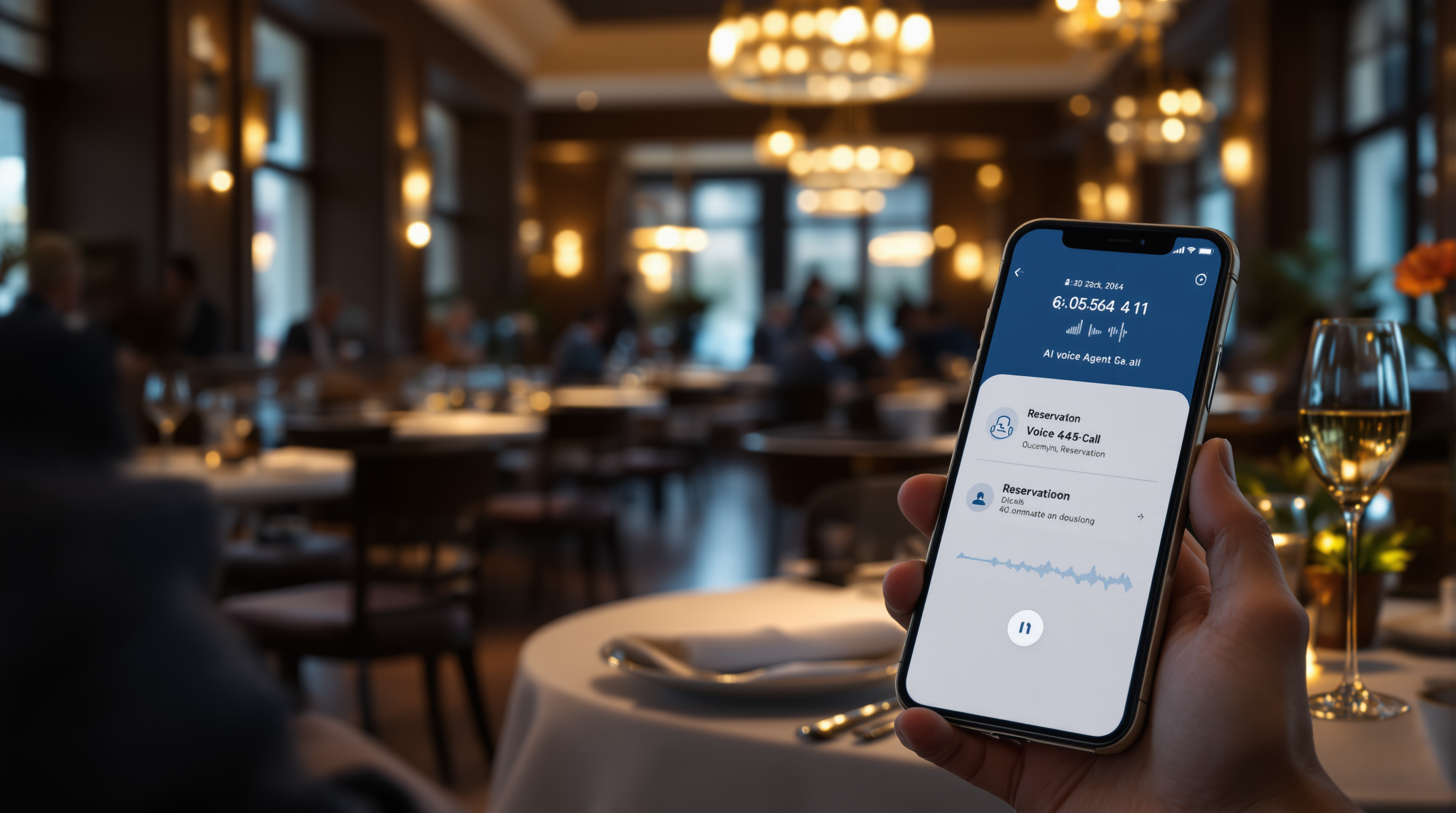
Friday night, 6:45 PM. Your dining room is packed, three servers are juggling tables, and the phone has rung for the seventh time in twenty minutes. Who picks up? Nobody — your hostess is swamped at the front door. Thousands of Quebec restaurant owners live this scenario every single week.
The problem goes far beyond a minor inconvenience. According to industry data, restaurants miss an average of 43% of their phone calls, and 83% of customers who can't get through will call a competitor. In Quebec, where the restaurant industry generates $18.6 billion and includes over 18,500 establishments — 58% of which are independent — every missed call hurts.
That's why a growing number of restaurant owners are turning to AI voice agents. Not the clunky automated voicemail systems of the 2000s, but conversational artificial intelligence that answers, understands, and acts. Here are 7 concrete reasons behind this shift.
1. Capture Calls Lost During the Rush — Without Pulling Anyone Off the Floor
Lunch and dinner rushes account for 70% of your daily revenue, but they're also when you miss the most calls. An AI voice agent answers on the first ring, 24/7, even when three lines ring simultaneously. Unlike a human hostess, it handles concurrent calls without putting anyone on hold.
The numbers speak for themselves: restaurants deploying AI voice agents see an 87% reduction in missed calls and a 78% increase in call-to-reservation conversion rates, according to data compiled by Hostie AI. For a mid-sized Quebec restaurant, that translates to dozens of recovered covers per week.
2. Book Tables 24/7 — Even After the Kitchen Closes
A customer wants to reserve for Saturday night, but it's Tuesday at 11 PM. Your restaurant is closed. Without a voice agent, that call goes to voicemail — and nobody calls back in time.
The AI voice agent never sleeps. It checks your availability in real time, suggests time slots, confirms the booking, and sends an SMS confirmation to the guest. As we explain in our article on after-hours revenue, late-night and weekend calls represent a goldmine that most restaurants leave on the table.
A restaurant owner on Montreal's Rue Saint-Denis told us: 'We discovered that 35% of our weekend reservations came in between 10 PM and 8 AM. Before the voice agent, we lost every single one.'
3. Cut No-Shows With Automated Reminders
No-shows cost restaurants between 5% and 10% of annual revenue. On a four-top averaging $65 per cover, a single no-show means $260 in vanished revenue — not counting the guests you turned away because the table was 'reserved.'
The AI voice agent sends automated reminders via SMS and voice call 24 to 48 hours before each reservation. It requests confirmation, offers rescheduling if needed, and frees the table on cancellation — all without human intervention. We've broken down the financial impact in detail in our analysis of how no-shows drain SMB revenue.
Restaurants using automated reminders see no-shows drop by 30% to 50%. Over a year, that's thousands of dollars recovered for a typical establishment in Quebec City or Laval.
4. Handle Takeout Orders Without Disrupting Table Service
Since the pandemic, takeout and delivery aren't a nice-to-have — they're a revenue pillar. But every takeout call ties up an employee for 3 to 5 minutes during service. Multiply by 30 orders per evening and you've lost the equivalent of 2.5 hours of labor.
An AI voice agent takes the order over the phone: it reads the menu, suggests add-ons and modifications, handles allergy and dietary restrictions, calculates the total, and sends a clean ticket directly to your POS or kitchen. No transcription errors, no 'can you repeat that?', no hold times.
For a restaurant doing $1,500 in weekly takeout sales, automating order-taking can free up a part-time employee — or better yet, let them focus on guests in the dining room.
5. Answer in French AND English — Without Hiring Bilingual Staff
In Montreal, Old Quebec, or Tremblant, your customers call in French and English. Finding reliable bilingual staff in food service is a challenge every Quebec restaurant owner knows too well. Industry turnover exceeds 60% across Canada, and the labor shortage hits front-of-house positions hardest.
The AI voice agent detects the caller's language within seconds and switches seamlessly between French and English — with a natural accent in both. The latest text-to-speech models, like ElevenLabs' v3 which now supports 70+ languages, make the experience nearly indistinguishable from a human conversation.
This is a competitive advantage that non-Quebec restaurants struggle to replicate. Here, bilingualism isn't a luxury — it's an operational necessity.
6. Save $1,800 per Month in Front-of-House Labor Costs
Let's talk numbers. According to a Voiceflow analysis citing a 2026 Forbes report, an AI voice agent handles an average of 80% of a restaurant's repetitive calls, saving roughly $1,800 per month in front-of-house labor. On the revenue side, restaurants automating their phone reception report $3,000 to $18,000 in additional monthly revenue per location.
An AI voice agent for SMBs starts at $49/month with Agent IA Vocal. Even in the most conservative scenario, ROI is reached within the first month. For a step-by-step calculation method, check out our 4-step ROI guide.
We're not talking about replacing your team. We're talking about freeing your hostess to greet guests with a smile instead of running between the phone and the door.
7. Turn Every Call Into a Revenue Opportunity — Not a Chore
Here's a truth few restaurant owners calculate: every inbound call has an average value of $45 to $85, based on party size and per-cover spending. When 43% of those calls go unanswered, you're literally leaving money on the table — pun intended.
The AI voice agent doesn't just answer. It confirms reservations, suggests special events ('Did you know we offer a tasting menu on Thursday nights?'), collects contact information for your marketing database, and identifies returning guests for personalized service. In 2026, the most advanced systems even use predictive learning to anticipate cancellations before they happen.
60% of customers who reach voicemail will never call back. The voice agent turns that dead loss into a conversation — and that conversation into revenue.
Frequently Asked Questions
Can the AI voice agent handle special requests (allergies, high chairs, wheelchair access)? Yes. The agent is configured with your restaurant's specific information. It notes allergies, accessibility needs, and seating preferences, then passes them to your reservation system or notifies your team directly.
Will my customers know they're talking to an AI? The synthetic voices of 2026 are remarkably natural. Most callers can't tell the difference, especially over the phone. And if a guest asks to speak to a human, the agent transfers the call immediately.
How long does setup take? With Agent IA Vocal, the TECHMA team handles everything for you — scripts, reservation software integrations, phone number setup — typically within 48 hours. You don't need to touch anything technical.
Does it work with my existing reservation software (TheFork, OpenTable, Libro)? The voice agent integrates with major reservation systems through Zapier or Make connectors. If you use a custom system, a tailored integration is available.
Ready to Recover Your Lost Calls?
Quebec restaurant owners adopting AI voice agents aren't chasing technology for technology's sake. They want to serve more guests, fill more tables, and stop bleeding revenue during every rush. With plans starting at $49/month and full setup by the TECHMA team, the question isn't 'is it worth it?' — it's 'how many covers did you lose this week?'
Book a free demo and find out how many calls your restaurant misses every week — the numbers might surprise you.