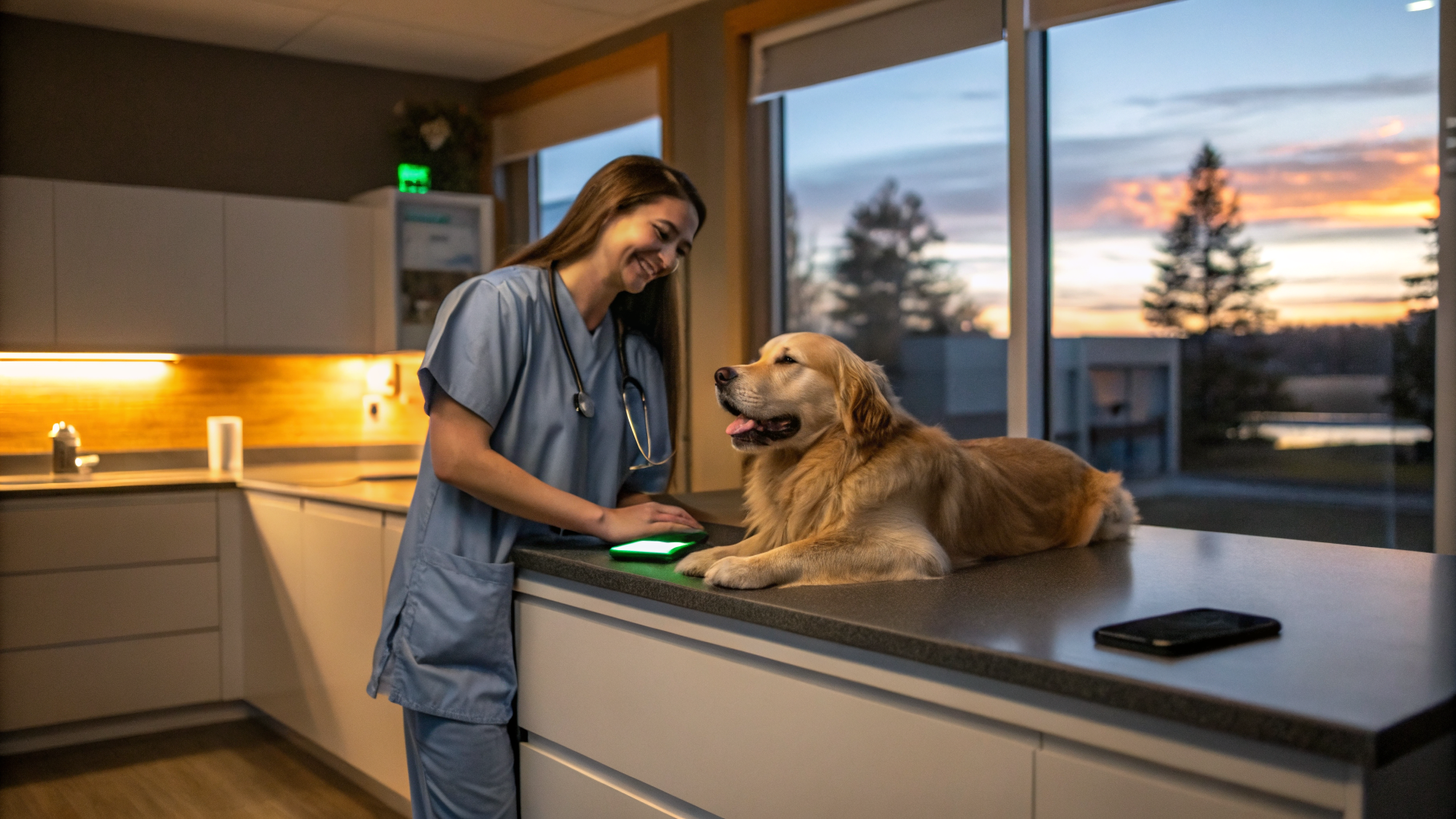
It is 9:47 a.m. on a Tuesday in Saint-Hyacinthe. The animal health technician is holding a nine-kilogram cat for blood work. The veterinarian is in the surgery room, halfway through a spay. The receptionist just took her fourth call in eight minutes — while a family with a puppy in their arms is standing at the counter. The phone rings. Nobody can pick it up. On the seventh ring, the call drops to voicemail. That is the third person this morning to hang up without leaving a message.
This scene is not an anecdote. It is the norm. And in Quebec, in 2026, it is quietly costing veterinary clinics millions — while the profession is going through the worst workforce shortage in its history.
The shortage sleeping under every missed call
According to the Ordre des médecins vétérinaires du Québec (OMVQ), the province has 2,701 active veterinarians. Of those, 1,121 — that is 42% — changed practice location at least once between 2019 and 2023. The veterinarian density in Quebec sits at 0.3 per 1,000 inhabitants, when it should be 0.4 to 0.5 in comparable jurisdictions. Closing that gap would require roughly 1,000 more vets on the ground.
The regions take the hardest hit. Three vets in Northern Quebec. Eight on the Côte-Nord. Twenty-nine in Abitibi-Témiscamingue. When one of those practitioners takes vacation or gets sick, an entire stretch of territory ends up without nearby animal care.
And behind every overloaded veterinarian, there is a front-line team: technicians, receptionists, interns. They are breaking down too. More than half of veterinary receptionists leave their job within two years, according to industry data. The phone is cited — call after call — as the number one source of stress.
24% of calls missed. 85% who never call back.
Here are the numbers most clinic owners do not actually know: between 24% and 28% of incoming calls to the average veterinary clinic are never answered. On 100 calls per day, that means 22 to 28 lost opportunities — annual visits, emergencies, prescription refills, referral requests.
And the worst part: 85% of the people who hit voicemail never call back. They dial the next clinic on the list.
Run the math for your own practice. A new client lost is rarely "just a wellness exam." The lifetime value of a Canadian veterinary client sits between $4,000 and $10,000 per animal — vaccines, dental work, medication, surgeries, geriatric care. At a rate of one or two lost clients per week from missed calls, a mid-sized clinic easily leaves $80,000 to $150,000 of annual revenue on the table. That does not even count the unhandled prescription refills, which end up as Google reviews.
Why hiring no longer solves the problem
The natural first reaction is to say: let us add a part-time receptionist. Except in Quebec in 2026, that position has become nearly impossible to fill sustainably. Hourly wages have climbed. Training takes weeks. And after six to twelve months, the person leaves — often for a less stressful administrative role at comparable pay.
Traditional human call centers cost a fortune, do not speak natural French, and know nothing about your practice management software, your emergency protocols, or your associate vet's name. For a Quebec veterinary practice that must respect the Charter of the French Language and the OMVQ Code of Ethics, that is not a viable solution — it is a compromise that adds complaints instead of preventing them.
What an AI voice agent actually does in a Quebec veterinary clinic
A well-configured AI voice agent for a veterinary clinic does not "replace" a receptionist. It absorbs the calls nobody could pick up anyway — and it frees your team for what they do best: being present with the animals and their owners.
Concretely, here is what it does while you are in consultation:
- Answers on the first ring, 24 hours a day, in natural Québécois French or English, with no robotic accent. The same voice on a Tuesday at noon and a Saturday at 10 p.m.
- Books appointments for vaccinations, annual exams, dentals, post-op checks, reading live availability from your practice management software (eVetPractice, IDEXX Cornerstone, Provet Cloud, or your shared Google Calendar).
- Triages emergencies with a strict protocol: if the owner mentions poisoning, seizures, breathing difficulty, abdominal distension, hemorrhage, or paralysis, the call is transferred or an SMS goes immediately to the on-call vet. No clinical judgment from the AI. Just fast, documented escalation.
- Provides service and pricing information: basic vaccinations, intake exams, prevention plans. Without making things up (a critical point — more on that below).
- Handles prescription refills by collecting the animal's name, the medication, and the prescription number, then dropping the information into your software's queue.
- Sends a recap email or SMS to your team after every call, with transcript and reason. Never again "I forgot who called about the poodle."
The topic that actually worries vets: hallucinations
Nobody in the profession wants an AI agent that invents dosages, falsely reassures an owner whose dog just ate rat poison, or confirms an appointment that does not exist. That is a real risk, and it is the first one we address at install. We documented our approach in a seven-step protocol against hallucinations that applies in full to veterinary clinics.
In a vet clinic, three non-negotiable rules:
- The agent never gives medical advice. It never says "it is not serious," "wait until tomorrow," or "give him some water." Any clinical question is escalated to a human.
- The agent never confirms a price it does not have in its database. If the rate for a behavioral consultation is not in its knowledge base, it says "I will have the team call you back today with the exact rate."
- The agent transcribes every call in full. You keep the written trail. At worst, you correct it. But you never discover the next morning a mistake nobody saw go by.
Québécois bilingualism and OMVQ compliance: what American vendors do not deliver
Most American solutions (Dialzara, AgentZap, Peerlogic) are configured in English with a "bilingual" module that speaks a Parisian, metallic, slow French. In Quebec, a stressed owner calling about their cat at 10 p.m. does not tolerate that French. They hang up.
An AI voice agent for Quebec must understand "mon chien a mangé du Tylenol," "ma chatte fait des crises," "il faut renouveler la Apoquel." Not just the word "medication" pronounced with an accent.
On the compliance side, Law 25 requires clear consent on call recording, data hosting that respects Quebec's requirements, and a notification deadline in case of an incident. These elements must be baked into the agent from day one — not patched in after a complaint.
The OMVQ Code of Ethics also requires that all communication with a client be traceable and that clinical advice remain the exclusive responsibility of the veterinarian. A well-configured AI voice agent never crosses that line.
The cold math for a mid-sized clinic
Take a clinic in Drummondville: two vets, three technicians, two receptionists, 90 calls per day, 25% missed. That is roughly 22 lost calls per day, 110 per week, 5,500 per year. If 10% of those calls represent a potential new client and a new client is worth on average $6,000 over the lifetime of their animal, the theoretical shortfall runs into the hundreds of thousands of dollars per year.
An AI voice agent easily recovers 80% to 90% of those missed calls. Even being conservative and converting only one-third of those recoveries into actual visits, the return on investment is measured in weeks, not years. For a detailed breakdown of the true cost of an AI voice agent in Quebec, we published a recent comparison that takes the numbers apart line by line.
The other gain — the one nobody puts in an Excel cell — is team morale. When your receptionist no longer has to choose between hanging up on a client and making a family at the counter wait, the atmosphere changes. Your staff retention rate climbs. And that is the real shortage we are solving.
The setup: what TECHMA does for you
No veterinary clinic should have to configure its own AI voice agent. That is our job. The TECHMA team takes care of the entire deployment: extracting your service catalog from your website and internal documents, calibrating emergency scripts with your lead vet, integrating with your practice management software, configuring transfers to the right numbers, real-world testing, and a quick training session for your team on reading transcripts.
From the first meeting to the first call handled, the timeline typically runs 7 to 14 days. You do not have to learn a platform, maintain a prompt, or debug a webhook. You practice medicine. We run the machine.
The parallel is exactly the same as for Quebec dental clinics facing the 1,400-hygienist shortage: an understaffed health sector that cannot afford to lose calls, and that needs a solution built for the Quebec context — not a badly translated American product.
The question to ask yourself this week
Ask your receptionist tomorrow morning how many calls she thinks she missed yesterday. Then compare her answer to your phone log. The gap will surprise you. That is usually the trigger.
Quebec's veterinarian shortage will not resolve itself in the next five years. The cohorts at the Université de Montréal's Faculty of Veterinary Medicine are full, but they only produce just enough graduates to replace retirements. Meanwhile, the number of companion animals keeps growing. The clinics that will survive the 2026-2035 decade best will not be the ones that hired the most — they will be the ones that intelligently automated repetitive work to keep their humans focused on patients.
The AI voice agent is not a fad. It is, in 2026, the normal phone infrastructure of a veterinary clinic that wants to keep growing without burning out its people.
If you want to see what this looks like for your specific clinic — your software, your protocols, your call patterns — let's talk. The demo takes 20 minutes and uses real data from your practice.