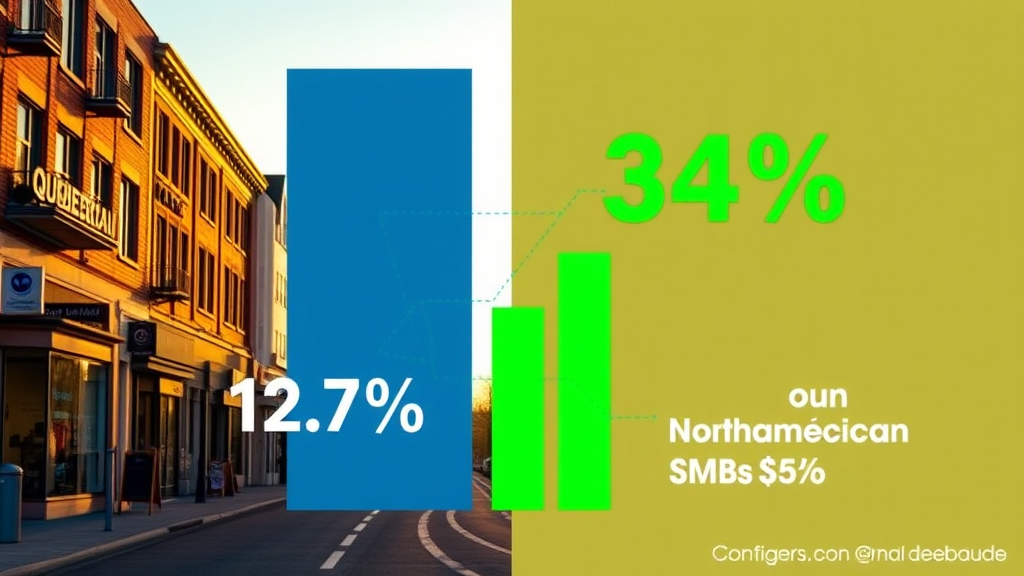
The uncomfortable number: Quebec at 12.7%, North America at 34%
Quebec's Institut de la statistique (ISQ) released fresh data in 2025: only 12.7% of Quebec businesses used an AI application for production purposes in the previous 12 months. For small businesses with 1 to 4 employees, that rate drops further to 12.2%.
The North American data tells a very different story. By Q1 2026, 34% of US SMBs with 10 to 500 employees had already deployed or were actively piloting an AI voice agent — versus just 8% in Q1 2024. That's a fourfold increase in 24 months.
This isn't conference hallway speculation. These are documented figures. And for Quebec business owners, they raise an uncomfortable question: while your competitors are automating their inbound calls, where do you stand?
Three global statistics that explain the acceleration
Before discussing strategy, you need to understand why this takeoff happened so fast globally. Three numbers tell the story.
First number: $0.40 versus $7 to $12. That's cost per automated call versus cost per call handled by a human agent. This comparison — drawn from Teneo.ai's analysis — represents a 90–95% cost reduction per interaction. For an SMB handling 400 calls per month, the annual difference reaches $31,200 to $55,200 in processing costs alone.
Second number: 331% to 391% ROI over three years. That's not a marketing claim on a brochure. It's the result of a Forrester Consulting study conducted on organizations that deployed voice AI agents in production. The same study shows a payback period under six months for the majority of deployments.
Third number: $80 billion. That's Gartner's forecast for contact center labor cost savings by end of 2026, driven by conversational AI. These savings aren't reserved for multinationals — they flow to any business managing its own phone operations, including SMBs.
These three numbers explain why voice agent deployments grew 340% year-over-year among organizations that made the move. The question is no longer "does it work?" It's "how fast should I act?"
Why Quebec SMBs are still hesitating — and what the ISQ data reveals
The ISQ study doesn't just measure adoption rates. It identifies the barriers declared by businesses that haven't yet invested in AI. The three main obstacles, in order: high implementation cost, uncertainty about return on investment, and lack of specialized knowledge.
These barriers are real. But they're often based on a market picture frozen in 2022–2023. The market has shifted dramatically since then.
On cost: Deploying an AI voice agent for a Quebec SMB now starts between $3,000 and $8,000 for a simple use case (appointment booking, FAQs, smart transfer). Solutions like Agent IA Vocal offer accessible monthly plans without a massive upfront investment. Compared to a full-time receptionist at $42,000–$58,000 per year, the math shifts fast.
On ROI uncertainty: Here's a simple calculation framework. Take your monthly call volume. Multiply by average cost per human-handled call (typically $8–$10 including salary and overhead). Subtract the monthly AI voice agent cost. The result is your gross monthly saving. For most Quebec SMBs, payback occurs within 3 to 6 months.
On knowledge gaps: Modern AI voice agents are configured through no-code or low-code interfaces. The TECHMA team handles the complete integration — ElevenLabs, phone numbers, CRM connections — without you needing to touch a line of code.
Concrete ROI calculation for an average Quebec SMB
Take a realistic example: a physiotherapy clinic in Laval with three therapists and a part-time medical secretary. They receive around 320 calls per month.
With a part-time secretary: roughly $22,000 per year in salary and benefits. Outside office hours, calls go to voicemail. About 35% of callers (112 per month) never call back. If each missed appointment is worth $85, that's $9,520 in lost monthly revenue.
With an AI voice agent: 24/7 availability. Monthly cost: roughly $300–$500. Estimated recovery of 60–70% of after-hours calls = 67 to 78 recovered appointments per month = $5,695 to $6,630 in additional monthly revenue. The 12-month ROI easily exceeds 200%, not counting savings on overtime and voicemail management.
This calculation scales across Quebec gyms, restaurants, auto repair shops, and any sector where inbound calls generate revenue.
What 2026 data says about the right time to act
There's a tension in the data. On one side, 34% of North American SMBs are already in the game. On the other, the voice AI market is growing at 34.8% annually (Market.us), meaning solutions keep improving and prices keep falling.
So should you act now, or wait for the technology to mature further?
The data's answer is unambiguous: SMBs that act now benefit from cumulative learning effects. Each week of deployment generates data on call types, recurring questions, peak hours. This data accumulates and enables agent refinement. An SMB that starts in June 2026 will have 6 to 12 months of lead over a competitor that waits for "the perfect moment."
The Institut du Québec summarizes it clearly in its automation report: every month of delay in AI adoption widens the productivity and competitiveness gap. This isn't an abstract warning — it's a documented economic finding.
7 statistics to anchor your decision
Here are the numbers that define the landscape in May 2026, consolidated for a 90-second overview:
- 12.7% — Quebec business AI adoption rate (ISQ, 2025)
- 34% — North American SMBs with 10–500 employees that have deployed a voice AI agent (Q1 2026)
- $0.40 vs $7–$12 — Cost per call: AI voice agent vs human agent (90–95% savings)
- 331–391% — 3-year ROI documented by Forrester Consulting for voice AI deployments
- Under 6 months — Median payback period for SMBs
- 18% — Average first-year revenue increase after deployment (from recovered missed calls)
- $80 billion — Gartner's projected contact center savings by end of 2026
To explore the mindset barriers still slowing adoption, read our piece on the 7 myths about AI voice agents Quebec SMBs need to bury.
How Quebec SMBs are putting this into action
The good news: you don't have to navigate this alone. The ecosystem has matured considerably. Solutions like Agent IA Vocal are built specifically for bilingual Quebec SMBs, with agents that understand Quebec French, regional accents, and local market specifics.
A typical TECHMA deployment follows three stages: a discovery session to identify priority use cases (which calls to automate first), ElevenLabs agent configuration with scripts, transfer scenarios, and calendar or CRM integration, then a 30-day calibration period with adjustments based on real call data.
Quebec is at 12.7%. North America is at 34%. The gap exists. But it's not inevitable — it's an opportunity for the SMBs that move first in their sector and their region.
Sources: ISQ (2025), Forrester Consulting/PolyAI, Gartner, Nextiva Conversational AI Statistics, Statistics Quebec — AI Adoption 2024-2025