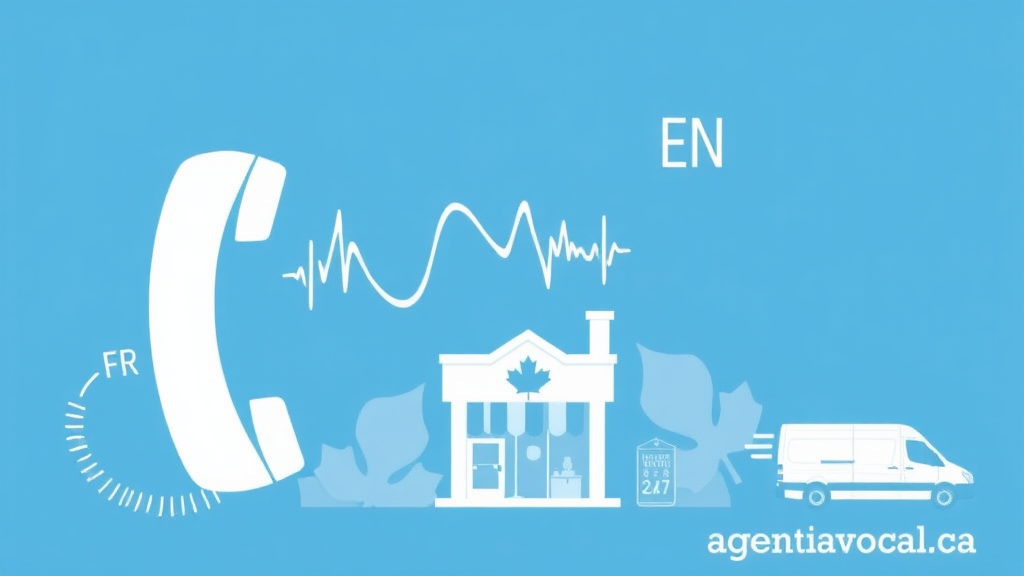
The phone rings at 8:12 p.m. in Calgary. The caller starts in English, switches to French to confirm a name, then asks one last question in English before booking. Your office is closed, your team is off the clock, and the opportunity is one missed call away. Do you really need to hire bilingual staff for every shift just to keep up across Canada?
Not anymore. A bilingual AI voice agent Canada setup can answer calls in French and English around the clock, detect the caller's language from the first words, and switch mid-conversation without awkward pauses or confusion. For Canadian businesses, that means better coverage across Toronto, Ottawa, Vancouver, Calgary, Winnipeg, Halifax and beyond, without the cost and scheduling pressure of staffing every hour with fully bilingual reception employees.
The practical outcome is straightforward: fewer missed calls, more booked appointments, more consistent customer service, and a smoother handoff to your human team when a call needs personal attention. And because Agent IA Vocal is implemented by the TECHMA IT team, you are not left alone with a self-serve phone bot builder. Your business rules, hours, pricing, FAQs, transfers, and after-hours flows are set up for you.
What you need before you start with a bilingual AI voice agent
Seamless bilingual phone service is not just about turning on two languages. It requires the right opening, accurate business information in both languages, caller-friendly escalation paths, and testing that reflects how people actually speak. In Canada, that matters because the country is officially bilingual, major cities are deeply multilingual, and businesses often serve customers across six time zones.
If your company operates in or serves Quebec, one legal point matters immediately: phone greetings must prioritize French first under Quebec's Charter of the French language and Loi 96 rules. Another language may follow only after French has been given priority. The OQLF explains the expectation here: OQLF guidance for phone systems and voicemail. So even for a Canada-wide business, if Quebec callers are part of your market, your setup should reflect that.
You also need a realistic staffing lens. Hiring fully bilingual reception staff is expensive in Toronto and Ottawa, hard in Montreal and Vancouver, and especially difficult for evenings, weekends, holidays, and overflow periods. That is why many SMEs compare an Agent IA Vocal versus traditional answering options before making a decision. With plans at $49, $99, and $199 per month, one AI voice agent can cover a large share of routine bilingual call handling for a fraction of the monthly labour cost.
Technology has also caught up to customer expectations. In 2026, modern platforms can detect language almost instantly and keep latency under roughly 75 to 100 milliseconds, which makes switching feel natural in live conversation. That matters in places like Ottawa-Gatineau, where callers may move between French and English in a single sentence, but it also matters for national businesses handling calls from across the country. Providers such as ElevenLabs and market roundups like this multilingual voice agent comparison show how far the category has evolved, often supporting 10 to 30+ languages. Still, for most Canadian SMEs, the first win is simpler: get French and English right, every time.
Step 1 - Set a French-first greeting if you serve Quebec
Start with the opening line. If your business serves customers in Quebec, your phone greeting should begin in French, then offer English after French has been prioritized. A practical example is: Bonjour, vous avez joint [Business Name]. Comment puis-je vous aider aujourd'hui? / Hello, you've reached [Business Name]. How may I help you today?
This is not a cosmetic detail. It is both a compliance issue and a customer experience issue. A French-first greeting signals that your business understands the market, especially if you operate in Montreal, Laval, Longueuil, Quebec City, Sherbrooke, or Trois-Rivieres. It also avoids the common mistake of sounding like a national brand that forgot Quebec has its own expectations.
For businesses outside Quebec, this step still matters if Quebec callers are part of your audience. A company based in Toronto or Halifax may still receive inbound calls from Quebec customers, partners, or suppliers. Why make those callers work harder from the first second of the interaction?
Step 2 - Enable automatic language detection and mid-call switching
Next, make sure your voice agent can identify the caller's language from the first few words and continue naturally if the caller switches later. This is one of the biggest differences between a modern conversational system and an old menu-based IVR.
Here is a common real-world example: a caller says, Hi, I'm calling about your service a Montreal, est-ce que vous avez des disponibilites demain? A modern agent should understand the intent, answer in the language that best fits the moment, and keep the conversation moving. No awkward reset. No forcing the caller to choose “Press 1 for English, 2 for French” unless your workflow truly requires it.
That capability matters far beyond Ottawa-Gatineau. A Vancouver company may take calls from federal contacts in Ottawa. A Winnipeg clinic may hear from bilingual families. A Calgary service business may serve relocations from Montreal. Across Canada, bilingual coverage is often the difference between a completed booking and a dropped lead.
And yes, customers notice when the switch feels smooth. If latency is low enough, the interaction feels less like software and more like a competent front desk assistant supporting your team.
Step 3 - Mirror your real business information in both languages
Once the language layer is in place, the next priority is content accuracy. Your bilingual phone service must reflect your actual business information in both languages: hours, service areas, pricing ranges, appointment rules, booking links, cancellation policies, and frequently asked questions.
This is where many businesses stumble. They write one English script, translate it, and assume the job is done. It is not. If your English version says same-day appointments are available in Ottawa and Gatineau, but the French version omits Gatineau, callers will notice. If your French script says estimates are free but the English version mentions consultation fees, trust disappears fast.
Localization matters too. A translated script may be technically correct but still sound unnatural. A better approach is to build two versions that carry the same business meaning while sounding native in each language. If you are evaluating what to include, this guide on choosing the right Agent IA Vocal for SMEs is a useful starting point, even for businesses serving customers across Canada.
Do not forget after-hours content. Evening, weekend, and holiday calls often carry the highest urgency and the highest conversion value. If you want a stronger framework for coverage outside business hours, review this article on 24/7 phone service with Agent IA Vocal. It highlights the operational side that many teams overlook.
Step 4 - Build a clean human escalation path in the caller's language
An AI voice agent should support your staff, not trap your callers. That means every bilingual setup needs clear escalation rules. When should the call stay with the agent? When should it transfer immediately? When should it create a message, a task, or a priority alert?
A simple structure works well for most SMEs:
- Urgent issue: transfer to the on-call person or create a high-priority alert.
- Routine question: answer directly in the caller's language.
- Booking or quote request: collect details and complete the booking or send the lead to the right team member.
- Complex or sensitive case: summarize the call for a human follow-up so the customer does not have to repeat everything.
One important detail: the escalation should continue in the caller's language. If someone is speaking French, the transfer destination should not suddenly become an English-only voicemail. Likewise, if the caller moved into English, the handoff should respect that choice. Seems obvious, right? Yet this is one of the most common breakdowns in bilingual call flows.
It is also smart to define business-hour logic by region. Canada spans six time zones, so “after hours” is not the same in Vancouver as it is in Halifax. Your call handling rules should match where your team is available, not just where your head office sits.
Step 5 - Test with real bilingual call scenarios before launch
Before going live, test the system the way customers will actually use it. Do not rely on ideal scripts alone. Use messy, realistic scenarios: mixed-language questions, regional accents, rushed callers, after-hours requests, pricing questions, and handoff situations.
Here are five practical tests every business should run:
- Greeting test: does the opening prioritize French when Quebec is in scope?
- Detection test: does the agent correctly identify French or English from the first words?
- Switch test: can the caller move from one language to the other mid-call without friction?
- Accuracy test: are hours, service areas, pricing, and booking rules consistent in both languages?
- Escalation test: does the transfer or follow-up path stay in the caller's language?
Run these tests with real examples from your business. A dental clinic in Ottawa will need different scripts than a home services company in Calgary or a legal office in Toronto. Pronunciation also matters more than many teams expect, especially for street names, neighbourhoods, and personal names. If the system says them poorly, the interaction loses polish fast.
Common mistakes to avoid
1. Using an English-first greeting for Quebec callers. This creates avoidable compliance and customer experience problems.
2. Translating scripts instead of localizing them. Literal wording sounds stiff and can confuse callers.
3. Forgetting the human fallback. Automation should help route and resolve, not block access to your team.
4. Ignoring voicemail and after-hours flows in both languages. Many missed opportunities happen outside standard office hours.
5. Letting French and English business details drift apart. Inconsistent hours, prices, or policies quickly damage trust.
What results can you expect?
For most Canadian SMEs, the first result is practical: more answered calls without hiring a full roster of bilingual staff. The second is operational: your team spends less time repeating standard information and more time handling high-value conversations. The third is commercial: callers are more likely to stay on the line, trust the business, and move toward booking or buying when they can speak comfortably in their preferred language.
The cost difference can be dramatic. Recruiting and scheduling bilingual reception coverage for evenings, weekends, and overflow can easily run into thousands of dollars per month once wages, training, turnover, and coverage gaps are included. By contrast, Agent IA Vocal plans start at $49 per month, with higher tiers at $99 and $199 depending on your needs. That makes bilingual coverage accessible to smaller businesses that previously had to choose between patchy service and expensive staffing.
There is also a brand advantage. Canada is officially bilingual, and major urban markets are multilingual on top of that. If your business can answer clearly in French and English from coast to coast, you remove friction for customers in Toronto, Ottawa, Vancouver, Calgary, Winnipeg, Halifax, and Quebec-facing markets at the same time. Better accessibility usually leads to better conversion. Simple as that.
FAQ
Can a voice agent really switch languages during the same call?
Yes. Modern systems can detect the caller's language from the opening words and switch between French and English mid-call with very low latency, so the interaction feels natural.
Do I need to build and manage the setup myself?
No. With Agent IA Vocal, the TECHMA IT team handles the setup for your business, including scripts, hours, transfers, and call scenarios. It is not a self-serve product you have to assemble alone.
Is this only useful for Quebec businesses?
No. It is valuable across Canada. Quebec compliance is one important case, but bilingual phone coverage also helps businesses serving federal, interprovincial, travel, education, healthcare, and national customer bases.
Will it replace my front desk staff?
No. The goal is to augment your team by handling repetitive calls, after-hours inquiries, and first-line routing, while your people stay focused on the conversations that need judgment, empathy, or sales skill.
Ready to offer bilingual phone service across Canada without hiring for every shift?
If you want French-English call coverage that feels natural, respects Quebec requirements, and supports customers across Canada's time zones, Agent IA Vocal is built for exactly that. TECHMA IT handles the implementation so your business gets a tailored setup instead of a generic bot.
See a live demo at https://agentiavocal.ca/demo and review plans at https://agentiavocal.ca/pricing to find the right fit at $49, $99, or $199 per month.