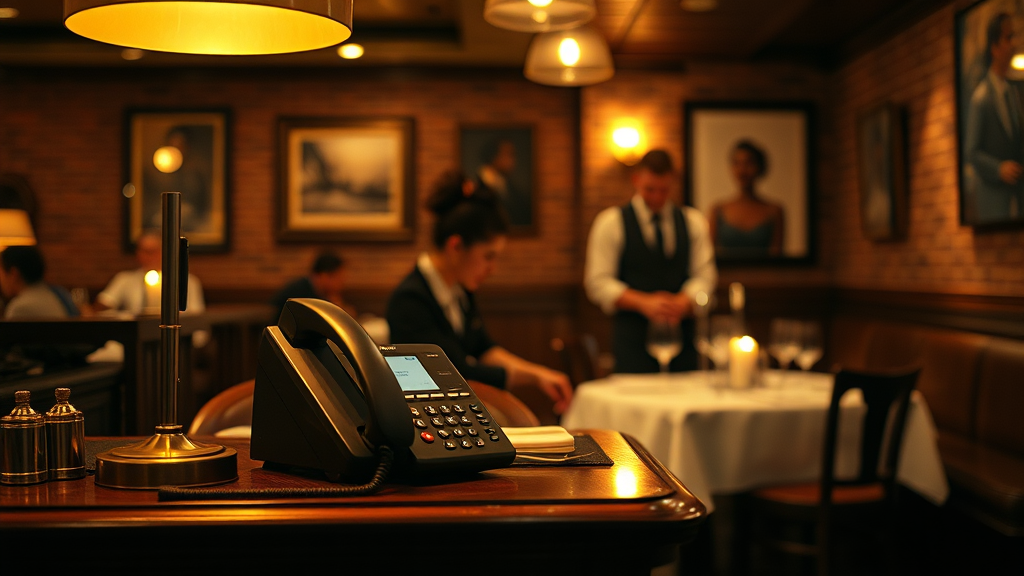
Friday, 7:17 PM. Your hostess is juggling two parties at the door, a vibrating cell phone, and a guest pointing at the menu asking if the sole is gluten-free. The desk phone rings — four times, five, six. It stops. Someone in Outremont or Sainte-Foy just hung up. They've already opened OpenTable to call the bistro next door.
Multiply that across all your peak hours in a year, and you're looking at roughly $49,000 gone. That's not a number pulled from the air — it's the average calculated by the Association Restauration Québec on ghost reservations alone. Add the calls you simply never picked up, and the bill climbs fast.
The number nobody wants to look at: 43%
A recent study spanning over 500,000 restaurant calls (Hostie AI, 2025) measured what operators suspected without daring to total: 43% of restaurant phone calls go unanswered. Average annual cost for a mid-sized venue: up to $292,000 USD (around $400,000 CAD).
And the worst part isn't that it's spread evenly across the day. It isn't.
Between 5 PM and 8 PM — your golden window — you miss 32% of all incoming calls. Meanwhile, 47% of your daily phone orders arrive precisely in those three hours. The dip isn't at night. It's right before service, when your team is already the busiest.
The phone ringing into the void rarely means a grandmother asking about hours. It's a party of four who would have ordered a $95 bottle of Fronsac.
Why Quebec amplifies the problem
Three factors specific to the Quebec market make the math worse.
1. Bilingualism on the front line. A reservation in Montreal or Gatineau comes in French, in English, or both in the same sentence. An overwhelmed hostess answering "bonjour-hi" to an anglophone caller after three transfer rings isn't a direct loss — it's the friction that makes them hang up. Internal data we've compiled for restaurant clients in Laval and Verdun shows 18% to 23% of peak-hour calls get abandoned before the second redirect ring even happens.
2. The hostess shortage. The vacancy-to-candidate ratio in Quebec hospitality remains tight in 2026. Many venues run with a single person handling greeting, phones, the cash desk, and sometimes the bar. A missed call, in that context, isn't an individual failure. It's a structural problem.
3. The "$10 no-show fee." Since July 17, 2025, Quebec restaurants can charge up to $10 per person when a reservation is dishonoured (gosnappy). Good news — except $10 per person doesn't cover even half the lost margin on a duo cancelling a Saturday night. And more importantly: this measure does nothing about the largest loss of all — calls never answered in the first place.
What this looks like in real numbers for an 80-seat venue
Take a case we see regularly at TECHMA for family bistros and neighbourhood restaurants in Quebec:
- Capacity: 80 covers
- Typical weekly call volume: 180 calls
- Peak-hour miss rate: 28% (more conservative than the 43% North American average)
- "Actionable" call rate: 60% (reservation, order, specific info request)
- Average converted check: $75 per cover
Math. 180 calls × 28% missed = roughly 50 missed calls/week. 60% actionable = about 30 lost potential reservations. With a historical 70% conversion rate and a 2.5-person average party, you're looking at ~52 lost covers per week, or about $3,900 CAD in weekly revenue evaporated.
Annually: around $200,000 CAD.
And that's before counting takeout orders, corporate groups calling on a Tuesday to lock in Wednesday lunch, and the callbacks that never happen because voicemail is full or the displayed number is private.
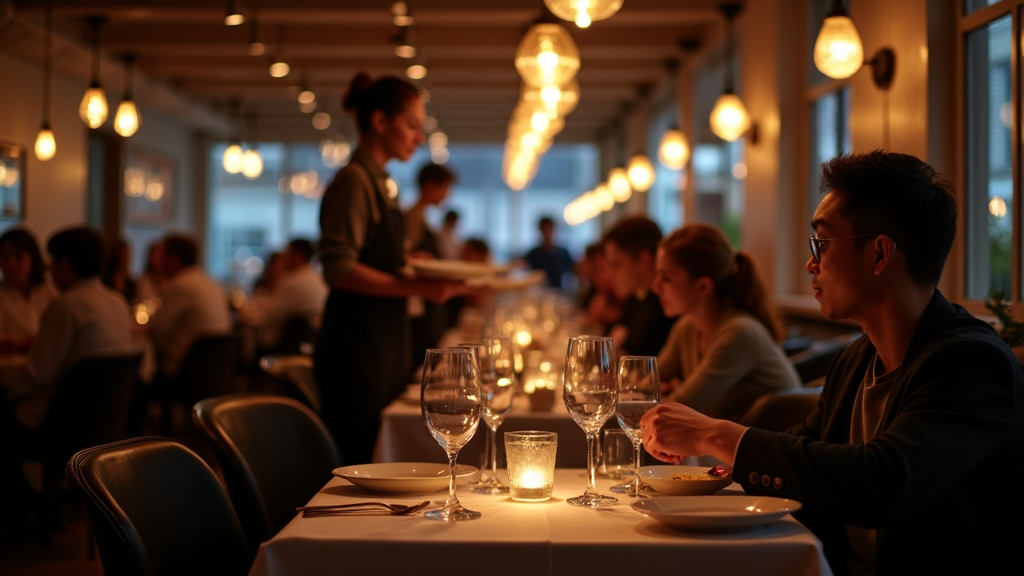
Salle pleine d'un bistro québécois à 19h le vendredi, ambiance de service de pointe
Why traditional fixes don't hold up in 2026
Let's be direct: traditional options come from an era when customers were patient.
Voicemail + callback. 71% of customers don't leave a message (HungerRush) and 69% will move on to the next restaurant if nobody answers. The callback arrives too late for that night's service.
Outsourced answering service. $800 to $1,800/month depending on volume, generic scripts, no menu knowledge, no integration with your reservation system. And — let's be honest — it rarely speaks quality French.
A second hostess. $35,000 to $50,000/year with benefits, and you have to find one — which, in 2026 in Quebec, is far from given.
This is precisely the gap a properly configured AI voice agent fills.
What an AI voice agent actually changes (and what it doesn't)
Be honest: a voice agent doesn't replace a charismatic hostess who remembers that Mr. Tremblay likes table 12 by the window. It does something else, more humble: it always answers, on the first ring, in Quebec French or English, and it frees your human to focus on the people standing in front of them.
Here's what it does genuinely well today for a restaurant in Quebec:
- Take a simple reservation (date, time, party size, allergies, special occasion) and push it directly into Veloce, Maitre'D, OpenTable or Resy via API.
- Answer FAQ questions — hours, parking, terrace, kids menu, accessibility — without interrupting service.
- Filter priority calls: a supplier, a VIP flagged in the CRM, a corporate group inquiry → immediate transfer to the right person.
- Confirm 24 hours ahead by SMS, which cuts no-shows by 30% to 50% based on data measured across our restaurant clients since 2025.
What it does not do (yet):
- Handle an angry customer who wants the manager right now. Human transfer, period.
- Decide on a party of 14 on a Saturday at 7:30 PM when your room is overflowing. That's still your call.
- Pour wine. (Working on it.)
The trap to avoid: picking an agent like a WordPress theme
Three mistakes we regularly see at restaurants that tried it solo with a consumer-grade tool:
1. Agent in standard France French. "Veuillez patienter un instant je vous prie" in a Trois-Rivières bistro creates instant distance. Quebec-French voice models (see our deep-dive on the April 2026 ElevenLabs Quebec French update) fix that — but only if you configure them correctly and test with real customers.
2. No integration with the restaurant knowledge base. An agent that doesn't know this week's menu, your Sunday brunch hours, your dog and kids policy, will invent answers. That's worse than no answer at all. Building a solid knowledge base for a voice agent takes 2 to 4 hours done well — and changes everything.
3. Direct phone hookup with no testing. Before going live on your main line, there are mandatory tests to run — otherwise you risk discovering on a Sunday at 12:45 PM that the agent is confirming reservations in a room that doesn't exist, or asking the same allergy question on loop.
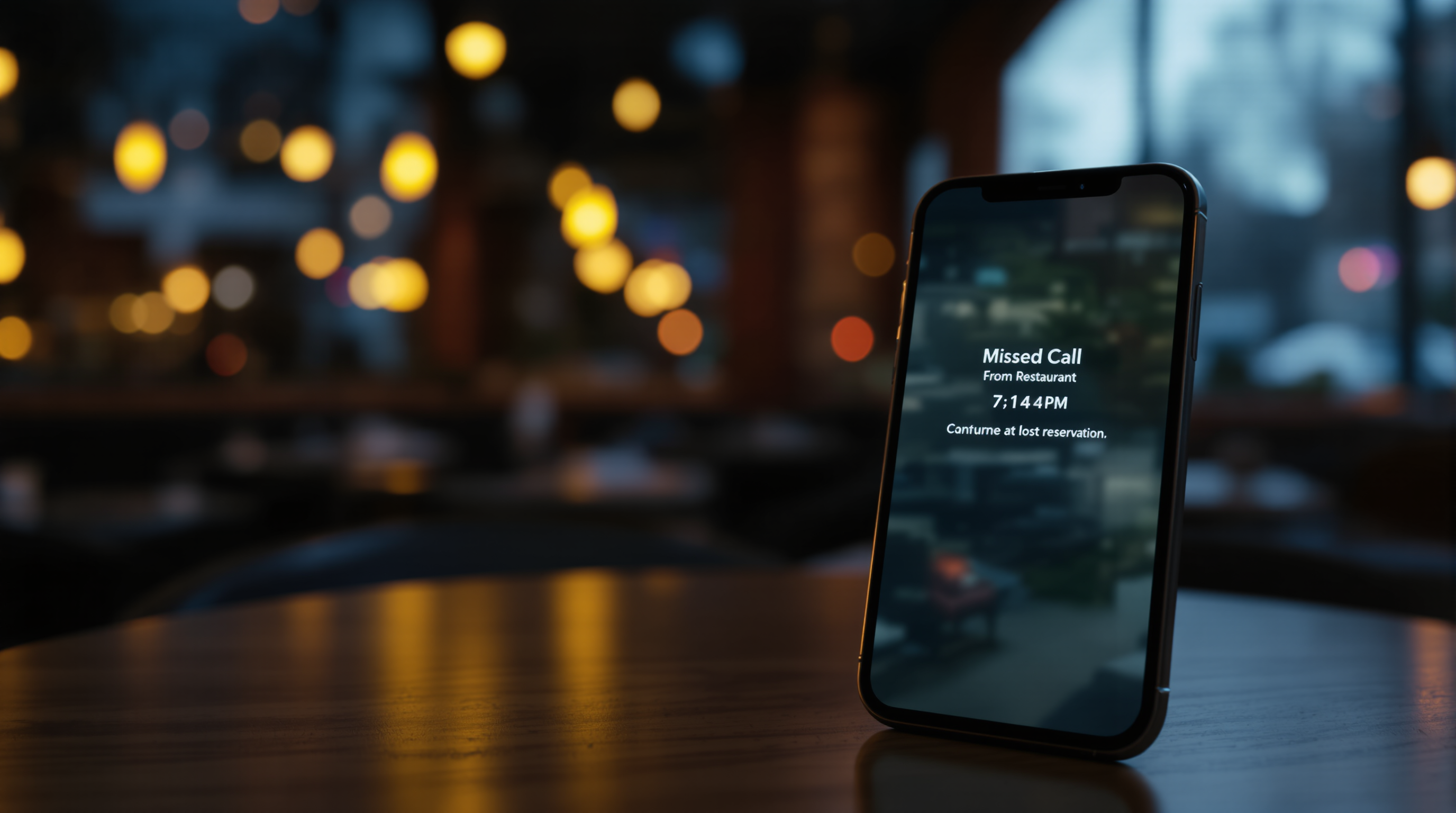
Notification d'appel manqué d'un restaurant sur un téléphone
The brutal arithmetic: typical ROI for a Quebec restaurant
For our 80-seat venue above, here are the orders of magnitude we see in the field:
- Realistic recovery at 3 months: 60% of previously missed calls → about $120,000 CAD/year in recovered revenue.
- Typical operating cost of a properly integrated AI voice agent: $6,000 to $12,000 CAD/year (telephony + platform + maintenance).
- Initial setup (configuration, integrations, knowledge base, bilingual testing, production rollout): $2,500 to $6,000 CAD one-time.
Break-even typically lands between week 4 and week 8. For a complete analysis, detailed numbers and a calculation adapted to your type of venue, see our complete ROI breakdown for Quebec SMBs.
So practically — where do you start?
For restaurateurs who want to evaluate this seriously: we don't sell software you download yourself. At Agent IA Vocal (by TECHMA), the team builds the agent for you — Quebec-French voice, integration with your existing reservation system, knowledge base of your menu and policies, real bilingual test scenarios, gradual rollout on your line.
First step is a free audit of your call volume and current losses. Not a sales call — a numbers analysis. If the investment doesn't make sense for your venue, we'll tell you.
The phone is going to keep ringing this Friday at 7 PM. The question, in 2026, is who answers.