Everyone's Racing to Answer. The Real Win Is Elsewhere.
For two years the advice has been the same everywhere: "Answer every call, never miss anything." It's good advice. It's also become the bare minimum — like having a website in 2010. The real question in 2026 isn't "did you answer?" It's: "what happens to the calls you missed anyway?"
Because you will miss some. The front desk is busy, two customers are waiting, and three calls come in at once. No human team, and no single voice agent, catches 100% of simultaneous calls. That's exactly why the automatic callback for missed calls is the most underrated — and most profitable — move a Canadian business can make this year.
The Uncomfortable Number: 85% Never Call Back
Here's the wall everyone runs into. According to 2026 missed-call data, roughly 85% of people who hit voicemail never call back. They just dial the next number. And in an analysis of over 130,000 calls across 45 contractors, 74% of calls went unanswered during normal business hours — not overnight, in broad daylight.
Do the math for a second. If the average small or mid-sized business loses more than $126,000 a year to missed calls, that's not a "pick up faster" problem. It's a recovery problem. As long as you rely only on answering live, you're letting 85% of missed opportunities evaporate for good.
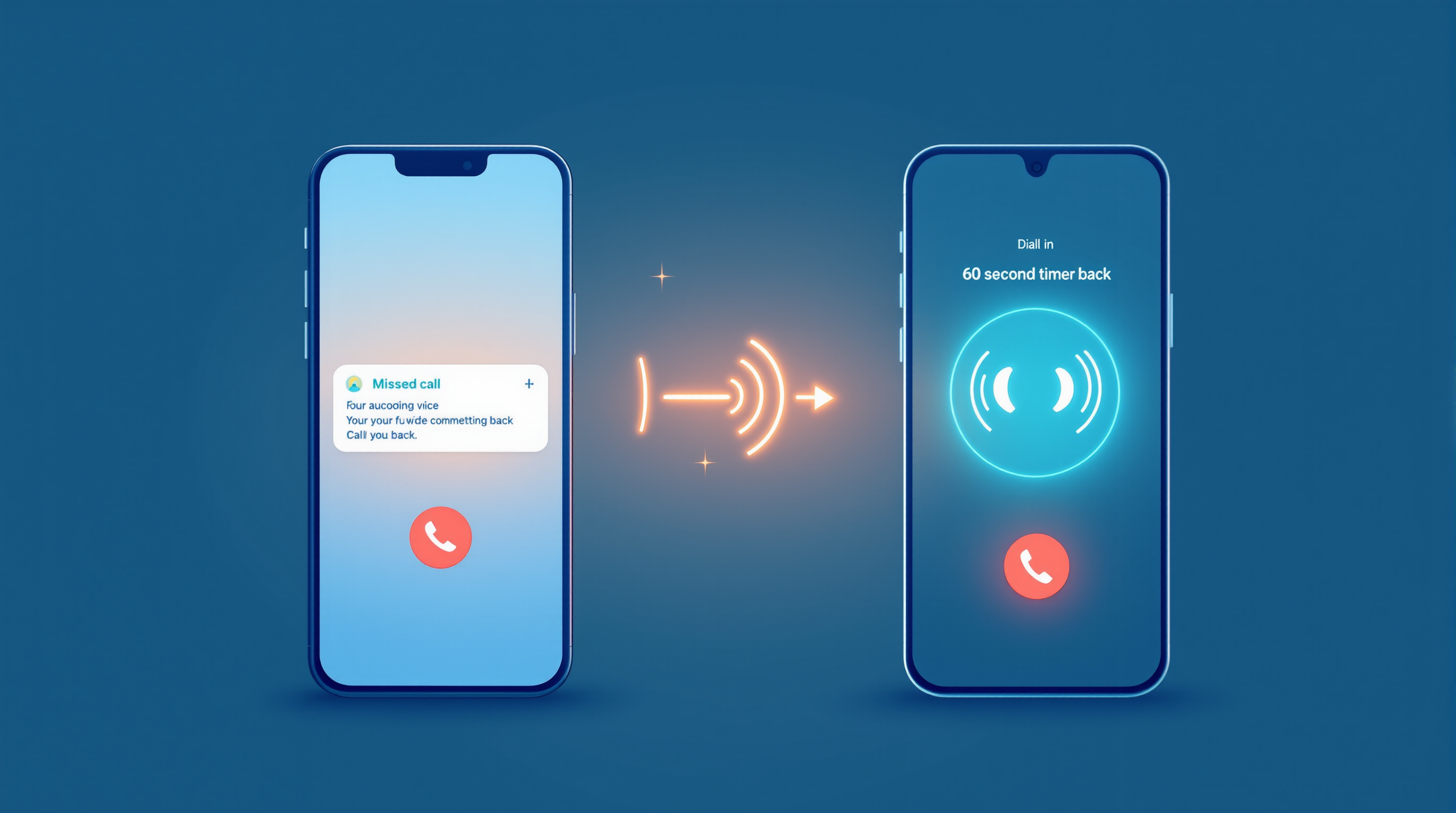
The flip is simple: if the customer won't call back, you call them. Automatically. In under a minute.
Speed Is the Whole Game
There's the famous "5-minute rule" in real estate: an agent who calls a lead back within five minutes is dramatically more likely to win the listing. But that principle isn't just for real estate. It applies to your clinic in Ottawa, your shop in Winnipeg, your restaurant in Vancouver, your firm in Halifax.
A missed call is perishable inventory. At minute zero, the customer still has their phone in hand and their intent is hot. By minute ten, they've called two competitors. An hour later, they've booked elsewhere. An AI voice agent that calls back automatically within 60 seconds catches the customer while the window is still open — it's the same revenue logic we broke down in our analysis of the ROI of an AI voice agent, but applied to the way out instead of the way in.
Why 2026 Finally Makes the Automatic Callback Acceptable
Two years ago, an automated callback sounded like a 2009 telemarketer: flat voice, mechanical delivery, an awkward pause before every reply. Nobody wanted to receive that. The technology just changed the equation.
In June 2026, ElevenLabs launched its Speech Engine for real-time voice, and OpenAI made gpt-realtime capable of running an actual phone call over SIP, with natural interruptions. Below the 200-millisecond latency mark, the brain stops perceiving a delay: the conversation "clicks," even outbound. We explained that threshold in detail in our piece on the 200 milliseconds that finally make voice AI sound human. The result: an automatic callback no longer sounds like a robot hounding you. It sounds like your receptionist politely circling back — except it happens in under a minute, at 9 p.m., in the caller's language.
The Snowball Effect: Every Source Becomes a Recovered Conversation
The automatic callback isn't limited to missed calls. Once the mechanism is in place, it applies everywhere: a web form filled out at 11 p.m., an unanswered text, a weekend voicemail. Every trace of a customer becomes a callback triggered within seconds, while interest is still warm.
That's where the economics flip. Instead of recovering 15% of your missed opportunities with a human callback that lands the next day, you recover the majority because contact happens inside the same window of intent. From Calgary to Mississauga, a business that turns even three callbacks a week into confirmed appointments has already paid for the tool — without hiring anyone.
Think of it as plugging every hole in the bucket at once — not just the front door. The businesses that win in 2026 aren't the ones with the fastest pickup; they're the ones where no genuine customer intent ever falls through the cracks unanswered, whatever channel it arrived on. That is a fundamentally different standard than simply staffing the phone, and it is now within reach of a five-person shop.
"Isn't an Automatic Callback Annoying?"
It's a fair objection, and it deserves a real answer. A cold, unsolicited callback is intrusive, yes. But that's not what this is. This is calling back someone who just called you. The customer took the action; they want to be reached. The callback isn't an intrusion — it's the service they were expecting.
Then there's the data question. Capturing a number, the call history, and triggering a callback touches privacy rules head-on. That's exactly why configuration shouldn't be done blind: we wrote a guide on the privacy questions you should ask before choosing an AI voice agent. A serious vendor governs retention, consent, and number use without flinching. If yours dodges, that's the real red flag.
Why Canadian Businesses Are Especially Well Positioned
There's a real edge here. An automatic callback that handles a caller in English, switches to French the moment it's asked, and matches the service tone customers expect is exactly what people want to hear back. Canada is officially bilingual, and our cities run on far more languages than two — a callback that meets the caller where they are turns a missed call into a kept customer.
While a competitor is still congratulating themselves for answering "almost everything" this week, the business that calls back automatically is turning its gaps into appointments. The difference doesn't show up on the call log. It shows up on revenue.
An Ordinary Tuesday, Seen From the Front Desk
Picture it: 11:40 on a Tuesday. Your front-desk person is ringing up one customer while another waits to pay. The phone rings — it's a new customer who wants an appointment this week. Nobody can pick up. In the old world, that call went to voicemail, and statistically, the customer didn't call back. The opportunity simply vanished, and you'd never even know it existed.
With an automatic callback, the whole scenario flips. Forty seconds later, while your team is still finishing the transaction, the AI voice agent dials the number back, introduces itself on behalf of your business, offers two time slots, and confirms the appointment straight into your calendar. The customer never felt ignored. They felt like they got impeccable service — even though both your hands were busy somewhere else. That's the entire difference between a missed call and a recovered one.
Now multiply that across a week. In any busy shop, three or four of those moments happen between Monday's opening rush and Friday's close. Each one is a real customer with real intent who would otherwise have dialed your competitor. Recovered, they're appointments on the book. Lost, they're invisible — the most dangerous kind of loss, because it never shows up as a complaint or a bad review. It just quietly never becomes revenue.
And none of this requires a bigger team or a new phone system. It's the same inbound line you already have, with a safety net underneath it that never sleeps, never takes a lunch break, and never forgets to follow up. That's what makes the math so lopsided: the cost is fixed and small, while the recovered revenue scales with how busy you already are.
Where It Can Go Wrong
Let's be honest: a bad callback is worse than no callback. If it lands twenty minutes too late, sounds robotic, or knows nothing about the context ("Hello, I'm calling about your recent contact with us…"), the customer hangs up, annoyed. The automatic callback is only a weapon if it's fast, natural, and contextual. That's exactly the kind of tuning the TECHMA team handles end to end, rather than leaving you to wire API connections on a Sunday night.
The Questions Owners Actually Ask Us
How fast does the callback trigger? Typically within seconds to a minute of the missed call or completed form — fast enough to catch the customer while their intent is still there.
What if the person doesn't want to be called back? The agent detects it, notes it, and doesn't push. The goal is to serve, not to harass. One clean callback beats five attempts.
Does it replace my receptionist? No. It recovers the calls she couldn't take while she was already helping someone. The agent augments; it doesn't replace.
How long to set up? Because TECHMA handles configuration, we're talking days, not months.
So, Shall We Recover Those Calls?
If you've already made peace with "we'll miss a few calls, it's inevitable," you're leaving money on the table every week. The good news is those calls aren't lost — they're just waiting for a callback.
The best way to see it is to hear it. Book a 15-minute demo to hear an automatic callback in action, explore our plans starting at $49/month, or reach out and let's look at your peak hours together. No pressure — just a real conversation. Which, fittingly, is exactly what your customers get when you call them back.