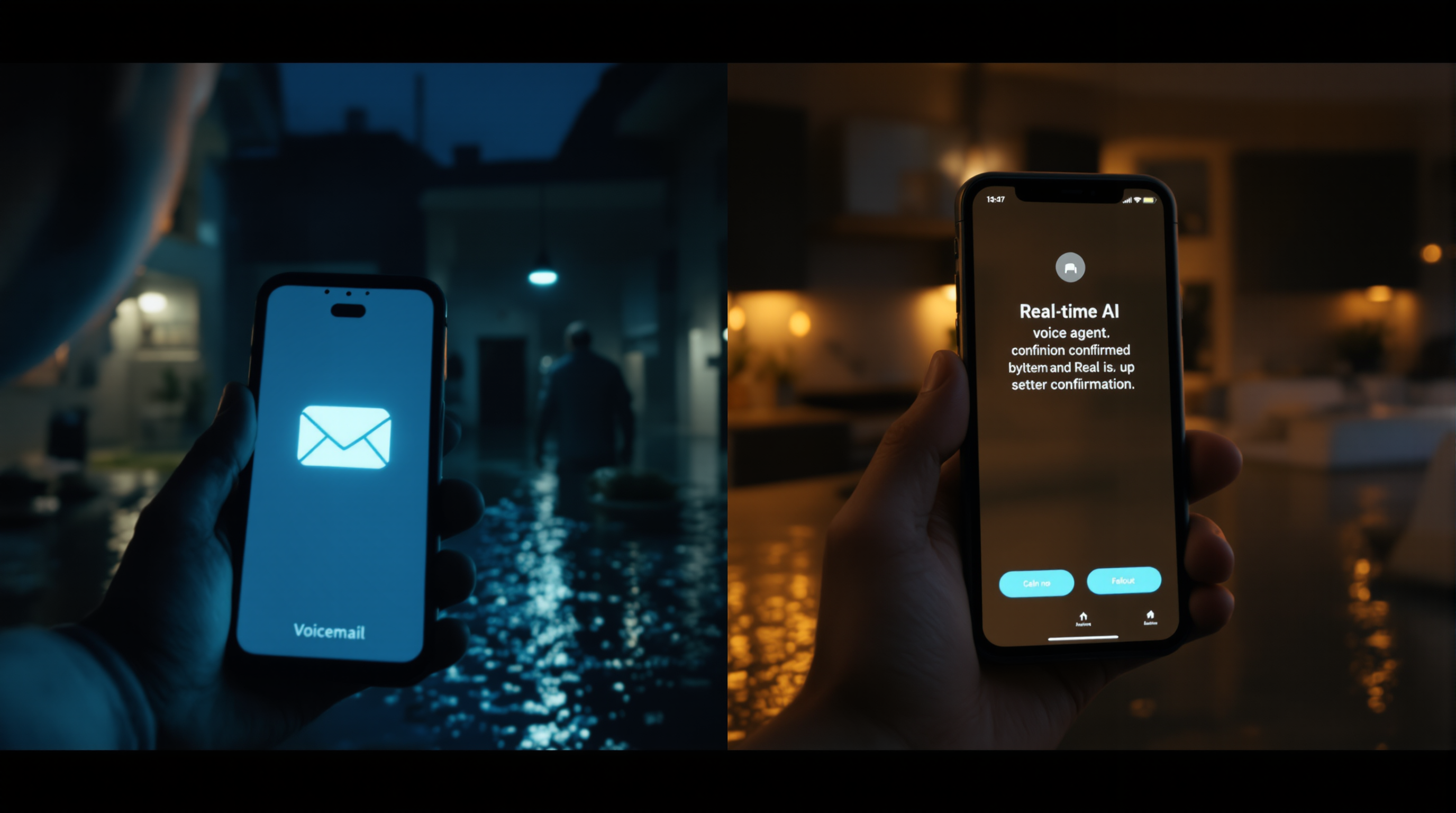
It's 2:17 AM
Lachine. Mrs. Tremblay just went down to the basement to refill a water bottle and stepped into two centimetres of cold water. A pipe has burst somewhere behind the furnace. She grabs her phone.
First call: the emergency plumbing company whose ad runs on the radio. Ring. Ring. Voicemail.
Second call: the service her neighbour recommended. Picked up by a call centre. Three minutes on hold. The operator takes her name, address, says "someone will call back in 30 minutes." Thirty minutes later, nothing.
Third call: an AI voice agent answers after two seconds. It asks three precise questions, identifies a priority-1 emergency, texts the on-call plumber with the address and problem description, and confirms to Mrs. Tremblay that a technician will be at her door in 40 minutes.
Guess who wins the $4,200 overflow + water damage contract.
The real problem at 2 AM
More than 40% of residential plumbing calls involve some level of urgency: leak, backup, no hot water, flooding. For electricians during a winter storm, the proportion climbs higher — emergency lighting failure, short circuit, burning smell.
According to 2026 data compiled across Reddit's r/smallbusiness and r/HomeImprovement threads, the testimony that recurs most often is this one: 70% to 80% of callers hang up without leaving a message when they hit voicemail during an emergency. They call the next number. And the next. And the $4,200 contract goes to whoever picks up.
For a Quebec SME — a solo plumber, an electrical team, a family-run roofing outfit — the question is no longer "should we cover after-hours calls?" It's: with what tool.
Three options dominate the Quebec market in 2026. Here's the 4-criteria table that settles it.
The three options on the table
Option A — Voicemail + callback next day. The 2010 method. Still used by roughly 30% of trade SMEs in Quebec. Zero cost. Capture rate close to zero too.
Option B — Human telephone answering service. Quebec (sometimes Ontario) call centres, priced monthly plus per call. Operator takes the message, emails you, phones you if it's urgent. The reassuring human touch — but with rising cost and lag.
Option C — AI Voice Agent. Virtual receptionist that answers in under 2 seconds, speaks Quebec French, qualifies urgency, accesses the on-call technician's calendar, and sends a dispatch SMS.
We ran the comparison on 4 criteria that genuinely matter to a Quebec plumber or electrician. Not the marketing features — the reality of a Tuesday at 9:40 PM.
Criterion #1 — Real cost in Canadian dollars per month
Let's be specific, because this is where the ads distort everything.
Human answering service in Quebec:
- Basic package: $300 to $600/month for limited coverage
- Dedicated package + after-hours + scheduling: $1,200 to $1,500/month
- Setup fees: $50 to $250
- Cost per extra call: $1 to $2 (a call = roughly 90 seconds)
AI Voice Agent for a solo plumber:
- Base plan: CAD $45 to $150/month (including phone plan)
- For a team of 3 technicians: $135 to $400/month
- Cost per call: $0.10 to $0.50
- No separate setup fees when deployment is done by a technical team like TECHMA
For a plumbing SME handling 200 calls/month, 60 of which are after-hours, the annual gap comes out to $8,000 to $14,000 in structural cost difference. Not a marketing discount — an actual cost-structure gap.
Criterion #2 — Responsiveness (and why 30 seconds change everything)
The average human call centre picks up in 20 to 45 seconds. The AI voice agent answers in under 2 seconds.
Sounds anecdotal at first. But here's what happens in a panicked caller's head:
- 0 to 10 seconds: waiting, ready to speak
- 10 to 20 seconds: starting to doubt, double-checking the number
- 20 to 30 seconds: already opened a Google tab for the next plumber
- 30+ seconds: hangs up
That's exactly the threshold where you lose the call. Not after five minutes — after 30 seconds.
And the worst part: with a human service, you still pay for the call even if the caller hung up at 35 seconds. The AI agent bills you nothing on a call that doesn't last.
Criterion #3 — Urgency qualification (and who wakes your on-call technician)
This is the most underestimated criterion.
A human answering service takes the message. Then decides, using a provided grid, whether it's "urgent" or "callback tomorrow." But the operator at 2:17 AM has no context on your truck inventory, the on-call schedule, the lead time on submersible pumps, or the difference between a stormwater drain and a pressurized supply leak.
A properly configured AI voice agent, on the other hand, asks the right questions:
- "Is the water still rising or has it stabilized?"
- "Have you shut off the main valve?"
- "Is there a risk to electrical infrastructure?"
It classifies urgency as priority 1 (wake the technician immediately), priority 2 (call back within 2 hours), or regular appointment within the week. It checks the live calendar via the ElevenLabs MCP protocol and offers a real time slot. For the API technical details, see the official ElevenLabs changelog.
The result: your on-call technician is only woken for genuine emergencies. Non-urgencies land as firm appointments for the next day, not as messages to triage.
Criterion #4 — Language and Quebec context
This is the blind spot of American solutions.
A caller from Trois-Rivières says "ma toilette refoule" — not "my toilet is backing up." A client from the Beauce talks about a "puits de remontée," not a "sump pit." The call centre charging you $1,200/month is probably based in Toronto or Mississauga with bilingual agents — doing their best, but missing the nuances.
Modern AI voice agents (the good ones) are trained on authentic Quebec French. They understand:
- regional expressions ("ça spritz", "le système est gelé ben dur")
- Quebec postal codes and city names
- neighbourhood names (Hochelaga, Limoilou, Saint-Sauveur)
- regulatory specifics (CMMTQ, Loi sur le bâtiment)
And critically, they reply in Quebec French, not in French-from-France or with a calqued English accent. For a Lévis plumber serving primarily francophone clients, this isn't negotiable.
For a deeper look at how to evaluate a solution on this criterion, we wrote a complete guide: receptionist vs answering service vs AI voice agent comparison for Quebec SMEs.
The decision table at a glance
When the human service is still the right call
Let's be fair: there are two scenarios where a human answering service is still the right investment.
Scenario 1 — Very high B2B technical volume with frequent exceptions. If you're a general contractor coordinating 40 subcontractors simultaneously across commercial sites, and every call requires a complex contextual decision, a full-time human coordinator earns their salary.
Scenario 2 — Transition period. During the first 4 to 8 weeks after deploying your AI voice agent, keeping a human service as backup can be reassuring. But the case weakens beyond that — the agent learns from every call and corrects its own blind spots.
For 90% of Quebec plumbers, electricians, and roofers, the math no longer requires debate.
How to avoid wasting your shopping time
Three questions that eliminate 80% of vendors in 5 minutes:
- Does the AI agent respond in native Quebec French (not via Google Translate)? Ask to hear a real call, not a scripted demo.
- Does deployment include integration with your on-call scheduling software (Jobber, ServiceM8, FieldEdge, or a shared Excel)? Otherwise it's just a glorified voicemail.
- Does the team deploying it understand your trade? The AI agent for a plumber doesn't sound like the AI agent for a dentist. The questions differ, the decision trees differ.
That's exactly what we do at Agent IA Vocal: we deploy the agent, train it on your fleet, your pricing, and your service zones, and integrate it with your on-call schedule. You don't write a line of code. The 7 most common deployment mistakes for AI voice agents in Quebec, we steer around them for you.
One Last Reality Check on Capture Rates
The numbers in this article aren't theoretical. A study from a US plumbing answering service vendor published in 2026 tracked 112 new leads captured by AI voice agents over a three-month period for a single mid-sized plumbing shop — 71 of those leads were qualified as high-intent emergencies, generating over $47,000 in direct booked revenue. The conversion math for Quebec trades is in the same range, because the underlying call behaviour (homeowners calling three providers in succession after a leak) is identical north of the border.
If you're a Quebec trade still running on a 2010 voicemail-plus-callback model, the gap between you and the next shop in your service zone widened sharply in the last 18 months. Closing that gap doesn't require hiring overnight staff — and the monthly cost is roughly the same as a Visa annual fee.
The real question to ask yourself this Tuesday night
How many calls did you miss last week between 5 PM and 8 AM the next morning?
If you don't know, that's already the signal. With a human answering service, you'll find out at the end of the month when the invoice arrives. With an AI voice agent, you know in real time — and you capture the revenue while the pipe is still leaking.
Mrs. Tremblay in Lachine paid $4,200. The plumber who answered at 2:17 AM quoted in 6 minutes. Nobody else even got the chance to try.